
Key Takeaways
- HSA GDP guidelines and SFA regulations both mandate documented cold chain validation. Mapping studies are not optional for licensed distributors.
- All temperature data loggers and sensors must be calibrated with traceable certificates; SAC-SINGLAS (ISO/IEC 17025) calibration is the benchmark accepted by Singapore regulators.
- Thermal mapping must be repeated after any significant change to the storage space, HVAC system, or layout, not just at initial qualification.
- Temperature excursions must be investigated, documented, and closed out with a written deviation report. Verbal acknowledgement is not sufficient for an audit.
- Penalties for serious cold chain non-compliance include licence suspension, product recall, and fines. Plus the commercial cost of a failed client or overseas audit.
Why Cold Chain Compliance Matters in Singapore
Singapore's role as a regional logistics and pharmaceutical hub means that cold chain integrity is not merely an operational concern. It is a regulatory and commercial imperative. The city-state distributes temperature-sensitive pharmaceuticals, vaccines, biologics, and food products across Southeast Asia, and local regulators have aligned their frameworks with international GDP (Good Distribution Practice) standards to maintain Singapore's standing as a trusted re-export hub.
For facilities managers and compliance officers, the stakes are concrete. A single temperature excursion that is not properly investigated and documented can result in product rejection by an overseas customs authority, a failed HSA audit, or (worst case), patient harm if a compromised vaccine or biologic reaches the end user. The regulatory response to serious breaches ranges from a warning letter to full suspension of a wholesale dealer's licence under the Medicines Act (Cap. 176).
The good news is that the compliance framework, while detailed, is systematic. Organisations that implement thermal mapping, calibrated monitoring, and robust SOPs early find that ongoing compliance becomes routine rather than reactive.
The Regulatory Landscape: Which Agency Governs Your Cold Chain?
The applicable regulator depends on what you are storing and distributing. Most Singapore distributors dealing with temperature-sensitive goods will fall under one or more of the following agencies:
| Regulator | Scope | Key Instrument | Cold Chain Requirement |
|---|---|---|---|
| HSA (Health Sciences Authority) | Pharmaceutical products, medical devices, biologics | Medicines Act; HSA GDP Guidelines | Temperature mapping, validated monitoring, calibrated instruments, deviation management |
| SFA (Singapore Food Agency) | Food and food ingredients, including chilled and frozen foods | Sale of Food Act; Food Regulations | Licensed cold storage, temperature records, proper handling SOPs |
| NEA (National Environment Agency) | Environmental health, licensed food premises | Environmental Public Health Act | Food hygiene standards including cold storage temperatures for licensed premises |
| AVS (Animal & Veterinary Service) | Veterinary medicines and biologics | Animals and Birds Act | Storage per product label; records available for inspection |
| MPA (Maritime and Port Authority) | Marine fuel and certain bulk chemical imports via port | Port regulations | Temperature control during loading/unloading for regulated cargo |
For most pharmaceutical distributors, HSA is the primary regulator. The HSA's Guidelines on Good Distribution Practice closely mirrors the EU GDP guidelines (2013/C 343/01) and PIC/S PI 041 guidance, meaning that facilities already compliant with EU GDP will find the Singapore framework familiar. However, HSA has Singapore-specific audit procedures and licensing conditions that must be understood separately.
Step-by-Step Cold Chain Validation Process
Validation (also called qualification) is the systematic process of demonstrating that your storage environment consistently meets its intended temperature specification. For pharmaceutical distributors under HSA GDP, this follows a four-stage qualification lifecycle: Design Qualification (DQ), Installation Qualification (IQ), Operational Qualification (OQ), and Performance Qualification (PQ). For most distributors, OQ and PQ are the practically significant stages.
Stage 1. Define Your Specification
Before placing a single sensor, document the required storage temperature range for every product category handled in the space. This is drawn from the product's SmPC (Summary of Product Characteristics) or the manufacturer's storage instructions. Common ranges are 2–8°C (refrigerated), 15–25°C (controlled room temperature), and -20°C or below (frozen). The specification becomes the acceptance criterion against which your mapping data is judged.
Stage 2. Thermal Mapping (Temperature Mapping Study)
Thermal mapping places a grid of calibrated temperature sensors throughout the storage space to identify the warmest and coldest locations under actual operating conditions. The study must be conducted under worst-case conditions. Typically during the hottest time of year (Singapore's tropical climate means ambient temperatures regularly exceed 33°C), with doors opened and closed at realistic frequencies, and with the storage unit loaded to its maximum capacity.
The number of sensors required depends on the volume of the space. International guidance (WHO TRS 961, PIC/S PI 041) recommends a minimum sensor density of one sensor per 5 m³ for cold rooms, with sensors at all eight corners of the rectangular space, one at the centre, and additional sensors near the door seal, air supply and return ducts, and the floor and ceiling plane. All mapping sensors must carry valid SAC-SINGLAS calibration certificates before the study begins, and should be verified again after the study concludes to confirm they did not drift during the exercise.
As explained in our guide to what a calibration certificate must contain, the certificate for each mapping sensor must state the instrument's serial number, the calibration date, the correction values (or confirmation of in-tolerance reading), and the traceability chain back to national standards. A certificate that lacks these elements will not satisfy an HSA auditor.
Stage 3. Identify Worst-Case Locations and Place Permanent Sensors
Once the mapping data is analysed, you can identify the warmest and coldest locations in the storage space. Your permanent monitoring sensors must be placed at these worst-case locations. Not at convenient points near the door or at eye level. This is the most common finding in HSA GDP audits: permanent sensors placed at locations that do not represent the extremes identified during mapping.
Stage 4. Continuous Monitoring and Alarming
Permanent temperature monitoring must be continuous, with data logged at intervals of no more than 15 minutes (many facilities use 5- or 10-minute intervals for critical storage). The monitoring system must have alarm functionality set at appropriate thresholds. Typically 1–2°C inside the specification limits to allow staff time to respond before a product-affecting excursion occurs. Alarms must be audible and, for unattended storage, must generate an SMS or email alert to a named responsible person.
Stage 5. Calibrate All Monitoring Instruments
Every temperature sensor, data logger, and thermometer used for GMP/GDP-relevant monitoring must be calibrated on a defined schedule. The calibration interval for temperature instruments in pharmaceutical cold chains is typically 12 months, though six-monthly calibration is recommended for sensors monitoring 2–8°C storage where the acceptable excursion window is narrow. Understanding how to determine the right calibration interval for your instruments is an important part of your instrument management programme.
Calibration must be performed by a laboratory accredited to ISO/IEC 17025 for the relevant measurement parameter (temperature). In Singapore, SAC-SINGLAS accreditation is the recognised standard. Unitest Instruments (Acc. No. LA-2023-0845-C) covers calibration of temperature data loggers, RTDs, thermocouples, and humidity sensors across the full cold chain temperature range.
Need calibration certificates for your cold chain instruments?
Unitest Instruments calibrates temperature data loggers, sensors, thermometers, and humidity instruments with full traceability to Singapore's NMC. Certificates accepted by HSA, SFA, and ISO 9001 auditors. Same-week turnaround available.
Calibration Instruments Required for Cold Chain Compliance
A compliant cold chain monitoring programme involves several categories of instrument, each with its own calibration requirements. The table below summarises the instruments typically found in a Singapore pharmaceutical cold chain operation and the calibration approach for each.
| Instrument | Typical Application | Required Accuracy | Calibration Frequency |
|---|---|---|---|
| Electronic data logger (temperature) | Cold room, refrigerator, freezer continuous monitoring | ±0.5°C or better for 2–8°C; ±1°C for ambient | Annual minimum; 6-monthly for critical 2–8°C storage |
| Thermocouple or RTD reference sensor | Thermal mapping studies; validation reference | ±0.1–0.2°C (reference grade) | Before and after each mapping study; at least annual |
| HVAC temperature sensor | Cold room air-handling unit temperature control | ±0.5°C to ±1°C depending on control tolerance | Annual; after HVAC servicing or repair |
| Handheld infrared thermometer | Goods-in checks; spot verification of product temperature | ±1°C for most applications | Annual minimum |
| Combination temperature/humidity logger | Storage areas where relative humidity is a product requirement | ±0.5°C / ±3% RH | Annual; humidity sensors may require 6-monthly calibration |
| Vaccine refrigerator thermometer (Fridge-tag) | Vaccine cold chain (MOH/HPB immunisation programmes) | ±0.5°C | Annual; after alarm event or suspected malfunction |
Calibration certificates for all of the above must state the measurement uncertainty of the calibration. Not just a pass/fail against tolerance. For a full explanation of why measurement uncertainty matters on a calibration certificate, see our article on measurement uncertainty in calibration. An instrument can be "in tolerance" but still have an uncertainty so large that it cannot reliably detect a real excursion. A risk that HSA technical auditors are trained to identify.
Managing Temperature Excursions: What the Regulation Requires
A temperature excursion is any recorded temperature reading outside the specified range. In Singapore, HSA GDP guidelines require that every excursion be treated as a deviation. Meaning it must be formally investigated, documented, and closed out with a written report. The report must address: what happened, why it happened, what impact (if any) it had on the stored product, what corrective action was taken, and what preventive measures have been implemented to prevent recurrence.
This is not bureaucratic box-ticking. An excursion report demonstrates to an auditor that your quality system is functioning as intended, that deviations are detected, investigated, and resolved rather than dismissed. Organisations that cannot produce excursion reports for historical events during an HSA audit face findings that can escalate from a minor observation to a critical finding depending on the pattern and the product affected.
Product Impact Assessment
For pharmaceutical products, every excursion requires a product impact assessment. A determination of whether the excursion was severe enough (in temperature and duration) to affect product quality, safety, or efficacy. This is typically documented using the product's stability data. If stability data is not available, the product owner or manufacturer must be contacted. Products where the impact cannot be determined must be quarantined and not released until the assessment is complete.
Revalidation Triggers: When You Must Repeat the Mapping Study
Initial validation is not a once-and-done exercise. HSA GDP guidelines require requalification whenever there is a significant change that could affect the storage environment. Common revalidation triggers include:
- Relocation of the cold room or warehouse to a different building or site
- Major renovation or structural change to the storage space
- Replacement or significant modification of the HVAC or refrigeration system
- Change in the maximum storage capacity or product loading configuration
- Repeated temperature excursions suggesting the original mapping is no longer representative
- Addition of a new product category with a different temperature requirement in a shared space
Even without a specific trigger, periodic requalification (typically every two to three years), is considered best practice and is expected by HSA auditors at wholesale dealer licence renewal inspections.
Penalties and Audit Findings: What Is at Stake
Singapore's regulatory penalties for cold chain non-compliance are serious, and the commercial consequences often exceed the regulatory fines. Under the Medicines Act (Cap. 176), HSA can suspend or cancel a wholesale dealer's licence for serious GDP non-compliance, order a product recall at the licence holder's expense, and refer cases involving intentional falsification to the Attorney-General for prosecution. Criminal penalties for serious offences include fines and imprisonment.
For food distributors, SFA can issue stop-sale orders for products stored outside the required temperature range, impose fines under the Sale of Food Act, and suspend or revoke food business licences. NEA can similarly act against licensed food premises where cold storage standards are not met under the Environmental Public Health Act.
Beyond regulatory action, the commercial cost of an audit failure is often greater. A failed HSA audit can result in a multinational principal withdrawing distribution rights from a Singapore distributor. A failed overseas customs inspection (triggered by inadequate cold chain documentation), can result in shipment rejection and the cost of disposal in the destination country. Distributors with robust validation and calibration programmes routinely pass audits and customs inspections that their less-prepared competitors fail.
Frequently Asked Questions
Cold chain operations in Singapore are primarily regulated by the Health Sciences Authority (HSA) under the Good Distribution Practice (GDP) guidelines for medicinal products, and by the Singapore Food Agency (SFA) under the Sale of Food Act for food products. NEA environmental health standards also apply to licensed food storage facilities. Importers and distributors must comply with the relevant agency's requirements depending on the product category handled.
HSA GDP guidelines and industry best practice recommend calibrating temperature loggers, data loggers, and thermometers at least once every 12 months, or after any repair, suspected malfunction, or significant shock. For critical pharmaceutical storage where product safety is at stake, many facilities calibrate every six months. Calibration must be traceable to national standards. Ideally performed by a SAC-SINGLAS accredited laboratory such as Unitest Instruments (Acc. No. LA-2023-0845-C).
Temperature monitoring is the ongoing, continuous recording of temperature at fixed sensor points during normal operations. Temperature mapping (also called thermal mapping or qualification) is a one-time or periodic validation exercise that places multiple calibrated sensors throughout a storage space to identify hot and cold spots, determine worst-case locations, and confirm that the entire space meets the required temperature range. Both are required under HSA GDP: mapping establishes where to place permanent sensors; monitoring verifies ongoing compliance.
Penalties vary by regulator. Under the Medicines Act (HSA), serious GDP non-compliance can result in suspension or cancellation of a wholesale dealer's licence, product recall, and prosecution, with fines up to S$50,000 and/or imprisonment for repeat or serious offences. SFA can impose fines up to S$10,000 per offence under the Sale of Food Act for improper storage of food products, and can revoke food business licences. Beyond regulatory penalties, product rejection by overseas customs or failure of a client audit can result in significant commercial losses.
HSA GDP guidelines require that instruments used for temperature monitoring be calibrated with traceability to national or international standards. SAC-SINGLAS accreditation under ISO/IEC 17025 provides the strongest form of traceability recognised in Singapore, and SAC-SINGLAS calibration certificates are accepted by HSA auditors, ISO 9001 auditors, and overseas regulatory authorities without question. While the regulation does not explicitly mandate SAC-SINGLAS, using a non-accredited lab creates a traceability gap that auditors routinely flag.
The required range depends on the product classification. Ambient products: 15–25°C (controlled room temperature). Refrigerated products (cold chain): 2–8°C. Frozen products: typically -20°C or below, and some vaccines require ultra-cold storage at -60°C to -80°C. The HSA GDP guidelines and individual product SmPCs specify the required range. Your storage validation must demonstrate that all locations within the storage space remain within the specified range under worst-case conditions.
Industry guidance (WHO Technical Report Series 961 and PIC/S PI 041) recommends a minimum of one sensor per 5 cubic metres for small rooms, with sensors at each corner and the geometric centre of the space, plus additional sensors near doors, air vents, and the floor and ceiling. For a typical 20 m² cold room of 2.4 m height (approximately 48 m³), a minimum of 9–12 sensors is standard practice. All mapping sensors must be calibrated before and verified after the study.
Yes. Unitest Instruments is SAC-SINGLAS accredited (Acc. No. LA-2023-0845-C) under ISO/IEC 17025 for temperature measurement, covering calibration of temperature data loggers, thermometers, RTDs, thermocouples, and humidity sensors used in cold rooms, refrigerators, freezers, and HVAC systems. Our calibration certificates are traceable to Singapore's National Metrology Centre (NMC) and are accepted by HSA, SFA, and ISO 9001 auditors. Contact us for same-week calibration turnaround.
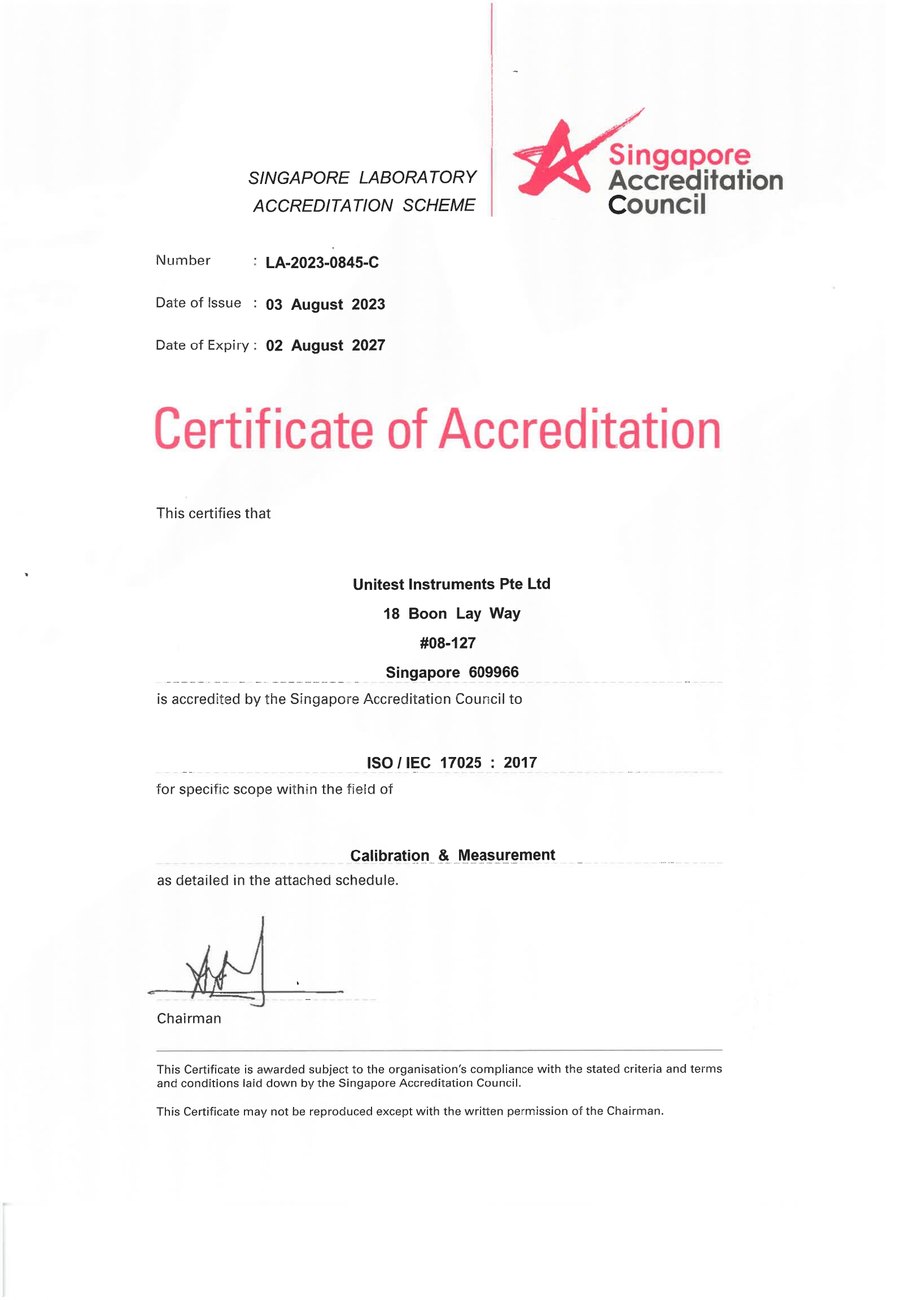
SAC-SINGLAS accredited calibration laboratory (Acc. No. LA-2023-0845-C) serving Singapore's industrial, pharmaceutical, and manufacturing sectors. All content reflects our ISO/IEC 17025 accredited scope and is reviewed by our technical calibration team.
Need temperature instrument calibration in Singapore?
Unitest Instruments is SAC-SINGLAS accredited (Acc. No. LA-2023-0845-C) to ISO/IEC 17025. Same-week turnaround, certificates accepted by ISO 9001 auditors and HSA inspectors.