
Key Takeaways
- Amprobe excels in accuracy-critical applications; Klein Tools leads in field durability and ergonomics for trade electricians.
- Both brands require periodic calibration by an accredited laboratory for compliance. Manufacturer specs are not the same as a calibrated uncertainty statement.
- Singapore's 230V/400V systems demand CAT III or CAT IV rated instruments; both brands offer compliant options, but verify the rating label before use.
- Mid-range models from both brands are closely matched in everyday accuracy; the gap widens at the high end, where Amprobe's laboratory-adjacent designs pull ahead.
- Unitest Instruments sells and calibrates both Amprobe and Klein Tools equipment. Procurement and calibration can be combined in a single engagement to reduce total cost.
Brand Backgrounds: Where Each Company Comes From
Understanding why Amprobe and Klein Tools feel different in the hand starts with understanding what each company was originally built to serve.
Amprobe was founded in 1948 and was, by most accounts, the company that commercialised the clamp meter concept. The idea of measuring current without breaking a circuit. The brand has always lived closer to the precision measurement and electrical testing side of the industry. Today part of the Fortive group (which also owns Fluke), Amprobe occupies a deliberate middle tier: more accuracy-oriented than pure trade tools, more accessible in price than the flagship Fluke range. In Singapore's industrial and facilities management sector, Amprobe is commonly specified for commissioning, energy auditing, and routine maintenance in manufacturing plants.
Klein Tools was founded in Chicago in 1857. Originally as a hand tool manufacturer for telegraph and telephone linemen. Electrical tools came later, but the DNA of the brand has always been about what a working tradesperson needs at the end of a long shift: tools that survive rough handling, fit comfortably in a tool pouch, and return a reading you can trust without fussing over settings. Klein's test equipment range is comparatively newer, launched in earnest in the 2010s, but it has been adopted rapidly by the electrical trade because the ergonomics and physical design reflect that tradesperson-first thinking.
Neither positioning is wrong. They simply serve different primary users, which is the key to making a good procurement decision.
Head-to-Head Comparison: Clamp Meters
Clamp meters are the most commonly compared product between the two brands. Both offer a broad range from entry-level to professional-grade instruments. The table below compares representative mid-to-high-range models in each line.
| Feature | Amprobe AMP-330 | Klein Tools CL900 |
|---|---|---|
| AC Current Range | Up to 400A | Up to 400A |
| AC Current Accuracy | ±2.0% ±5 digits | ±2.0% ±5 digits |
| AC Voltage Accuracy | ±1.5% ±3 digits | ±1.2% ±3 digits |
| DC Current Measurement | Yes (Hall effect) | Yes (Hall effect) |
| True RMS | Yes | Yes |
| Safety Rating | CAT III 600V / CAT IV 300V | CAT III 1000V / CAT IV 600V |
| Data Logging | Yes (with software) | No (display hold only) |
| Low-Pass Filter | Yes | Yes |
| IP Rating | IP40 | IP67 (dust and water resistant) |
| Drop Rating | 1 metre | 2 metres |
| Weight | ~380g | ~410g |
| Jaw Opening | 35mm | 47mm (wider. Suits larger cable bundles) |
| Backlight | Yes | Yes |
| Best For | Commissioning, energy auditing, data-logging tasks | Field service, MCC panels, physically demanding environments |
The headline finding: Klein Tools' CL900 carries a significantly higher CAT IV voltage rating (600V vs 300V) and a better IP67 ingress protection rating. For Singapore contractors working at the service entrance or outdoor distribution panels (common in industrial estates in Jurong or Tuas), the Klein's physical robustness is a genuine safety advantage, not just a marketing claim.
Amprobe's data logging capability is the differentiator on the other side. If you are conducting energy audits, load surveys, or commissioning reports that require a time-stamped record of readings, the Amprobe's ability to interface with PC software makes the analysis workflow significantly simpler than manually transcribing display-hold values.
Head-to-Head Comparison: Multimeters
Both brands produce digital multimeters (DMMs) ranging from basic CAT II units to full-featured true-RMS instruments. The comparison here is most relevant for panel technicians, facilities engineers, and laboratory technicians who need a versatile handheld DMM for voltage, current, resistance, and continuity tasks.
| Feature | Amprobe AM-570 | Klein Tools MM700 |
|---|---|---|
| Display Resolution | 60,000 counts | 40,000 counts |
| DC Voltage Accuracy | ±0.5% ±2 digits | ±0.5% ±2 digits |
| AC Voltage Accuracy | ±1.2% ±3 digits (True RMS) | ±1.5% ±5 digits (True RMS) |
| Resistance Range | Up to 60MΩ | Up to 40MΩ |
| Capacitance | Yes | Yes |
| Temperature (Type K TC) | Yes | Yes |
| Frequency Measurement | Up to 100kHz | Up to 100kHz |
| Safety Rating | CAT III 1000V / CAT IV 600V | CAT III 1000V / CAT IV 600V |
| TRMS Input | True RMS (AC+DC) | True RMS (AC+DC) |
| Bluetooth / App | No | Yes (Klein Tools app) |
| Best For | Higher resolution measurements, lab-adjacent work | Field electricians who value app-based logging and reporting |
Here the roles partially reverse. Amprobe's AM-570 offers 60,000-count resolution. Meaningfully higher than Klein's 40,000-count MM700. For measurements where you need to resolve small differences (for example, verifying that two legs of a three-phase supply are within tolerance of each other), the additional digit of resolution matters. AC voltage accuracy also edges slightly to Amprobe's favour on this model comparison.
Klein Tools' Bluetooth connectivity and companion app is a practical advantage for field electricians who need to produce basic inspection reports on-site without transcribing readings. The app allows screen capture of live readings. Useful for EMA-related documentation and handover records.
Calibrate your Amprobe or Klein Tools instruments at Unitest
We supply and calibrate both brands. Our certificates are traceable to Singapore's NMC and accepted by ISO 9001 auditors and EMA-licensed electrical workers. Same-week turnaround available.
Voltage Testers and Non-Contact Voltage Detectors
For quick, non-invasive voltage presence checks (the kind of task done dozens of times a day on a busy site), both brands offer non-contact voltage testers (NCVTs) and plug-in socket testers. This is arguably where Klein Tools has its strongest competitive position.
Klein's NCVT range, including the NCVT-6 and dual-range variants, have become de facto standard tools on Singapore construction sites due to their clear LED and audible alert hierarchy, slim tip profile for access in crowded panel spaces, and robust warranty support. The ergonomic design (weight distribution, clip design, tip shape), reflects decades of tradesperson feedback that Amprobe's equivalent products, while functionally accurate, do not yet match.
Amprobe's VP-1000 family and related testers are solid instruments, but they are designed more for the structured testing environment (regular site maintenance, electrical panel labelling, and systematic fault finding), rather than the fast, repeated "live or dead?" check that dominates trade-electrician workflow. If your team primarily uses NCVTs for safety verification rather than detailed diagnostics, Klein Tools is the practical winner in this category.
Calibration Considerations for Singapore Procurement
This is where procurement teams sometimes overlook a critical variable. Purchasing either brand without a calibrated instrument is purchasing a tool with an unverified measurement uncertainty. The manufacturer's accuracy specification tells you what the instrument is designed to achieve. It does not tell you what your specific unit is actually delivering on the day you use it.
Under ISO/IEC 17025 and Singapore's measurement traceability framework, any test instrument used for compliance or quality measurements should carry a calibration certificate from a SAC-SINGLAS accredited laboratory, traceable to Singapore's National Metrology Centre (NMC). Our article on accredited vs non-accredited calibration explains why this distinction matters. Particularly for manufacturers seeking ISO 9001 certification or companies under EMA regulatory scope.
Both Amprobe and Klein Tools instruments fall squarely within Unitest's accredited calibration scope. We calibrate AC/DC voltage, AC/DC current, and resistance parameters across both product families. For new instrument procurement, we strongly recommend combining the purchase with an initial calibration. You receive the instrument with a verified uncertainty statement and a documented calibration baseline, which simplifies future recall management.
Understanding how to read and interpret the certificate you receive is equally important. Our guide on what a calibration certificate contains walks through each section. Including the reported expanded uncertainty, reference standards used, and environmental conditions at the time of calibration, so your quality team knows exactly what they are relying on.
Clear Winner Recommendations by Use Case
Rather than declaring an overall winner (which would mislead buyers into the wrong purchase), the honest answer is use-case specific. Here is our recommendation matrix based on the instrument categories and user profiles we see most commonly in Singapore's industrial and construction sectors.
| Use Case | Recommended Brand | Reason |
|---|---|---|
| Energy auditing and load surveys | Amprobe | Data logging capability, tighter accuracy at sustained measurement |
| Daily field service (trade electricians) | Klein Tools | IP67 protection, higher drop rating, tradesperson ergonomics |
| Outdoor / service entrance measurements | Klein Tools | Higher CAT IV voltage rating (600V), better ingress protection |
| Commissioning and panel verification | Amprobe | Higher count resolution DMMs, better frequency range |
| Quick site safety checks (NCVT) | Klein Tools | Best-in-class ergonomics and alert hierarchy for trade use |
| QC and manufacturing compliance | Amprobe | Tighter AC voltage accuracy, software interface for records |
| Facilities management (general) | Either | Both are suitable; calibration state matters more than brand |
| Budget-constrained procurement | Klein Tools | Strong value in mid-range; app connectivity at lower price points |
One consideration that applies to all rows of the table: the calibration state of the instrument has a larger practical impact on measurement reliability than the choice of brand at comparable price points. A Klein Tools CL900 with a current calibration certificate from an accredited lab is a more trustworthy instrument than an Amprobe AMP-330 that has not been calibrated in three years. Regardless of the nominal accuracy specification printed on the datasheet.
Procurement in Singapore: Practical Notes
Singapore's electrical testing environment has some specific considerations that influence the Amprobe vs Klein Tools decision beyond the technical specifications.
First, Singapore's grid is 230V/400V at 50Hz. Both brands' instruments are fully compatible with this system. However, some Amprobe models are primarily designed for the North American 120V/240V 60Hz market. Verify that the model you are procuring carries IEC 61010 ratings appropriate for Singapore's voltage levels, not just UL listings for the US market.
Second, humidity is a persistent challenge. Singapore's ambient relative humidity ranges from 70% to over 90% in outdoor and semi-outdoor environments. Instruments stored without climate control can accumulate moisture in critical measurement circuits. Klein Tools' IP67-rated instruments have a structural advantage here. For either brand, sealed storage and periodic desiccant management are good practice, and calibration frequency should account for the possibility of humidity-induced drift.
Third, after-sales support and service availability matters for procurement. Unitest supplies and services both brands locally, which means calibration, repair quotation, and replacement parts queries can be handled without international shipping lead times. For government-linked companies (GLCs) and statutory boards with local-support requirements in their procurement frameworks, this is a non-trivial consideration.
Insulation Resistance and Continuity Testing: A Secondary but Important Comparison
Beyond clamp meters, DMMs, and NCVTs, a full electrical test kit typically also needs an insulation resistance tester (megohmmeter) for cable and motor winding testing, and both brands offer entries in this category worth a closer look for Singapore buyers assembling a complete kit.
Amprobe's insulation testers (the AMB-45/AMB-55 range) are built around the same accuracy-first philosophy as the rest of the line, offering test voltages up to 1000V DC and resistance measurement into the gigaohm range, with a reading resolution that suits condition-monitoring programmes where small year-on-year drift in insulation resistance is being tracked as a predictive maintenance indicator. Klein Tools' insulation testers are a newer addition to their catalogue and prioritise a simpler operating model: fewer test voltage steps, a more straightforward pass/fail-oriented display, and the same rugged housing and drop rating as the rest of their field line.
For Singapore facilities running formal predictive maintenance programmes on motors and switchgear (a growing practice among manufacturers pursuing ISO 55001 asset management alignment), the Amprobe's finer resolution and trending capability generally serves the use case better. For electricians performing a straightforward pass/fail insulation check as part of routine maintenance or fault-finding, either brand is adequate, and Klein's ruggedness again becomes the deciding factor in harsher site environments.
Accessories, Probe Ecosystem, and Total Cost of Ownership
A test instrument's purchase price is only the starting point of its real cost. Test leads, probes, replacement fuses, and carrying cases are consumed and replaced over the instrument's working life, and the two brands differ meaningfully here.
Klein Tools has built out a genuinely extensive accessory ecosystem, reflecting its trade-tool heritage. Replacement test leads, alligator clips, and probe tips are widely stocked by local electrical wholesalers in Singapore, and cross-compatibility between different Klein instrument generations is generally good, meaning a crew standardising on Klein Tools can share consumables across a mixed fleet of older and newer meters. Amprobe's accessory range is narrower and, because the brand sits closer to the professional/laboratory segment, replacement parts are more commonly sourced through the authorised distributor rather than general electrical wholesalers, which can mean a slightly longer lead time for a replacement lead set or probe tip.
Fuse replacement is a specific point worth flagging: both brands specify high-energy ceramic fuses rated for their CAT III/CAT IV inputs, and using a generic, lower-rated fuse as a substitute (a shortcut some site electricians take when the correct part is not immediately available) defeats the instrument's overcurrent protection and creates a genuine safety hazard. Procurement teams standardising on either brand should stock the correct manufacturer-specified fuse as a standing spare part, not source it only when a fuse blows.
Building a Mixed-Brand Fleet: A Practical Middle Path
Many of the larger facilities-management and M&E contracting firms we work with in Singapore do not actually settle the Amprobe-versus-Klein-Tools question with a single answer. Instead, they run a deliberately mixed fleet, and the logic behind that decision is worth setting out because it is often the most cost-effective outcome for a team covering a range of task types.
The typical pattern: Amprobe instruments are issued to commissioning engineers, energy auditors, and QC/compliance staff whose work involves documented measurement, data logging, and formal reporting; Klein Tools instruments are issued to field service technicians and maintenance electricians whose work is dominated by fast diagnostic checks in physically demanding conditions. This split plays to each brand's genuine strength rather than forcing one instrument type to cover every role adequately but optimally for none.
The operational cost of running a mixed fleet is a slightly more complex calibration schedule, since two brands means two sets of manufacturer specifications, two accuracy tables to reference when reviewing a certificate, and, potentially, two different recommended calibration intervals to track across the asset register. In practice this is a minor administrative overhead. A single calibration provider, such as Unitest, that services both brands under one accredited scope and issues certificates on a common register format removes most of the friction, and the resulting fleet is genuinely better matched to the range of tasks a Singapore M&E team actually performs day to day than a single-brand standardisation would be. The key discipline is keeping the asset register current regardless of brand mix, so that no instrument, from either manufacturer, is quietly running past its due date while sitting in a technician's tool bag.
Frequently Asked Questions
It depends on the application. Amprobe leads for precision measurement and laboratory-adjacent tasks where accuracy specifications and data logging matter. Klein Tools is the stronger choice for daily field use. Their ergonomics, durability ratings, and safety features are optimised for trade electricians working in harsh site conditions. Most Singapore contractors keep both brands in their toolkit.
Yes. Both brands are test and measurement instruments, and any instrument used for safety-critical or compliance measurements must be periodically calibrated by an accredited laboratory. In Singapore, SAC-SINGLAS accredited labs (such as Unitest Instruments, Acc. No. LA-2023-0845-C) issue certificates that are accepted by ISO 9001 auditors, BCA inspectors, and EMA-licensed electrical workers. Calibration intervals of 6–12 months are typical for clamp meters used in regular service.
Top-tier Amprobe clamp meters (e.g. AMP-330 series) specify AC current accuracy of ±2.0% and AC voltage of ±1.5%. Klein Tools flagship clamp meters (e.g. CL900) specify AC current at ±2.0% and AC voltage at ±1.2%. In practice, both brands perform closely at the mid-range; Amprobe's higher-end models often provide tighter uncertainty envelopes useful for commissioning work. Real-world performance should always be verified against a calibrated reference. Nominal specs are manufacturer claims, not certified values.
Yes. Unitest Instruments calibrates electrical test and measurement equipment from both Amprobe and Klein Tools across our SAC-SINGLAS accredited scope (Acc. No. LA-2023-0845-C), covering AC/DC voltage, AC/DC current, and resistance parameters. We also supply both brands. Contact us for procurement pricing combined with calibration packages.
There is no single mandated interval in Singapore, but ISO/IEC 17025 and most quality management standards require a risk-based interval determined by the instrument's drift history, usage intensity, and criticality of the measurements taken. For field-used clamp meters, a 12-month interval is standard; instruments used for safety or compliance testing are often calibrated every 6 months. Unitest provides interval recommendation reports alongside each calibration certificate.
Both brands offer meters with IEC 61010 CAT III and CAT IV ratings suitable for Singapore's 230V/400V distribution systems. CAT III covers fixed building installations up to 1000V; CAT IV covers the supply level (outdoor, utility service entrance). Always match the instrument's CAT rating and voltage rating to your measurement environment. A CAT II meter should never be used on a CAT III panel. Unitest recommends verifying the safety rating label before any energised measurement.
Measurement uncertainty is the quantified doubt around a measured value. It tells you how close the reading is likely to be to the true value. When comparing Amprobe vs Klein Tools, the manufacturer-quoted accuracy specification is the starting point, but the actual expanded uncertainty (at k=2, 95% confidence) depends on the instrument's calibration state, operating conditions, and the reference standard used. For compliance and auditing purposes, only a calibration certificate from an accredited lab provides a traceable uncertainty statement.
Unitest Instruments supplies both Amprobe and Klein Tools test equipment and can bundle new instruments with initial calibration certificates at the time of purchase. This is the most cost-effective approach for companies building a calibrated instrument inventory. You receive the instrument, a calibration certificate traceable to Singapore's NMC, and a recommended recall date in a single transaction. Contact us via the website for pricing.
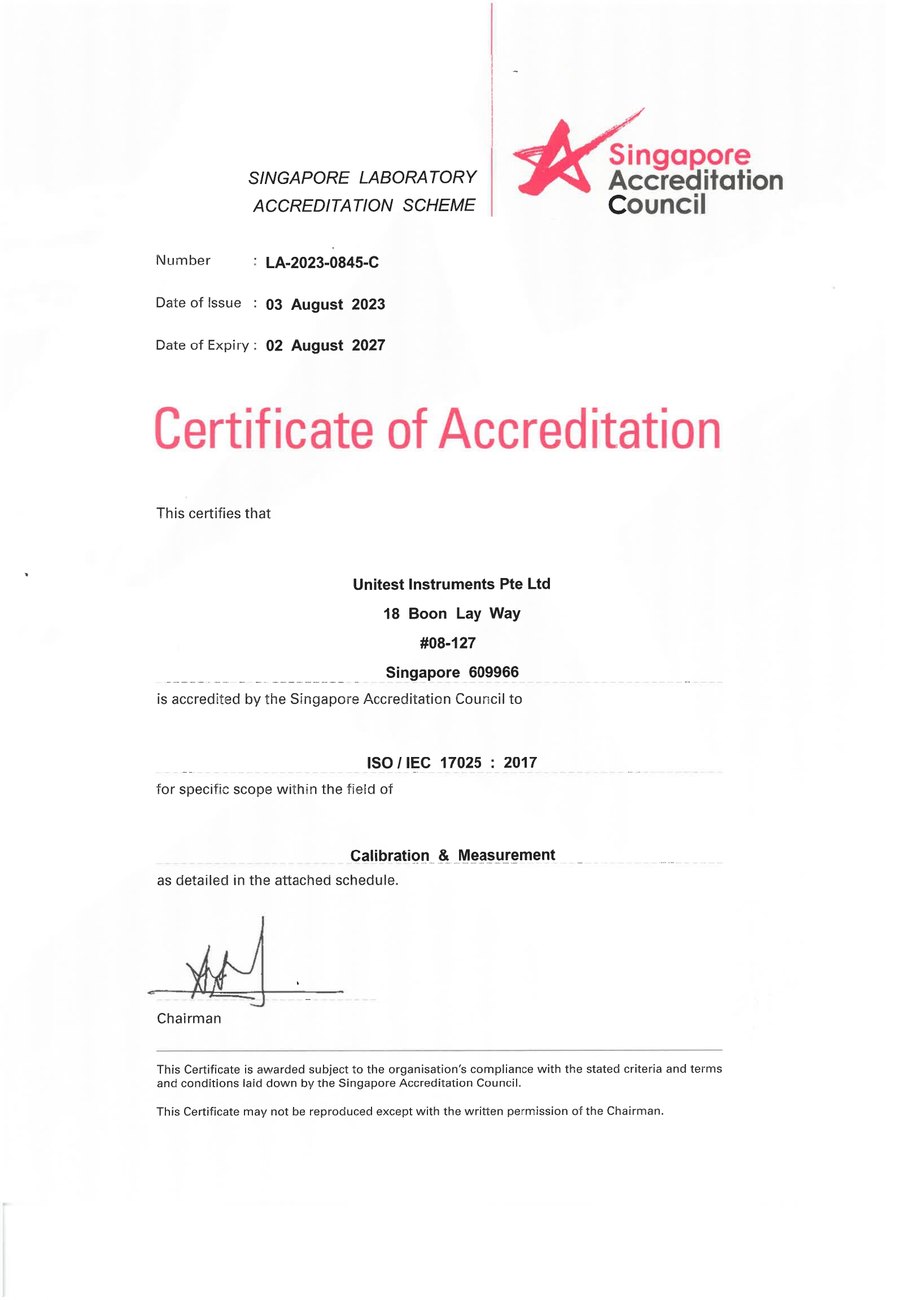
SAC-SINGLAS accredited calibration laboratory (Acc. No. LA-2023-0845-C) serving Singapore's industrial, pharmaceutical, and manufacturing sectors. All content reflects our ISO/IEC 17025 accredited scope and is reviewed by our technical calibration team.
Need electrical instrument calibration in Singapore?
Unitest Instruments is SAC-SINGLAS accredited (Acc. No. LA-2023-0845-C) to ISO/IEC 17025. Same-week turnaround, certificates accepted by ISO 9001 auditors.