
Key Takeaways
- All four types are governed by IEC 60584-1:2013, which defines the EMF-temperature reference tables and two accuracy tolerance classes (Class 1 tighter than Class 2) that calibration certificates report against.
- Type K is the most widely used industrial thermocouple worldwide, but it suffers from 'green rot' degradation in reducing or low-oxygen atmospheres above 800 °C. Use Type N instead in these conditions.
- Type T is the correct choice for temperatures below 0 °C, including pharmaceutical cold-chain, food storage, and cryogenic research applications.
- Type J must never be used above 760 °C or in moist air; iron oxidation accelerates rapidly above that threshold and the wire becomes brittle within hours.
- Extension and compensating cables must match the thermocouple letter type exactly (IEC 60584-3); a mismatched cable junction introduces a parasitic EMF that can cause errors exceeding 10 °C.
What Is a Thermocouple and How Does It Work?
A thermocouple is a temperature sensor consisting of two dissimilar metallic conductors joined at one end (the measuring junction) and connected to a measuring instrument at the other end (the reference junction). When the two junctions are at different temperatures, a net electromotive force (EMF) is produced along the circuit. A phenomenon described by the Seebeck effect, first observed by Thomas Seebeck in 1821. The magnitude of this EMF is a predictable function of the temperature difference between the junctions and the specific alloy combination used.
The Seebeck coefficient (expressed in microvolts per degree Celsius (µV/°C)), is not constant; it varies with temperature for every alloy pair. International standard IEC 60584-1:2013 (Thermocouples. Part 1: EMF specifications and tolerances) tabulates the reference EMF-temperature relationship for eight letter-designated types at intervals of 1 °C, using 0 °C as the reference junction temperature. This is why a measuring instrument requires cold-junction compensation (CJC): it must know the actual temperature of its own terminals to convert the measured EMF into a true process temperature.
The four base-metal types covered in this guide (J, K, T, and N), are the most cost-effective and widely used. They are distinguished from noble-metal types (R, S, B) by their lower cost, broader availability, and suitability for general industrial rather than ultra-high-temperature applications. However, base-metal thermocouples are more susceptible to oxidation, contamination, and thermoelectric drift over time, which makes regular calibration against a traceable reference essential.
Type J Thermocouple: Iron / Constantan
Composition and EMF output
The Type J thermocouple uses iron (Fe) as the positive leg and constantan (a copper-nickel alloy, nominally 55% Cu / 45% Ni) as the negative leg. At 0 °C it produces 0 µV by definition; at 400 °C it generates approximately 21.85 mV; and at its upper working limit of 750 °C it produces approximately 42.28 mV. The average Seebeck coefficient across the 0–750 °C range is approximately 54 µV/°C. The highest of the four types discussed here, giving Type J slightly better signal-to-noise at moderate temperatures when compared with a low-resolution ADC.
Temperature range and tolerance
IEC 60584-1 specifies Type J across −40 °C to +750 °C (extended EMF tables run from −210 °C to +1200 °C, but these are outside the recommended continuous-use envelope). Class 1 tolerance is ±1.5 °C (or ±0.4 % of the reading in °C, whichever is greater) from −40 °C to +375 °C, widening to ±0.4 % above 375 °C. Class 2 tolerance is ±2.5 °C or ±0.75 %, whichever is greater.
When to use Type J, and when to avoid it
Type J is the appropriate choice for measurement in inert atmospheres, vacuum furnaces, or reducing gas environments (such as hydrogen-rich atmospheres common in metal annealing) where oxygen partial pressure is low. In these conditions, its iron leg does not oxidise and the sensor remains stable. However, three situations make Type J unsuitable:
- Moist or oxidising air above 540 °C: iron oxidises rapidly, forming magnetite (Fe₃O₄) and haematite (Fe₂O₃) on the wire surface, which alters the alloy composition and drives the EMF output negative (reads lower than actual).
- Temperatures above 760 °C: an irreversible metallurgical phase transformation (magnetic transition) occurs in the iron leg near 769 °C (the Curie point), causing a permanent step-change in the EMF output that cannot be corrected by recalibration.
- Humid environments at any temperature: iron corrodes, and the resulting surface layer is electrically parasitic. Type T or Type K is far more appropriate where condensation or water ingress is possible.
Type K Thermocouple: Nickel-Chromium / Nickel-Aluminium
Composition and global dominance
Type K uses nickel-chromium alloy (nominally 90% Ni / 10% Cr, trade name Chromel) as the positive leg and nickel-aluminium alloy (nominally 95% Ni / 2% Al / 2% Mn / 1% Si, trade name Alumel) as the negative leg. It is by far the most widely produced thermocouple type in the world, used in applications ranging from household ovens to aerospace test rigs. Its dominance stems from its wide temperature range, good oxidation resistance, and broad commercial availability at low cost.
At 400 °C, a Type K produces approximately 16.40 mV; at 1000 °C it generates approximately 41.27 mV. The mean Seebeck coefficient from 0–1000 °C is approximately 41 µV/°C. IEC 60584-1 specifies the operating range as −200 °C to +1260 °C. Class 1 tolerance is ±1.5 °C or ±0.4 %; Class 2 tolerance is ±2.5 °C or ±0.75 %.
The 'green rot' degradation mechanism
The most significant failure mode unique to Type K is chromium selective oxidation. Colloquially called 'green rot' from the colour of the chromic oxide (Cr₂O₃) deposit formed on the wire surface. This occurs in environments where the oxygen partial pressure is low but not truly reducing (typically between 10⁻⁶ and 10⁻² atm O₂), at temperatures between 800 °C and 1050 °C. In this partial pressure window, Cr in the Chromel leg oxidises preferentially while Ni remains metallic, stripping chromium from the alloy, reducing its EMF output, and causing the thermocouple to read significantly lower than actual temperature. The change is insidious because there may be no visible damage to the wire's outer surface. An instrument displaying an apparently stable reading may be reporting a temperature 5–20 °C below actual.
The Curie-point anomaly near 354 °C
Type K also exhibits a minor but measurable EMF non-linearity near 354 °C related to a magnetic transition in the Alumel negative leg. This produces a hysteresis of up to ±0.5 °C when the thermocouple is cycled through that temperature range, which is significant for precision applications near 300–400 °C. Processes such as pharmaceutical autoclave validation or precision heat-treatment that cycle repeatedly through this zone should consider Type N as an alternative.
Type T Thermocouple: Copper / Constantan
Composition and low-temperature excellence
Type T uses pure copper (Cu) as the positive leg and constantan as the negative leg. Its great strength is behaviour at sub-zero temperatures: it can be calibrated with excellent accuracy from −200 °C to 0 °C and used continuously up to +350 °C. IEC 60584-1 Class 1 tolerance is ±0.5 °C or ±0.4 % from −40 °C to +125 °C. The tightest Class 1 tolerance of all four types in this zone, making it the instrument of choice for cold-chain qualification.
At −100 °C, a Type T generates approximately −3.379 mV; at +200 °C it generates approximately 9.286 mV. The Seebeck coefficient at room temperature is approximately 40 µV/°C, very similar to Type K but with superior linearity and stability in the cryogenic range. Class 2 tolerance from −40 °C to +350 °C is ±1.0 °C or ±0.75 %.
Application profile and limitations
Type T is the standard sensor in pharmaceutical cold-chain qualification, food-industry refrigeration mapping, laboratory cryostats, and the measurement of liquefied gases. It is also commonly used in the electronics industry for PCB thermal profiling, where its small wire diameter (as fine as 0.08 mm) enables fast response and minimal thermal loading. The upper limit of +350 °C is its main constraint: above this temperature, copper oxidises rapidly in air, and the sensor drifts negatively within a matter of hours. For anything above 300 °C, Type K or Type N is the correct choice.
Need thermocouple calibration traceable to Singapore's NMC?
Unitest Instruments calibrates Type J, K, T, and N thermocouples against IEC 60584-1 reference tables. Certificates are accepted by ISO 9001, GMP, and HACCP auditors. Same-week turnaround for most sensors.
Type N Thermocouple: Nicrosil / Nisil
The engineered successor to Type K
Type N (Nicrosil/Nisil) was developed in the 1970s and 1980s by Noel Burley at the Australian Defence Science and Technology Organisation, with the specific objective of overcoming Type K's principal failure modes. The positive leg, Nicrosil, contains nominally 84.4% Ni, 14.2% Cr, and 1.4% Si; the negative leg, Nisil, contains 95.5% Ni, 4.4% Si, and 0.1% Mg. The higher silicon and chromium content, combined with the deliberate formation of a stable, protective silicon oxide surface layer, prevents the selective chromium oxidation that causes green rot in Type K.
IEC 60584-1 specifies Type N from −200 °C to +1300 °C, with a Class 1 tolerance of ±1.5 °C or ±0.4 % and Class 2 of ±2.5 °C or ±0.75 %. Identical to Type K on paper. The practical advantage lies in drift: in comparative long-term tests at 1000 °C, Type N typically accumulates less than 0.5 °C of drift after 1000 hours of exposure, versus 2–4 °C for equivalent Type K wire. For processes that must maintain measurement confidence over months or years without frequent recalibration, this stability difference is operationally significant.
Trade-offs and where Type N does not win
Type N is not universally superior. Its mean Seebeck coefficient of approximately 36 µV/°C is lower than Type K's 41 µV/°C, meaning it produces a weaker signal. Particularly relevant when using long cable runs or low-resolution instrumentation. Below 400 °C, Type K and Type T both offer comparable or better accuracy for the cost. Type N wire and accessories also command a price premium over Type K and are less universally stocked. The practical recommendation is to default to Type K for general industrial use and upgrade to Type N when operating above 800 °C in oxidising atmospheres, when long-term drift budgets are tight, or when sensors must survive reducing or cyclic atmospheres.
Side-by-Side Comparison: J, K, T, N
| Property | Type J | Type K | Type T | Type N |
|---|---|---|---|---|
| Positive leg alloy | Iron (Fe) | Chromel (Ni-Cr) | Copper (Cu) | Nicrosil (Ni-Cr-Si) |
| Negative leg alloy | Constantan (Cu-Ni) | Alumel (Ni-Al-Mn-Si) | Constantan (Cu-Ni) | Nisil (Ni-Si-Mg) |
| IEC 60584-1 range | −40 °C to +750 °C | −200 °C to +1260 °C | −200 °C to +350 °C | −200 °C to +1300 °C |
| Class 1 tolerance | ±1.5 °C / ±0.4 % | ±1.5 °C / ±0.4 % | ±0.5 °C / ±0.4 % | ±1.5 °C / ±0.4 % |
| Class 2 tolerance | ±2.5 °C / ±0.75 % | ±2.5 °C / ±0.75 % | ±1.0 °C / ±0.75 % | ±2.5 °C / ±0.75 % |
| Approx. Seebeck (20 °C) | ~52 µV/°C | ~41 µV/°C | ~40 µV/°C | ~26 µV/°C |
| Oxidising atmosphere | Poor above 540 °C | Good to 1260 °C | Poor above 300 °C | Excellent to 1300 °C |
| Reducing atmosphere | Good | Green rot risk 800–1050 °C | Poor above 200 °C | Excellent |
| Long-term drift (1000 hr, 1000 °C) | N/A (beyond range) | 2–4 °C typical | N/A (beyond range) | <0.5 °C typical |
| Best fit applications | Vacuum furnaces, inert gas ovens, plastics processing | General industry, HVAC, engines, autoclaves | Cold-chain, cryogenics, food refrigeration, PCB profiling | High-temp oxidising ovens, long-life sensors, reducing atmospheres |
Calibration Implications and Singapore Regulatory Context
How thermocouple calibration works
Thermocouple calibration compares the sensor's actual EMF output (measured at a series of known, stable temperatures using a reference standard), against the EMF-temperature values tabulated in IEC 60584-1. The difference is the sensor's error at that temperature point. A calibration certificate for an ISO/IEC 17025 accredited laboratory such as Unitest Instruments (SAC-SINGLAS Acc. No. LA-2023-0845-C) will report each measured error alongside the associated measurement uncertainty, expressed at a coverage factor of k=2 (approximately 95% confidence level). For a deeper explanation of what each element of a calibration certificate means, see our guide to reading a calibration certificate.
The calibration is traceable when the reference standard used by the laboratory has itself been calibrated against a higher-level reference that ultimately links back to a national metrology institute. In Singapore, the national measurement standard for temperature is maintained by the National Metrology Centre (NMC) under A*STAR. Unitest Instruments' temperature calibrations are traceable to NMC Singapore's ITS-90 realisations, ensuring that a certificate issued in Singapore is compatible with calibration certificates from accredited laboratories worldwide. Understanding what calibration traceability means is essential for anyone interpreting these certificates in a compliance context.
Singapore regulatory requirements for thermocouple calibration
In Singapore, thermocouple calibration requirements arise from several regulatory and quality frameworks:
- GMP / HSA requirements: The Health Sciences Authority (HSA) Guidance Document on Good Manufacturing Practice references the need for calibrated temperature sensors with traceable certificates. Autoclaves, stability chambers, and cleanroom monitoring systems that use thermocouples must have current calibration records. HSA typically expects calibration intervals not exceeding 12 months for sensors used in product contact or critical process monitoring.
- ISO 9001:2015: Clause 7.1.5 requires that monitoring and measuring resources be calibrated or verified against measurement standards traceable to international or national measurement standards. A SAC-SINGLAS accredited certificate satisfies this requirement directly.
- HACCP and food safety: The Singapore Food Agency (SFA) requires food businesses operating HACCP systems to calibrate their temperature monitoring equipment. Thermocouples used in cooking, chilling, or cold-storage monitoring fall within this scope.
- SAC-SINGLAS TC-01: The SAC's Technical Criteria for the Accreditation of Calibration Laboratories defines the metrological requirements that laboratories themselves must meet to issue accepted certificates. For thermocouple calibration, this references IEC 60584-1 tolerance classes as the pass/fail benchmark.
Common Mistakes, and How to Avoid Them
1. Using mismatched extension cables
IEC 60584-3 specifies extension and compensating cables by letter type, using a defined colour code (which varies by country. Note that the ANSI/ASTM colour code differs from the IEC colour code). A Type K thermocouple must use Type KX extension cable. Using a Type JX cable on a Type K thermocouple creates a parasitic junction wherever the two alloys meet, generating a spurious EMF that adds to or subtracts from the true signal. The error magnitude depends on the ambient temperature at the terminal block and can easily exceed 10 °C at temperatures above 50 °C.
2. Grounding a grounded-junction sensor in an electrically noisy environment
Thermocouples are available with grounded junctions (tip welded to the sheath), ungrounded junctions (tip floating inside the sheath), or exposed junctions. Grounded junctions have the fastest response time but are electrically connected to the process. In industrial environments with strong electrical interference (motors, inverters, induction heaters), a grounded thermocouple can pick up ground loop currents that appear as measurement noise or a DC offset. For electrically noisy environments, specify an ungrounded (insulated) junction and verify that the measuring instrument has appropriate common-mode rejection.
3. Ignoring the reference junction temperature
Every thermocouple measurement requires knowledge of the reference junction temperature (traditionally an ice bath at 0 °C, now usually a cold-junction compensation circuit inside the meter). If a handheld meter is left in direct sunlight at 50 °C and its CJC sensor reads the ambient temperature incorrectly, every temperature measurement it makes will be offset by the error in the CJC reading. This is particularly relevant in Singapore's climate, where instrument enclosures in outdoor installations can reach 60–70 °C, well outside the CJC compensation range of many lower-cost instruments.
4. Not accounting for thermoelectric drift after high-temperature excursions
A single over-temperature event (even brief), can permanently alter a thermocouple's EMF output. A Type K sensor that has been taken to 1350 °C (above its rated limit) may subsequently read 5–15 °C low at its normal operating temperature. Because the wire appears physically undamaged, this drift is easily overlooked. Any sensor that has experienced a suspected over-temperature event should be recalibrated before being returned to service. Documenting calibration intervals properly, as outlined in our guide on how often to calibrate instruments, helps establish a drift history that can detect these events.
5. Selecting type by price rather than by application chemistry
Type J wire is frequently the cheapest option and is sometimes specified by default for general process work. In Singapore's humid industrial environment (heat-treatment shops, food processing facilities, chemical plants), the choice of Type J over Type K introduces corrosion risk that will shorten sensor life dramatically and potentially cause safety-critical measurement errors. The additional cost of Type K over Type J is typically recovered within one replacement cycle.
Frequently Asked Questions
Type J thermocouples use an iron/constantan alloy pair and cover −40 °C to +750 °C with a Class 1 tolerance of ±1.5 °C (or ±0.4 %). They are best suited to inert or vacuum environments but rust in moisture. Type K thermocouples use nickel-chromium/nickel-aluminium alloys, cover −200 °C to +1260 °C, and are far more oxidation-resistant, making them the general-purpose workhorse for industrial and laboratory use. At temperatures above 700 °C, Type K is preferred; below 400 °C in reducing or vacuum conditions, Type J can offer slightly better sensitivity.
Per IEC 60584-1:2013, the Type K thermocouple has a recommended continuous-use range of −200 °C to +1260 °C, though brief excursions to +1372 °C are possible before wire degradation occurs. It generates an EMF of approximately 41 µV/°C at room temperature. At the upper end of its range, Type N is often preferred due to its superior long-term drift stability.
Type T (copper/constantan) is the preferred choice for low and cryogenic temperatures. It is specified from −200 °C to +350 °C under IEC 60584-1 and offers excellent stability at sub-zero temperatures. Its Class 1 tolerance is ±0.5 °C or ±0.4 % (whichever is greater) from −40 °C to +125 °C, making it suitable for cold-storage monitoring, pharmaceutical freezers, and cryogenic research.
IEC 60584 is the internationally recognised standard governing thermocouple EMF-temperature reference tables and tolerance classes. Part 1 (IEC 60584-1:2013) defines reference functions and tolerances for eight letter-designated thermocouple types including J, K, T, and N. Calibration laboratories that are ISO/IEC 17025 accredited (such as Unitest Instruments (SAC-SINGLAS Acc. No. LA-2023-0845-C)), use these reference tables to verify that a sensor's actual output matches the published EMF curve within declared tolerance limits. A calibration certificate issued against IEC 60584 is accepted by ISO 9001 and GMP auditors as evidence of traceability.
'Green rot' (formally known as preferential oxidation of chromium) is a degradation mechanism that affects Type K thermocouples exposed to low-oxygen or reducing atmospheres at temperatures between 800 °C and 1050 °C. The chromium in the nickel-chromium positive leg selectively oxidises, forming green chromic oxide and depleting the alloy. This causes a significant negative drift in the EMF output (the thermocouple reads lower than actual temperature), which can be several degrees without any visible physical damage. The remedy is to use Type N thermocouples in these environments, as its Nicrosil/Nisil alloy is resistant to this failure mode.
There is no single mandated interval; it depends on sensor type, application severity, and regulatory requirements. Thermocouples used in critical processes (pharmaceutical cold-chain, GMP manufacturing, SAC-accredited testing) should be calibrated at least annually. Sensors used above 800 °C or in chemically aggressive environments may require six-monthly calibration due to accelerated drift. Singapore's Health Sciences Authority (HSA) GMP guidelines and the SAC Guidance Document SAC-SINGLAS TC-01 reference IEC 60584 tolerance limits as the pass/fail criterion at calibration.
No. Mixing extension cable types is one of the most common and costly thermocouple errors. Extension and compensating cables must match the thermocouple type, as specified in IEC 60584-3. Using a Type J extension cable with a Type K thermocouple introduces a parasitic EMF at the junction between the dissimilar alloys, causing a measurement error that can exceed 10 °C at elevated temperatures. Always use cables colour-coded and rated for the specific thermocouple letter type.
Type N (Nicrosil/Nisil) was developed specifically to address the principal weaknesses of Type K. It offers three key advantages: (1) significantly lower long-term drift at temperatures between 300 °C and 1200 °C, typically less than 0.5 °C drift after 1000 hours at 1000 °C versus 2–4 °C for Type K under the same conditions; (2) resistance to the 'green rot' chromium-oxidation mechanism; and (3) a higher Curie-point transition temperature, avoiding the magnetic anomaly that causes a step-change in Type K output near 354 °C. The trade-off is that Type N has a slightly lower EMF output (~36 µV/°C) and a narrower base-metal thermocouple advantage over Type K below 400 °C.
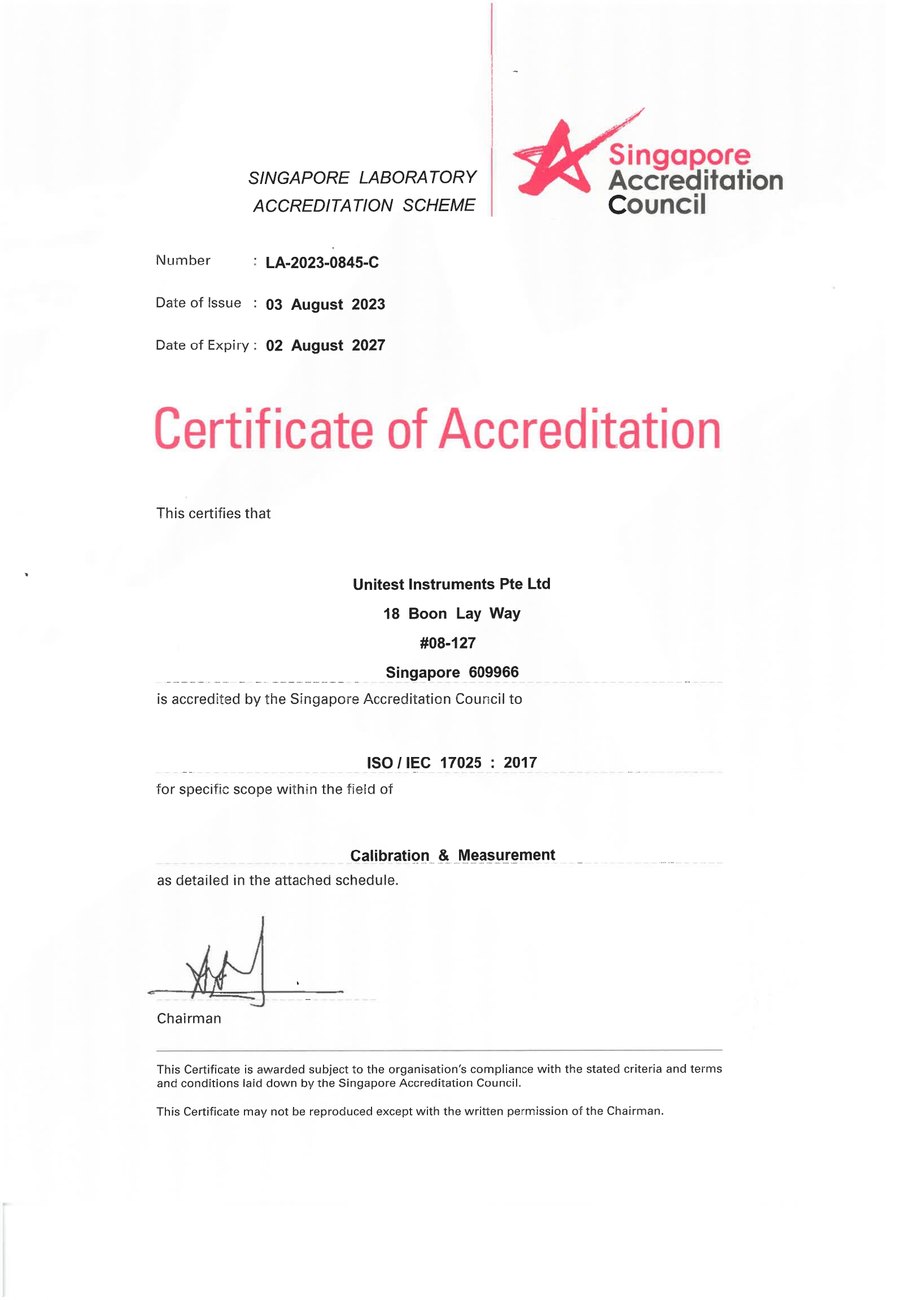
SAC-SINGLAS accredited calibration laboratory (Acc. No. LA-2023-0845-C) serving Singapore's industrial, pharmaceutical, and manufacturing sectors. All content reflects our ISO/IEC 17025 accredited scope and is reviewed by our technical calibration team.
Need thermocouple calibration in Singapore?
Unitest Instruments is SAC-SINGLAS accredited (Acc. No. LA-2023-0845-C) to ISO/IEC 17025. We calibrate Type J, K, T, and N thermocouples against IEC 60584-1 reference tables. Same-week turnaround, certificates accepted by ISO 9001 auditors.