

Key Takeaways
- Telecom and 5G operators use calibrated RF equipment to verify base station transmit power, frequency accuracy, and spectral mask compliance across dense multi-band deployments.
- Semiconductor manufacturers rely on calibrated RF test systems for wafer-scale probing and RF chip test, where calibration drift can misclassify good or bad die at volume.
- Aerospace and defense radar and avionics systems depend on precise, traceable frequency and timing references, often under AS9100 in addition to ISO/IEC 17025.
- Broadcast transmitters must stay within tightly regulated frequency channels, verified using calibrated signal generators, spectrum analyzers, and power meters.
- EMC/EMI test laboratories depend on RF calibration accuracy to correctly determine pass/fail against defined electromagnetic compatibility limits.
Why RF Calibration Matters Across Industries
RF and microwave test equipment sits at the centre of how modern industries verify that wireless, electronic, and safety-critical systems actually perform as designed. Unlike a general-purpose electrical measurement, an RF measurement error does not just risk an inaccurate reading. It can mean a product that interferes with other spectrum users, a radar system that misjudges range, or a semiconductor batch that fails in the field despite passing a flawed test. This is why the industries covered below treat traceable RF calibration not as a paperwork exercise but as a functional requirement of their quality and compliance systems.
| Industry | Typical RF Equipment Used | Why Calibration Matters |
|---|---|---|
| Telecom / 5G | Signal generators, spectrum analyzers, power meters | Verifies transmit power, frequency accuracy, spectral mask compliance |
| Semiconductor | VNAs, RF probes, signal/spectrum analyzers | Confirms RF chip performance at wafer-scale production test |
| Aerospace & Defense | Signal generators, spectrum analyzers, radar test sets | Ensures radar/avionics timing, frequency, and power accuracy for safety |
| Broadcast | Signal generators, spectrum analyzers, power meters | Confirms transmitter stays within licensed frequency channel |
| EMC / EMI Test Labs | Spectrum analyzers, signal generators, power meters, antennas | Determines accurate pass/fail against compliance emission limits |
Telecommunications and 5G Network Equipment
Telecom operators and equipment manufacturers use RF signal generators, spectrum analyzers, and power meters throughout the lifecycle of a base station or radio unit, from design verification through production test to field commissioning and ongoing maintenance. 5G networks operate across a wide range of frequency bands, from sub-6 GHz to millimetre-wave, and use dense small-cell deployments in urban environments. In this environment, a base station's transmit power and frequency accuracy must stay within tight tolerances to avoid interfering with adjacent channels or neighbouring operators' spectrum.
Because test equipment calibration drift compounds across a large deployed fleet, telecom operators typically require RF test instruments used in production and field test to carry a current calibration certificate traceable to national standards. A spectrum analyzer that reads transmit power incorrectly by even a small margin could allow a non-compliant base station to pass acceptance testing, creating a downstream interference or regulatory compliance problem.
Working in telecom, semiconductor, aerospace, or EMC test?
Unitest Instruments calibrates the signal generators, spectrum analyzers, and power meters these industries depend on, with certificates traceable to Singapore's NMC.
Semiconductor Manufacturing: Wafer Probing and RF Chip Test
Semiconductor manufacturers producing RF integrated circuits (components used in smartphones, Wi-Fi modules, and 5G chipsets), depend on RF test systems throughout production, from wafer probing (testing individual die while still on the silicon wafer, before packaging) through final packaged-device test. These test systems typically combine a vector network analyzer or signal/spectrum analyzer with an RF probe station, verifying that each device meets its frequency response, gain, and output power specification.
Because these tests run at volume across thousands of die per wafer, the economics are unforgiving in both directions: a miscalibrated test system that is too strict wastes good die as false failures, while one that is too lenient risks shipping out-of-specification chips into finished products. This is why semiconductor test floors treat calibration of their RF test instrumentation as a core production quality control activity, not an occasional maintenance task, and typically calibrate on a defined schedule tied to production volume and risk.
Aerospace and Defense: Radar and Avionics
Aerospace and defense systems place some of the most demanding requirements on RF measurement accuracy, because the underlying systems (radar, electronic warfare equipment, and avionics communication and navigation systems), combine safety-of-life consequences with strict regulatory frequency allocation. Radar systems determine target range and velocity from precise measurement of signal timing and frequency (via the Doppler effect); an inaccurate frequency or timing reference in the test equipment used to verify a radar transmitter or receiver directly undermines confidence in the deployed system's real-world performance.
Avionics communication and navigation equipment must also operate strictly within its allocated frequency bands to avoid interference with other aircraft systems and air traffic control infrastructure. Test equipment used to verify this class of equipment is often required to be calibrated under a quality system that layers aerospace-specific requirements (such as AS9100), on top of the general ISO/IEC 17025 accredited calibration framework, reflecting the higher consequence of measurement error in this sector.
Broadcast Transmission
Radio and television broadcasters operate transmitters within frequency channels licensed by their national spectrum regulator. Straying outside the licensed channel (even briefly, due to a drifting or unverified transmitter), can create interference with adjacent broadcast services or other licensed spectrum users. Broadcast engineers use calibrated signal generators, spectrum analyzers, and power meters to verify transmitter output frequency and power level during commissioning, periodic compliance checks, and after any maintenance that could affect RF performance.
Because the frequency plan for broadcast spectrum is coordinated at a national or regional level to prevent overlapping stations from interfering with one another, the industry has a direct and immediate interest in ensuring its own test equipment is itself accurate. A broadcaster relying on an unverified spectrum analyzer has no independent way to confirm its transmitter is actually within its licensed channel.
EMC and EMI Test Laboratories
Electromagnetic compatibility (EMC) and electromagnetic interference (EMI) test laboratories verify that electronic products neither emit excessive interference into the RF environment nor are unduly susceptible to interference from other sources. Testing required for regulatory compliance and market access in most jurisdictions. These labs rely on calibrated spectrum analyzers to measure emissions, calibrated signal generators and amplifiers to generate defined interference levels for susceptibility (immunity) testing, and calibrated antennas and power meters to correctly relate what the test equipment measures to actual field strength or radiated power at the device under test.
Because EMC compliance limits are defined as absolute values across a frequency range (for example, a maximum permitted emission level in dBµV/m at a given frequency), the calibration accuracy of the test equipment directly determines whether a borderline product correctly passes or fails. An EMC lab's own accreditation to ISO/IEC 17025 typically requires it to demonstrate that all RF measurement equipment used in compliance testing is itself calibrated and traceable, closing the loop between the product being tested and the national measurement standards that give the result its meaning.
Maritime and Satellite Communications
Singapore's position as one of the world's busiest ports and a regional satellite ground station and teleport hub gives it a concentration of maritime and satcom RF test activity beyond what its physical size would suggest. Marine radio, radar, and satellite communication equipment installed on vessels and offshore platforms is subject to periodic testing and certification under both international maritime conventions (SOLAS-related radio equipment requirements) and IMDA's spectrum licensing framework, with calibrated signal generators and power meters used to verify transmitter output power and frequency accuracy meet the equipment's type approval. Satellite ground station equipment, uplink and downlink RF chains supporting the region's teleport operators, requires similarly rigorous calibration given the very tight frequency coordination required to avoid interference between adjacent satellite operators sharing the same orbital arc and frequency bands, a coordination regime that depends entirely on every operator's test equipment being genuinely accurate, not just nominally compliant.
Medical Devices and Wireless Healthcare Equipment
Wireless medical devices, from Bluetooth-connected patient monitors to implantable devices with RF telemetry, require RF testing for both regulatory approval (HSA in Singapore, alongside international bodies like the FCC and relevant EU frameworks for export markets) and, for devices worn on or near the body, Specific Absorption Rate (SAR) testing verifying the device's RF emissions stay within limits considered safe for human tissue exposure. SAR testing in particular depends on precisely calibrated RF power measurement, since the safety limit itself is defined in absolute terms (watts per kilogram of tissue), and any calibration error in the test chain directly translates into either an unsafe device incorrectly passing, or a genuinely safe device failing certification and facing costly redesign or retesting. Medical device manufacturers exporting from Singapore into regulated markets should specifically confirm their RF test partner's calibration scope covers the exact frequency bands and power levels relevant to SAR and emissions testing, not just general-purpose RF calibration.
IoT and Consumer Electronics Certification
Singapore's growing IoT device manufacturing and design sector, spanning smart home devices, industrial sensors, and wearables, faces RF certification requirements for every regional market a product ships into, each with its own spectrum regulator and technical standard (IMDA locally, alongside FCC, CE/RED, and other regional frameworks for export). Pre-compliance testing during product development, checking a prototype's RF emissions and receiver performance against target market limits before committing to full formal certification testing, relies on the same calibrated spectrum analyzers and signal generators used in later formal compliance testing, and catching an RF design issue early using properly calibrated pre-compliance equipment is considerably cheaper than discovering the same issue during a formal (and non-refundable) certification test at an accredited lab. For IoT manufacturers, RF test equipment calibration is as relevant to R&D and pre-compliance testing as it is to the formal certification stage most people associate with regulatory compliance.
What miscalibrated RF equipment actually costs when it goes wrong
Across every industry covered here, the practical consequence of undetected RF test equipment drift follows a similar pattern: a product, transmitter, or system that should have failed a check passes it, or one that should have passed is incorrectly rejected, and the cost of discovering the error later is disproportionately higher than the cost of the calibration that would have prevented it. A telecommunications base station transmitting outside its licensed spectrum mask risks regulatory enforcement action and interference complaints from neighbouring operators. A semiconductor RF chip incorrectly passed at wafer test ships into a customer's product and fails in the field, triggering a warranty or recall investigation that traces back through the test process. An EMC lab issuing a compliance certificate based on drifted equipment exposes both itself and its client to the certificate being challenged later, potentially after a product has already shipped to market. In every case, the cost of routine, accredited RF calibration is a small, predictable operating expense measured against a comparatively large and unpredictable downstream cost, which is the practical argument underlying why every industry covered in this guide treats RF test equipment calibration as non-negotiable rather than optional overhead.
Research Institutes and Spectrum Regulation Itself
Beyond the commercial and industrial applications covered above, Singapore's research institutes (A*STAR-affiliated labs and university engineering departments conducting RF and wireless research) and the spectrum regulator IMDA itself both depend on accurately calibrated RF equipment for reasons distinct from product compliance testing. Research work characterising novel antenna designs, propagation models, or next-generation wireless technologies depends on measurement accuracy for the underlying science to be valid and reproducible, since a published research result built on uncalibrated equipment cannot be independently verified or trusted by the wider research community. IMDA's own spectrum monitoring and enforcement activity, confirming licensed users are not exceeding their authorised power or straying outside their allocated frequency bands, itself depends on calibrated monitoring receivers and field strength meters; the regulator enforcing spectrum discipline against licensees is itself subject to the same underlying measurement integrity requirement it expects from the industries it regulates, which is a useful reminder that traceable calibration is not merely a compliance burden imposed on industry but the shared technical foundation the entire spectrum management system, regulator included, actually depends on.
Choosing an RF Calibration Provider: What to Verify Before Committing
Given how widely RF calibration needs vary across the industries covered in this guide, from a simple frequency counter check to a full VNA characterisation for aerospace radar work, choosing a provider means matching their specific accredited scope to your actual instrument population, not assuming any accredited lab covers all RF work equally. Confirm the provider's published SAC-SINGLAS (or equivalent) scope explicitly lists the specific instrument types, frequency ranges, and parameters relevant to your work, since RF accreditation scope is often narrower and more specifically defined than general electrical calibration scope, given the specialised reference equipment and methods each RF parameter requires. Ask specifically about the provider's stated uncertainty at the frequencies and power levels most relevant to your actual usage, not just a headline "RF calibration available" claim, and where your work involves vector measurements (VNA-based S-parameter testing), confirm the provider's scope explicitly covers this more specialised discipline, since not every RF-capable lab extends its accreditation to full vector network analysis. The same verification discipline covered throughout our broader guide to choosing an accredited calibration provider applies to RF work, with the added step of confirming frequency-range-specific scope given how much RF measurement capability varies by frequency band.
Cross-industry lessons: what every RF-dependent organisation gets wrong at least once
Across the industries covered in this guide, a handful of patterns recur regardless of which specific sector is involved. Organisations frequently under-budget for RF calibration when scaling up test capacity, treating the calibration cost of a newly purchased spectrum analyser or signal generator as an afterthought rather than a genuine recurring operating cost planned in from the start, only to discover the true annual cost once a growing instrument fleet's combined calibration bill arrives. Organisations also commonly assume general electrical calibration accreditation extends to RF work, discovering only during an audit or a customer's supplier qualification review that their provider's accredited scope does not actually cover the specific RF parameters and frequency ranges their work depends on, a gap this guide's earlier sections on choosing a provider are specifically written to prevent. And organisations across every sector covered here occasionally treat a spectrum analyser or signal generator's calibration certificate as satisfying every measurement need, without recognising that connector condition, cable and adapter effects, and correct use of calibration kits, all discussed in our companion guide to RF calibration standards and methods, remain live factors affecting measurement quality even between formal calibration cycles. Recognising these recurring patterns before they bite is considerably cheaper than discovering them through a failed audit, a rejected compliance certificate, or a product recall traced back to an RF measurement that was never as trustworthy as it appeared.
The Common Thread: Traceability Under ISO/IEC 17025
Across all industries covered here, the underlying requirement is the same: RF test equipment must be calibrated by a process that demonstrates traceability to national measurement standards, with documented measurement uncertainty, through a laboratory operating under ISO/IEC 17025. For readers wanting the mechanics behind that traceability chain (including calibration kit standards and how RF uncertainty budgets are built), see our companion guides on RF calibration standards and methods and how RF test equipment calibration works step by step.
Frequently Asked Questions
Telecom and 5G network operators rely on calibrated RF signal generators, spectrum analyzers, and power meters to verify that base stations, antennas, and radio units meet transmit power, frequency accuracy, and spectral mask requirements. Because 5G networks operate across a wide range of frequency bands and use dense small-cell deployments, even small calibration drift in test equipment can lead to base stations that are out of specification, causing interference with neighbouring channels or reduced coverage.
Semiconductor manufacturers use calibrated RF test equipment for wafer probing and RF chip test, verifying that radio-frequency integrated circuits (such as those used in smartphones, Wi-Fi modules, and 5G chipsets), meet their frequency response, gain, and output power specifications before packaging. Because these tests are performed at wafer scale on thousands of devices, even a small calibration error in the test system can misclassify good die as failing, or worse, pass out-of-specification die, so traceable calibration of the RF test instrumentation is treated as a production quality control requirement.
Aerospace and defense systems such as radar and avionics communication equipment depend on precise RF signal timing, frequency, and power for both safety and mission performance. Radar systems rely on accurate frequency and timing to correctly determine range and velocity, while avionics communication and navigation equipment must operate within tightly regulated frequency allocations. Test equipment used to verify these systems must itself be calibrated with traceable, low-uncertainty references, often under stricter quality systems such as AS9100 in addition to ISO/IEC 17025.
Yes. Broadcast transmitters and associated test equipment must operate within tightly regulated frequency channels to avoid interfering with adjacent broadcast services, so signal generators, spectrum analyzers, and power meters used to verify transmitter output are calibrated to confirm frequency accuracy and power level traceability. Regulatory bodies that license broadcast spectrum typically expect test equipment used for compliance verification to have a current calibration record.
EMC (electromagnetic compatibility) and EMI (electromagnetic interference) test laboratories use calibrated spectrum analyzers, signal generators, and RF power meters to verify that a device under test neither emits excessive electromagnetic interference nor is unduly susceptible to it. Because EMC test limits are defined in absolute terms across a frequency range, the test equipment's own calibration accuracy directly determines whether a product correctly passes or fails a compliance test, making traceable RF calibration a core part of EMC laboratory accreditation.
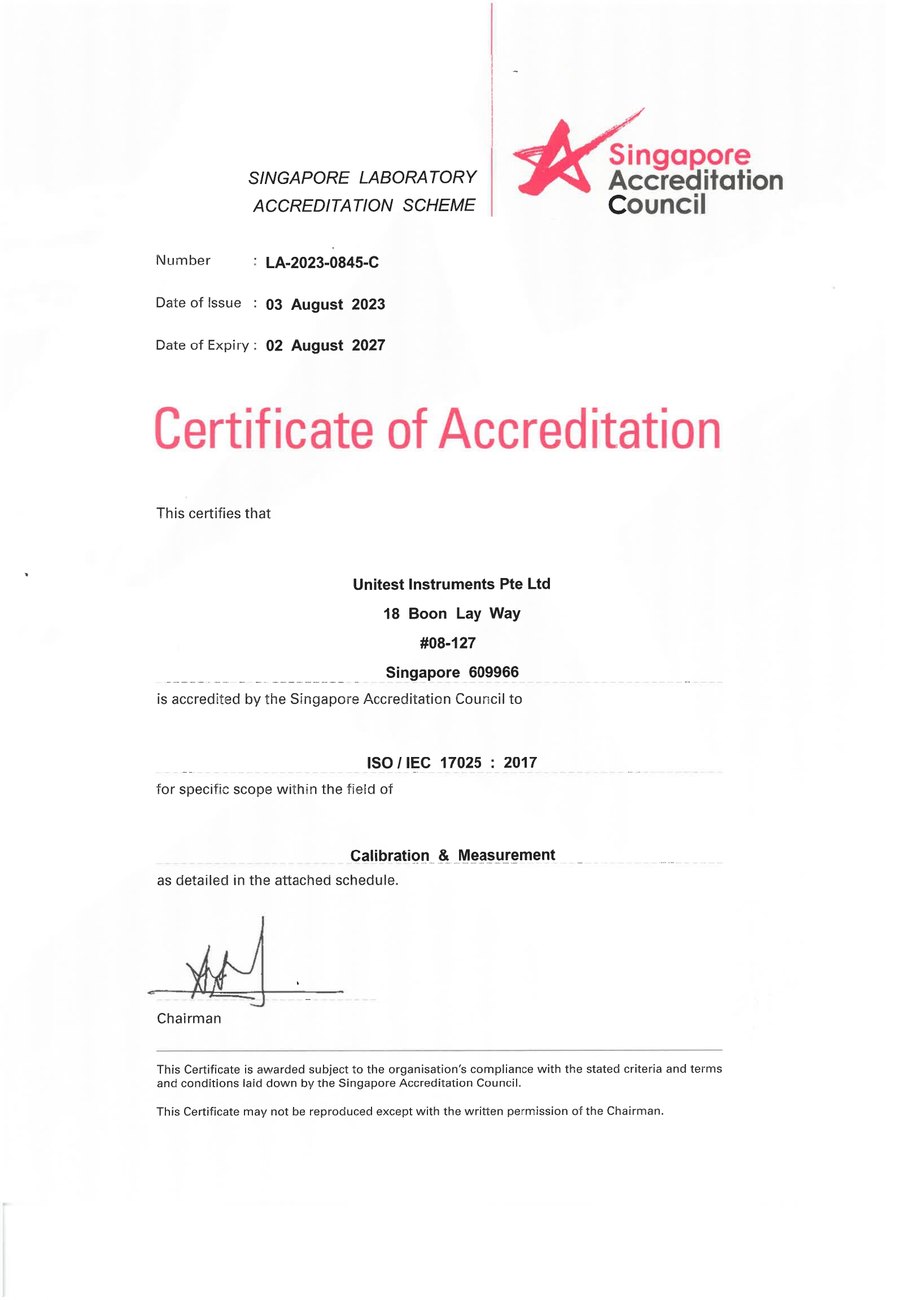
SAC-SINGLAS accredited calibration laboratory (Acc. No. LA-2023-0845-C) serving Singapore's industrial, telecom, and manufacturing sectors. All content reflects our ISO/IEC 17025 accredited scope and is reviewed by our technical calibration team.
Need RF test equipment calibrated for a regulated industry?
Unitest Instruments is SAC-SINGLAS accredited (Acc. No. LA-2023-0845-C) to ISO/IEC 17025, serving telecom, semiconductor, aerospace, broadcast, and EMC test clients across Singapore.