
Key Takeaways
- Relative humidity is temperature-dependent: the same mass of water vapour yields different RH values at different temperatures.
- Absolute humidity (g/m³) and dew point (°C) are temperature-independent measures of actual moisture content.
- Singapore's ambient dew point averages 23–26 °C year-round (one of the highest in the world), making humidity sensor calibration critical for all climate-controlled facilities.
- Dew point is the preferred measurand in precision metrology (ITS-90) because it changes only when water vapour is added or removed, not when temperature fluctuates.
- ISO/IEC 17025 calibration certificates must state both temperature and RH set-point (or equivalent dew point) to be unambiguous for regulatory audit purposes.
Defining the Two Quantities Precisely
Water exists in the atmosphere as an invisible gas (water vapour), mixed with nitrogen, oxygen, and trace gases. Two fundamentally different numbers describe how much is present, and confusing them is one of the most common errors in environmental monitoring and instrument calibration.
Relative humidity is defined by the World Meteorological Organization (WMO) and BIPM as the ratio of the partial pressure of water vapour (e) to the saturation vapour pressure of water (es) at the same temperature and total pressure, multiplied by 100: RH = (e / es(T)) × 100%. It is dimensionless and ranges from 0% (perfectly dry air) to 100% (air saturated with water vapour, at the dew point). Values above 100% are physically possible in supersaturated conditions (e.g. cloud formation), but instruments are not calibrated in that range.
Absolute humidity is the total mass of water vapour contained in a unit volume of air, most commonly expressed in grams per cubic metre (g/m³). Unlike RH, it does not depend on temperature. A parcel of air at 28 °C with 21 g/m³ still contains 21 g/m³ when cooled to 20 °C, even though the RH will have risen from roughly 79% to approximately 100%.
A third quantity (dew point temperature), bridges the two. It is the temperature to which a parcel of air must be cooled (at constant pressure) for condensation to begin. Dew point is the primary reference in precision humidity metrology because it is measured by a chilled-mirror hygrometer against the International Temperature Scale of 1990 (ITS-90), giving direct traceability to SI units.
The Underlying Physics: Why RH Changes with Temperature
The saturation vapour pressure of water increases steeply and non-linearly with temperature, described by the Clausius-Clapeyron equation. In practice, the Magnus formula provides an accurate approximation: es(T) = 6.112 × exp(17.67 × T / (T + 243.5)) hPa (valid from −40 °C to +60 °C with <0.3% error). This relationship means that saturation vapour pressure roughly doubles every 10 °C.
The practical consequence for Singapore is significant. Outdoor air at 32 °C and 80% RH entering an air-conditioned space cooled to 23 °C does not lose its water content, but its RH climbs to approximately 97%, close to condensation. The very act of cooling a building's air without active dehumidification turns Singapore's ambient air into near-saturated air that risks condensation on cold surfaces, corrosion on precision instruments, and mould growth on building fabric.
Conversely, outdoor air at 28 °C and 85% RH pulled into an industrial furnace at 150 °C would register approximately 2% RH. Hot industrial processes can feel extremely dry even in Singapore's climate, which matters for static-sensitive electronics assembly.
| Temperature (°C) | Saturation Vapour Pressure (hPa) | Absolute Humidity at 80% RH (g/m³) | Dew Point at 80% RH (°C) |
|---|---|---|---|
| 10 | 12.27 | 7.6 | 6.7 |
| 20 | 23.37 | 13.8 | 16.4 |
| 25 | 31.67 | 18.4 | 21.3 |
| 28 | 37.80 | 21.8 | 24.3 |
| 32 | 47.55 | 27.2 | 28.1 |
| 40 | 73.77 | 40.9 | 35.8 |
Measurement Methods and Sensor Technologies
Understanding what is being measured (and its limitations), is the first step to specifying the right calibration. Four primary technologies are used in industrial and laboratory humidity measurement.
Capacitive Polymer Sensors
The most widely deployed sensor type in Singapore's HVAC, pharmaceutical, food storage, and cleanroom applications. A hygroscopic polymer film absorbs or desorbs water vapour in proportion to RH; the changing dielectric constant shifts the capacitance of a thin-film capacitor. Response time is 15–60 seconds, range is typically 0–100% RH, and accuracy for a quality sensor is ±2–3% RH before calibration. The primary failure mode is chemical contamination (solvents, cleaning agents) and long-term drift of the polymer. Annual calibration against a chilled-mirror reference is standard practice under ISO/IEC 17025-aligned quality systems.
Chilled-Mirror (Dew-Point) Hygrometers
The primary reference standard for humidity metrology. A thermoelectrically cooled mirror is brought to the dew point; optical detection of condensation onset (ASTM E1353, ISO 10720) gives dew point directly traceable to ITS-90. Accuracy of a well-maintained instrument is ±0.1–0.2 °C Td (equivalent to ±0.3–0.6% RH near ambient conditions). Chilled-mirror instruments are used as the reference standard in SAC-SINGLAS accredited laboratories (including Unitest Instruments (Acc. No. LA-2023-0845-C)), to calibrate working-level sensors.
Psychrometers (Wet-Bulb / Dry-Bulb)
A paired thermometer system: the wet-bulb temperature is depressed by evaporative cooling; psychrometric equations (as codified in ASHRAE Handbook. Fundamentals) give RH from the temperature difference. Accuracy is ±2–5% RH under field conditions. Psychrometers require active airflow (≥2.5 m/s per WMO standards) and are sensitive to wick contamination. They are rarely used for calibration reference but remain common in outdoor meteorological stations and ventilation duct surveys in Singapore.
Electronic Impedance and Resistive Sensors
Lithium chloride (LiCl) resistive sensors are used in dew-point hygrometers for industrial process control, rated to dew points as low as −40 °C. Aluminium oxide capacitive sensors offer fast response and work in process streams with elevated pressures and temperatures. Relevant for Singapore's petrochemical plants on Jurong Island. These require periodic reconditioning and calibration against dew-point references.
Need your humidity sensors calibrated against a chilled-mirror reference?
Unitest Instruments issues traceable calibration certificates accepted by HSA, NEA, and ISO 9001 auditors. Same-week turnaround for most instruments.
Calibration Implications: What the Standards Require
Humidity calibration is governed by ISO/IEC 17025:2017 (general requirements for calibration laboratories) and a body of supporting metrology documents including EURAMET cg-3 (Guidelines on the Determination of Uncertainty in Humidity Measurements) and EA-4/02 (Expression of the Uncertainty of Measurement in Calibration). In Singapore, the SAC Technical Note for Humidity lays out the national traceability chain from NMC Singapore through SAC-SINGLAS accredited laboratories to end-user instruments.
A conforming calibration certificate for a humidity sensor must include: the calibration temperature(s) in °C, the RH set-points tested, the sensor's indication at each set-point, the correction (if applied), and the expanded uncertainty U at coverage factor k=2 (95% confidence). A certificate that states only "calibrated to ±3% RH" without specifying the calibration temperature and the reference standard used is not compliant with ISO/IEC 17025 and will not satisfy a pharmaceutical GDP audit or a semiconductor cleanroom ISO 14644 verification.
Importantly, the calibration uncertainty budget for a capacitive RH sensor must account for: the reference standard's dew-point uncertainty (converted to % RH at the calibration temperature), the stability of the calibration chamber's temperature and humidity during the test, the sensor's resolution and repeatability, and any drift since the last calibration. For more detail on how uncertainty is formally propagated, see our article on measurement uncertainty in calibration.
Calibration Intervals for Humidity Sensors
Unlike temperature sensors, humidity sensors can drift significantly more quickly because the sensing element is in direct contact with the measured medium. For pharmaceutical and food cold-chain applications in Singapore, annual calibration is the regulatory norm, but sensors in high-humidity or contaminated environments (e.g. food processing, coastal industrial sites) should be calibrated every six months. The appropriate interval should be justified by in-use drift data from previous calibration records, as described in ILAC-G24 / OIML D 10.
Singapore Regulatory Context
Humidity monitoring and traceability are embedded in multiple Singapore regulatory frameworks. The Health Sciences Authority (HSA) Good Distribution Practice (GDP) guidelines require that storage areas for pharmaceutical products maintain documented temperature and humidity records with calibrated, traceable instruments. Specifically, products requiring "cool storage" (15–25 °C, ≤60% RH) and "controlled room temperature" (20–25 °C, ≤65% RH) must be monitored continuously with calibrated data loggers reviewed at least quarterly.
The Singapore Food Agency (SFA) applies analogous requirements for licensed food storage facilities under the Environmental Public Health Act. NEA-licensed laboratory facilities that use humidity-sensitive analytical instruments (including gravimetric balances, Karl Fischer titrators, and UV spectrophotometers), are expected to maintain environmental monitoring records. Singapore's SS 536:2017 (Code of Practice for Air-Conditioning and Mechanical Ventilation in Buildings) specifies design RH bands for different building types but does not itself prescribe calibration requirements; those are inherited from the quality management system of each facility.
For manufacturing exporters, EU GMP Annex 11 (computerised systems) and 21 CFR Part 11 (FDA) require that electronic humidity records are generated by calibrated instruments with documented uncertainty. If your instruments are calibrated by a non-accredited laboratory, the calibration certificates will not satisfy these regulations. A point of common failure during overseas regulatory inspections of Singapore-based manufacturers. Our article on accredited vs non-accredited calibration explains the distinction in detail.
Common Mistakes When Working with Humidity Data
Several systematic errors appear repeatedly in Singapore's industrial and laboratory humidity practice. Being aware of them can prevent both measurement error and regulatory non-compliance.
Mistake 1: Comparing RH Values Measured at Different Temperatures
A temperature-controlled store recorded 58% RH at 22 °C on Monday and 62% RH at 25 °C on Thursday. Is the humidity rising? Not necessarily. The absolute humidity may be identical. Without normalising to a common temperature or converting to dew point, RH trends are meaningless across temperature fluctuations. Data loggers should always record temperature alongside RH; most modern loggers calculate and display dew point for this reason.
Mistake 2: Placing the Sensor Near a Heat Source
A hygrometer mounted near a light fitting, motor, or air-conditioning discharge register will read artificially low RH because the local temperature is elevated, raising the saturation vapour pressure while the water vapour content remains the same as the bulk air. The result is a sensor that consistently underreports RH. The dangerous failure mode in pharmaceutical storage, where the real condition may exceed the 60% RH limit while the display reads 52%.
Mistake 3: Assuming Factory Calibration is Current
Capacitive humidity sensors are typically factory-calibrated using a single-point check against a salt-solution reference (e.g. LiCl at 11% RH, MgCl₂ at 33% RH, NaCl at 75% RH per ASTM E104). This is not a multi-point ISO/IEC 17025 calibration. Without a current calibration certificate from an accredited laboratory, a sensor's stated accuracy (e.g. ±3% RH) cannot be assumed. Sensors commonly drift 2–5% RH per year in Singapore's demanding climate, particularly after exposure to cleaning solvents or periods of saturation above 95% RH.
Mistake 4: Ignoring Pressure Effects on RH
Relative humidity is defined at a specific total atmospheric pressure. In pressurised environments (compressed air systems, autoclaves, pressure vessels), RH calculated from vapour pressure must account for the total pressure. A compressed air line at 7 bar (g) with a dew point of 3 °C Td has an RH equivalent to less than 1% RH at atmospheric pressure. Highly relevant for instrument air quality in pneumatic calibration systems.
Mistake 5: Using the Wrong Humidity Quantity in a Calculation
Mixing relative and absolute humidity in the same psychrometric calculation is a routine source of error. HVAC engineers sizing dehumidifiers must work in absolute quantities (enthalpy, mixing ratio) rather than RH to get correct load calculations. A common error is specifying a dehumidifier duty based on "reducing RH from 85% to 60%" without fixing the supply temperature. A meaningless specification that results in undersized equipment for Singapore's tropical conditions.
Choosing the Right Quantity for the Job
The practical question most engineers and QA staff actually face is not "what is the definition of RH" but "which of these three quantities should I be recording, alarming on, and reporting." The answer depends entirely on what decision the number is meant to support, and picking the wrong one is a recurring, largely invisible source of error across Singapore's pharmaceutical, food, and building services sectors. Relative humidity is the correct quantity when the underlying risk is genuinely temperature-relative, mould and microbial growth thresholds, most pharmaceutical stability specifications, and material hygroscopic behaviour are all defined against RH because the biological and physical mechanisms they describe respond to the vapour pressure ratio, not the absolute water content. This is why a pharmaceutical storage SOP correctly specifies "≤60% RH" rather than a fixed g/m³ figure.
Absolute humidity is the right quantity whenever you are tracking whether moisture has actually been added to or removed from an air mass, independent of what temperature changes are doing to the RH reading, this is the correct basis for dehumidifier and HVAC load calculations, for verifying that a drying or moisture-removal process is genuinely working (rather than just appearing to work because the air was reheated), and for comparing conditions between two locations at different temperatures where an RH comparison alone would be misleading. Dew point earns its place as the preferred quantity in two specific situations: wherever condensation risk on a cold surface is the actual hazard (chilled pipework, cold room door thresholds, cryogenic equipment, compressed gas systems), because dew point tells you directly what surface temperature will trigger condensation regardless of the ambient air temperature; and wherever the highest achievable calibration traceability and lowest measurement uncertainty is required, because dew point is the primary metrological reference and every RH reading is, underneath, derived from a dew-point or equivalent physical measurement in the first place. Facilities that pick the wrong quantity for their actual risk (alarming on RH in a chilled pipework application, for instance, when what actually matters is whether the pipe surface temperature has dropped below the ambient dew point) often build monitoring systems that pass every internal check right up until the failure mode they were meant to catch occurs anyway.
Specifying Instruments Around the Right Quantity, Not Just "a Humidity Sensor"
Once the correct quantity for your application is clear, instrument specification becomes a much more precise exercise than simply asking a supplier for "a humidity sensor accurate to ±3% RH." A facility whose real risk is condensation on chilled pipework should specify and calibrate against dew point directly, using a chilled-mirror or high-quality aluminium oxide dew-point transmitter, rather than deriving an approximate dew point from a capacitive RH and temperature pair whose combined uncertainty compounds at exactly the low-temperature, high-RH conditions where condensation risk is highest. A pharmaceutical warehouse whose compliance obligation is genuinely expressed in RH terms is correctly served by a capacitive sensor calibrated at the specific RH set-points and temperature relevant to its storage specification, rather than over-specifying an expensive dew-point-traceable instrument whose extra precision has no bearing on the actual compliance question being asked.
This distinction also determines what you should ask your calibration laboratory to test against. When Unitest calibrates a humidity instrument, the certificate states the specific set-points and the calibration temperature used, and a facility specifying its own calibration scope should choose set-points that bracket its actual operating range and decision thresholds, not a generic mid-range check, because a sensor's error is rarely uniform across its full range and the calibration point closest to your actual alarm threshold is the one that matters most for a defensible compliance record.
Frequently Asked Questions
Relative humidity (RH) is the ratio of the current water vapour pressure to the saturation water vapour pressure at the same temperature, expressed as a percentage (0–100% RH). Absolute humidity is the actual mass of water vapour present in a given volume of air, typically expressed in grams per cubic metre (g/m³). RH changes when temperature changes even if no water is added or removed; absolute humidity does not change unless water vapour is added or removed from the air parcel.
Warm air can hold more water vapour than cold air. The saturation vapour pressure approximately doubles for every 10 °C rise in temperature, as described by the Clausius-Clapeyron relation. So if air at 25 °C with 60% RH is cooled to 15 °C, the same absolute amount of water vapour now represents a higher fraction of the lower saturation capacity. RH rises even though no water was added. This is why indoor air in air-conditioned Singapore offices often feels dry: the RH of the cooled air drops as the saturation capacity rises with the heating cycle outdoors.
Dew point is the temperature at which air becomes saturated (100% RH) when cooled at constant pressure. The point at which condensation begins. It is a direct proxy for absolute moisture content: a higher dew point means more water vapour is present. Dew point is preferred in precision metrology and industrial process control because it does not change when temperature changes (unlike RH). In Singapore, ambient dew points typically range from 23 °C to 26 °C year-round due to the tropical climate.
Absolute humidity is most commonly expressed as mass per volume: grams of water vapour per cubic metre of air (g/m³). In HVAC and industrial contexts, mixing ratio (grams of water per kilogram of dry air, g/kg) and specific humidity (grams of water per kilogram of moist air) are also used. Dew point temperature (°C or °F) serves as a practical surrogate for absolute moisture content in precision applications. Parts per million by volume (ppmV) is used for trace-moisture measurement in dry gases and semiconductor fabrication.
ISO/IEC 17025 requires that calibration certificates report the measurand in unambiguous terms. For humidity sensors and hygrometers, the calibration point is most rigorously expressed as dew point (°C Td) or as both temperature and %RH at that temperature. Relative humidity alone is ambiguous without an accompanying temperature value. Singapore's SAC-SINGLAS accredited laboratories (including Unitest Instruments (Acc. No. LA-2023-0845-C)), issue certificates that state calibration temperature, %RH set-point, expanded uncertainty U (k=2), and the measurement standard traceable to the National Metrology Centre (NMC).
A well-calibrated capacitive RH sensor calibrated against a chilled-mirror hygrometer reference (the primary standard for dew point per ITS-90) can achieve expanded uncertainty of ±1.5–2.0% RH (k=2) across 10–90% RH. Chilled-mirror references themselves typically achieve ±0.1–0.2 °C dew point (k=2), equivalent to ±0.3–0.6% RH near ambient conditions. Measurement uncertainty grows at the extremes of the humidity range (below 20% RH and above 90% RH) due to sensor non-linearity.
Singapore's Health Sciences Authority (HSA) requires pharmaceutical manufacturers and wholesalers to maintain storage conditions in accordance with WHO GDP guidelines, which specify temperature and humidity ranges (typically 15–25 °C, ≤60% RH for cool storage). The Singapore Food Agency (SFA) applies analogous controls for cold-chain food facilities. Instruments monitoring these conditions must be calibrated with documented traceability to demonstrate compliance. An uncalibrated humidity sensor with a 5% RH drift could report 55% RH when the actual condition is 60% RH, triggering silent non-compliance.
Yes. Given RH (%) and dry-bulb temperature T (°C), you can calculate absolute humidity (AH in g/m³) using the Magnus approximation: AH = (6.112 × exp(17.67 × T / (T + 243.5)) × RH × 2.1674) / (273.15 + T). For example, air at 28 °C and 80% RH contains approximately 21.8 g/m³ of water vapour, typical Singapore ambient conditions. This conversion is accurate to within 0.3% for temperatures between −40 °C and +60 °C.
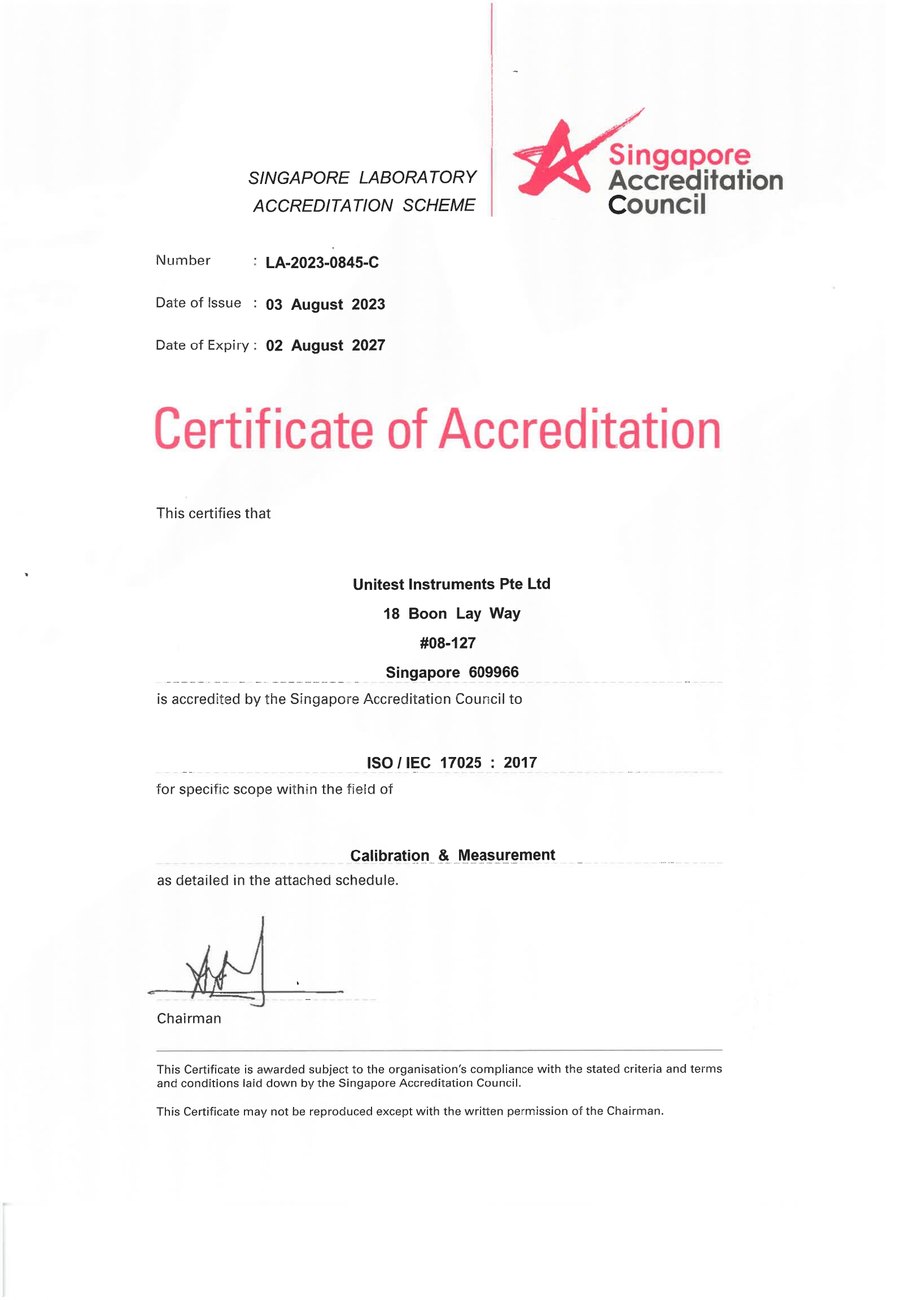
SAC-SINGLAS accredited calibration laboratory (Acc. No. LA-2023-0845-C) serving Singapore's industrial, pharmaceutical, and manufacturing sectors. All content reflects our ISO/IEC 17025 accredited scope and is reviewed by our technical calibration team.
Need humidity calibration in Singapore?
Unitest Instruments is SAC-SINGLAS accredited (Acc. No. LA-2023-0845-C) to ISO/IEC 17025. Same-week turnaround, certificates accepted by ISO 9001 auditors and Singapore regulatory bodies including HSA and SFA.