
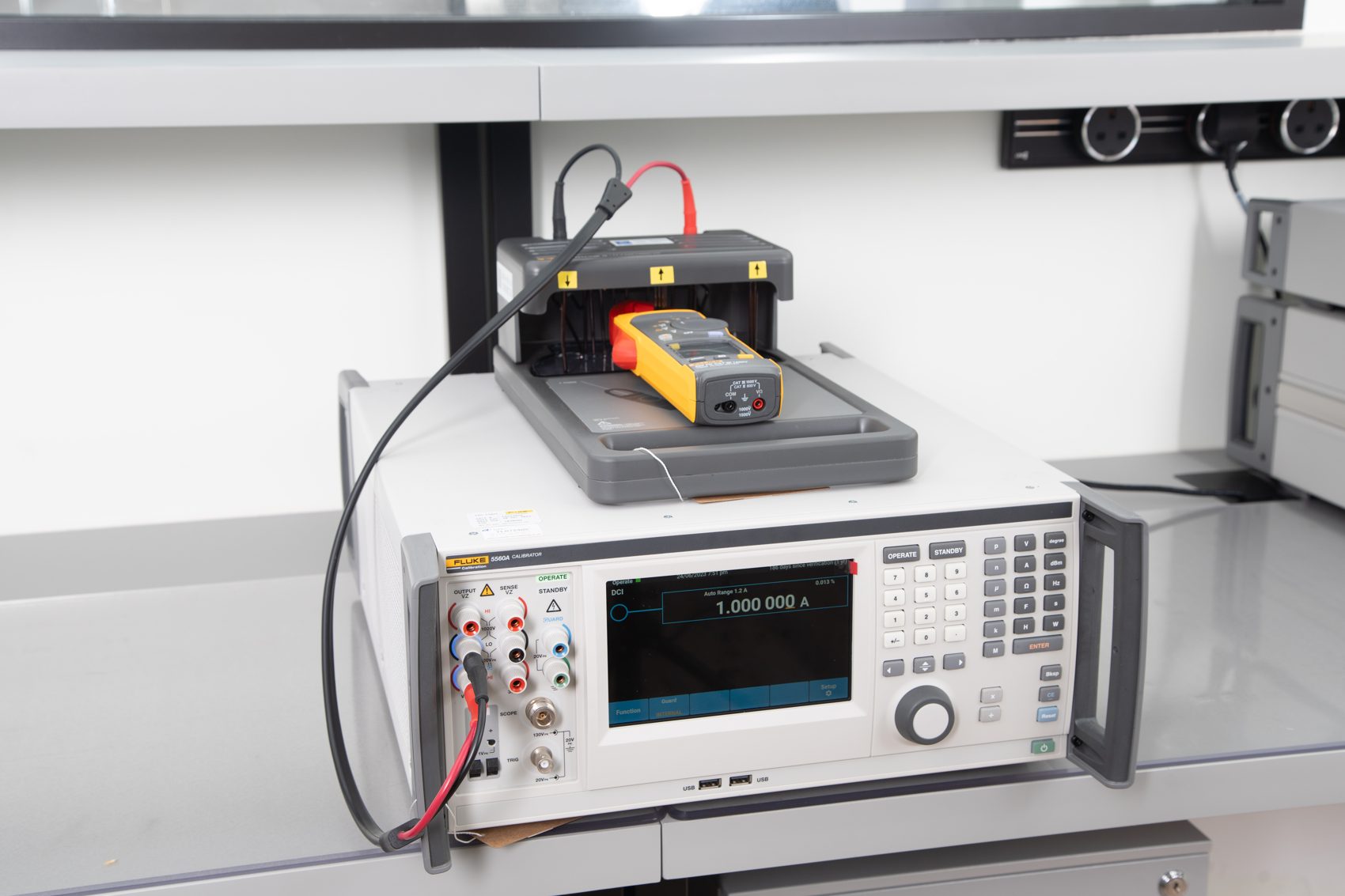
Key Takeaways
- The WSH Act (Cap. 354A) is the primary legal instrument. Employers must ensure portable appliances are safe so far as reasonably practicable.
- Test frequencies are risk-based: 3 months for site hand-held tools, 12 months for office Class I equipment, 24 months for double-insulated Class II items.
- PAT tests include visual inspection, earth continuity (≤0.1 Ω), insulation resistance (≥1 MΩ), and leakage current measurement.
- PAT testers are measuring instruments. They must be calibrated at 12-month intervals by a SAC-SINGLAS accredited laboratory to produce auditable records.
- Non-compliance penalties: up to S$500,000 fine and/or 12 months' imprisonment; MOM can also issue Stop-Work Orders immediately halting operations.
- Comprehensive records (appliance register, test sheets, and PAT tester calibration certificates), must be retained for at least five years.
The Legal Framework: Which Singapore Agencies Are Relevant?
Unlike the UK, where the IET Code of Practice for In-Service Inspection and Testing of Electrical Equipment provides a single consolidated reference, Singapore's PAT testing obligations derive from several overlapping instruments. Understanding which agency has jurisdiction over your workplace is the first step toward a defensible compliance programme.
Ministry of Manpower (MOM) is the central enforcer. The Workplace Safety and Health Act 2006 (Cap. 354A) and its subsidiary regulations (particularly the WSH (General Provisions) Regulations and the WSH (Construction) Regulations), require employers to maintain all plant, machinery, and equipment (including portable electrical appliances) in a safe condition. MOM's WSH Council publishes industry-specific codes of practice that operational sectors are expected to follow.
Energy Market Authority (EMA) regulates electrical installations and licensed electrical workers. The Electricity Act and the Code of Practice on Electrical Installations (SS 638:2018) govern how electrical systems (including the fixed wiring to which portable appliances are connected), must be installed, inspected, and maintained. SS 638 references IEC 60364 throughout and sets out inspection and testing requirements that apply to in-service equipment.
Building and Construction Authority (BCA) has jurisdiction over construction sites and temporary electrical supplies. The BCA's Code of Practice on Buildability includes provisions on temporary electrical installations, and MOM's WSH (Construction) Regulations impose tighter PAT intervals for tools used in the harsh construction environment.
For facilities in regulated sectors (hospitals (HSA), port areas (MPA), airports (CAAS), or petrochemical plants (MOM/NEA)), additional sector-specific codes may impose supplementary requirements. Facilities managers should audit all applicable codes before setting their PAT programme parameters.
What the Standards Require: Test Types and Pass/Fail Criteria
A complete PAT inspection in Singapore comprises two elements: a formal visual inspection and an instrument-based electrical test. Both elements must be completed and recorded for a test result to be considered valid by auditors and enforcement officers.
Visual Inspection
The visual inspection checks the plug (correct fuse rating, no cracked casing, no signs of arcing), the power cable (no cuts, kinks, or insulation damage, strain relief intact at both ends), the appliance body (no cracks or modifications that expose live parts), and the rating label (ensure the supply voltage and frequency match the Singapore 230 V / 50 Hz standard). Appliances that fail the visual check must be withdrawn from service immediately. No electrical test is required before withdrawal.
Electrical Tests
For Class I appliances (those relying on an earth connection for safety), the test sequence is:
- Earth continuity test: Resistance between the earth pin of the plug and any exposed metalwork on the appliance must be ≤0.1 Ω plus the resistance of the supply lead. A failed earth path means a shock risk if the insulation fails.
- Insulation resistance test: Applied at 500 V DC between live conductors (L+N joined) and earth. Result must be ≥1 MΩ. Values below 1 MΩ indicate deteriorating insulation, moisture ingress, or a damaged component.
- Protective conductor current (leakage) test: Measures current flowing through the earth conductor during normal operation. Typical limits are 3.5 mA for hand-held Class I appliances and 0.75 mA per kW of rated power (not exceeding 5 mA) for stationary Class I appliances.
For Class II (double-insulated) appliances, the earth continuity test is not applicable. The insulation resistance test is applied at 500 V DC between live conductors and any accessible conductive part, with a pass threshold of ≥2 MΩ to reflect the more demanding double-insulation requirement. A substitute leakage test is also appropriate for Class II items.
| Test | Class I Equipment | Class II Equipment | Instrument Required |
|---|---|---|---|
| Visual Inspection | Required. All items | Required. All items | Eyesight; good lighting |
| Earth Continuity | ≤0.1 Ω + lead resistance | Not applicable | Calibrated PAT tester / low-resistance ohmmeter |
| Insulation Resistance | ≥1 MΩ at 500 V DC | ≥2 MΩ at 500 V DC | Calibrated insulation resistance tester |
| Leakage / Protective Conductor Current | ≤3.5 mA (hand-held); ≤5 mA (stationary) | ≤0.25 mA (touch current) | Calibrated PAT tester with leakage function |
| Functional Check | Required | Required | Operational test. Confirm normal function |
Recommended Test Intervals for Singapore Workplaces
Singapore regulators do not prescribe universal fixed intervals, which is a deliberate design choice. A risk-based approach is more appropriate than a one-size-fits-all schedule. However, the following intervals are widely accepted by MOM auditors, ISO 9001 certification bodies, and the engineering community, and they form the defensible baseline for any PAT programme.
| Equipment Category | Environment | Recommended Interval |
|---|---|---|
| Class I hand-held tools (drills, grinders, heat guns) | Construction / outdoor / wet | 3 months |
| Class I movable equipment (fans, floor polishers, extension leads) | Industrial / warehouse | 6 months |
| Class I portable appliances (computers, monitors, desk lamps) | Office / retail | 12 months |
| Class II double-insulated tools | Construction / outdoor | 6 months |
| Class II double-insulated appliances | Office / retail | 24 months |
| Medical portable appliances | Healthcare | As per IEC 62353 and HSA requirements. Typically 6–12 months |
These intervals assume moderate use. If an appliance is used more intensively, operated in an unusually harsh environment (high humidity, chemical exposure, vibration), or has a history of faults, the interval should be shortened. Document the rationale for every deviation from the baseline. This is what demonstrates due diligence to MOM if an incident occurs.
Need your PAT testers calibrated to Singapore's NMC traceability standard?
Unitest Instruments calibrates insulation resistance testers, earth continuity testers, and combined PAT testers with full SAC-SINGLAS accredited certificates. Accepted by MOM auditors and ISO 9001 certification bodies.
Calibration Requirements for PAT Testing Instruments
This is the most frequently overlooked element of a PAT programme, and the one most likely to invalidate your records in a MOM investigation. A PAT tester is a measuring instrument. Its readings (earth resistance in ohms, insulation resistance in megaohms, leakage current in milliamps), are only meaningful if the instrument itself is calibrated and its measurement uncertainty is known.
In Singapore, calibration must be traceable to the National Metrology Centre (NMC), which maintains Singapore's national measurement standards. Traceability is established through an unbroken chain of calibrations, each with documented measurement uncertainty, linking your PAT tester to the NMC's reference standards. The most reliable way to obtain NMC-traceable calibration is through a laboratory accredited by the Singapore Accreditation Council (SAC) under its SINGLAS programme. Specifically, a laboratory with ISO/IEC 17025 accreditation covering the relevant measurement parameters.
As explained in our guide on what traceability in calibration means, an unaccredited calibration certificate (even one that claims traceability), does not provide the independent technical assurance that accredited calibration delivers. ISO 9001 auditors and MOM enforcement officers are increasingly aware of this distinction and will scrutinise whether the calibration certificate was issued by an accredited laboratory.
For most PAT testers used in standard commercial and industrial environments, an annual calibration interval is appropriate. Instruments used in high-frequency testing programmes, or exposed to physical shocks and harsh conditions, should be calibrated more frequently. Every six months is defensible for high-use instruments. When a PAT tester is dropped, repaired, or gives anomalous readings, it must be removed from service and calibrated before further use.
What Parameters Need Calibration?
A complete calibration of a PAT tester covers the measurement ranges used in practice: earth bond resistance (typically 0.01 Ω to 1.99 Ω), insulation resistance (0.01 MΩ to 999 MΩ at 250 V and 500 V DC), and leakage current (typically 0.01 mA to 20 mA). Some PAT testers also include a loop impedance or RCD test function. If these are used, they must also be within their calibration scope. Confirm with your calibration provider that the certificate covers all the measurement functions you actually use, not just the most common parameters.
For a deeper understanding of what a valid calibration certificate must contain (including the required measurement uncertainty statement), see our article on how to read a calibration certificate.
Step-by-Step Compliance Process for Facilities Managers
Establishing a PAT programme from scratch (or formalising an existing informal practice), follows a logical sequence. Each step produces a document or record that builds toward a complete, auditable compliance file.
- Conduct an asset inventory. Walk every area of your facility and list every portable electrical appliance: item description, serial number, location, class (I or II), rated power, and the environment in which it operates. This becomes your appliance register.
- Perform a risk assessment for each category. Use the table above as a starting point and adjust based on your specific operating conditions. Document the assessment in writing, signed by the responsible person.
- Set test intervals and assign responsibility. Define who will carry out testing (in-house technician or contracted party), what equipment they will use, and when each appliance category is due. Enter due dates into your CMMS or a spreadsheet register.
- Verify that your test instruments are calibrated. Before conducting any testing, confirm that your PAT tester has a current SAC-SINGLAS accredited calibration certificate. If not, send it for calibration first. Testing with an uncalibrated instrument produces records that cannot be defended.
- Conduct tests and record results. For each appliance: complete the visual inspection, run the applicable electrical tests, record measured values (not just pass/fail), and affix a dated pass label (or remove the appliance from service with a "FAILED, do NOT USE" label).
- Manage failed appliances. Failed items must be removed from service immediately, tagged clearly, and either repaired and re-tested or disposed of. Record the outcome in your appliance register.
- Retain records for at least five years. Keep the appliance register, individual test records, and PAT tester calibration certificates in a secure, retrievable format. Electronic records are acceptable provided they are backed up.
- Review the programme annually. Reassess risk assessments when the nature of work changes, new equipment is introduced, or after any electrical incident.
Penalties for Non-Compliance
The consequences of a poorly managed (or entirely absent), PAT programme are severe. Under the Workplace Safety and Health Act, MOM enforcement officers have wide powers of investigation and prosecution.
For an employer who fails to ensure, so far as reasonably practicable, that the workplace and work equipment are safe, the penalties on conviction include a fine of up to S$500,000 and/or up to 12 months' imprisonment for a first offence. Repeat offenders face doubled penalties. Where a fatality or serious injury results, the prosecution will also consider whether a charge of criminal negligence is appropriate under the Penal Code, carrying significantly higher penalties.
Beyond criminal prosecution, MOM can issue a Stop-Work Order (SWO) (an immediate, on-the-spot directive to cease operations), if an inspector identifies an imminent electrical risk. An SWO can halt an entire facility or construction site, causing commercially catastrophic disruption. The cost of a single day of lost production on a major site routinely exceeds the entire cost of a multi-year PAT compliance programme.
Insurance implications are equally significant. Most commercial and industrial property and liability insurers in Singapore will scrutinise maintenance records following an electrical fire or shock incident. A policy condition requiring "proper maintenance" of equipment is standard, and an insurer that can demonstrate the equipment was not inspected per a recognised standard may successfully deny a claim, leaving the business to bear losses uninsured.
Sector-Specific Considerations
While the WSH Act framework applies to all workplaces, several sectors have additional or more prescriptive requirements that facilities managers must layer on top of the baseline PAT programme.
Healthcare and Medical Facilities (HSA)
Portable medical electrical equipment is subject to IEC 62353 (Recurrent test and test after repair of medical electrical equipment) in addition to general PAT requirements. The permissible leakage current limits are significantly tighter in healthcare settings (typically 100 µA patient auxiliary current for patient-connected equipment), reflecting the direct patient-contact risk. HSA-licensed facilities will have these requirements reviewed during inspections.
Construction Sites (BCA / MOM)
The WSH (Construction) Regulations impose the most demanding intervals for site tools. Hand-held Class I power tools must be inspected before use and formally tested at least every three months. The site safety officer is responsible for maintaining the test register, and WSH inspectors will request it during site visits. Extension leads and residual current devices (RCDs) used on site must also be tested. RCDs require a monthly trip-test at minimum.
Ports and Marine Facilities (MPA)
The Maritime and Port Authority of Singapore (MPA) Port Marine Safety Code references electrical safety requirements for equipment used in port operations. Portable electrical equipment used in classified hazardous zones (zone 1 or zone 2) must be appropriately rated (Ex-rated) and subject to periodic inspection per IEC 60079-17, in addition to standard PAT requirements.
Frequently Asked Questions
PAT testing is not mandated by a single dedicated statute, but it is effectively required under the Workplace Safety and Health Act (Cap. 354A) administered by MOM. Under the WSH Act, employers must ensure, so far as reasonably practicable, that all plant and equipment (including portable electrical appliances), are safe and without risk to health. Failing to maintain or inspect portable appliances exposes employers to enforcement action, fines, and prosecution if an incident occurs. Additionally, the Code of Practice on Electrical Installations (SS 638) and relevant SS IEC standards set out inspection and testing requirements that regulators and auditors reference.
The Ministry of Manpower (MOM) is the primary enforcement body for PAT testing in workplaces under the Workplace Safety and Health Act. The Energy Market Authority (EMA) oversees electrical installation safety and licensing of electrical workers. The Building and Construction Authority (BCA) is relevant for construction sites. The Singapore Civil Defence Force (SCDF) may also be involved if an electrical fault causes a fire. In healthcare settings, HSA may review maintenance records for medical portable appliances.
Singapore does not prescribe universal fixed intervals by law. The recommended frequency follows a risk-based approach aligned with SS 638 and IEC 60364 guidance. As a practical benchmark: Class I hand-held tools used on construction sites should be tested every 3 months; Class I portable appliances in offices every 12 months; Class II double-insulated equipment every 24 months. Higher-risk environments (wet areas, outdoor, healthcare) warrant shorter intervals. Your risk assessment, documented in writing, determines the defensible interval.
A full PAT test typically comprises: (1) a visual inspection of the plug, cable, casing, and label; (2) an earth continuity test (≤0.1 Ω for Class I equipment); (3) an insulation resistance test (≥1 MΩ at 500 V DC for most appliances); (4) a protective conductor current test or substitute/touch current test where applicable; and (5) a functional check to confirm normal operation. Some testers also perform a flash/dielectric strength test, though this is less commonly applied to in-service appliances.
Under the Workplace Safety and Health Act, an employer who fails to ensure the safety of plant and equipment may face a fine of up to S$500,000 and/or up to 12 months' imprisonment for a first offence. If a fatality occurs, penalties increase significantly. MOM can also issue Stop-Work Orders, which immediately halt operations and can be commercially devastating. Beyond legal penalties, insurers may void liability cover if an incident results from equipment that had not been inspected in line with a documented maintenance programme.
Yes. A PAT tester is a measuring instrument, and the measurements it produces (earth resistance in ohms, insulation resistance in megaohms, leakage current in milliamps) are only reliable if the instrument is calibrated. In Singapore, calibration should be traceable to the National Metrology Centre (NMC) via an SAC-SINGLAS accredited laboratory. ISO 9001 auditors and MOM enforcement officers will ask for calibration certificates for the PAT tester. A calibration interval of 12 months is standard; high-use instruments may need more frequent calibration.
Singapore does not currently mandate a specific PAT testing licence equivalent to the UK's, but the WSH Act requires that work involving electrical equipment be carried out by a competent person. Someone with the knowledge, training, and experience to identify hazards and take corrective action. For installation-level electrical work, a licensed electrical worker (LEW) registered with EMA is required. For portable appliance testing, competence is typically demonstrated through relevant training, documented procedures, and use of calibrated test equipment. Many organisations engage accredited contractors or trained in-house technicians.
Organisations should retain: (1) a register of all portable appliances tested (asset ID, description, location, test date, next due date); (2) individual test records showing measured values and pass/fail outcome for each appliance; (3) calibration certificates for the PAT tester used; and (4) re-test or withdrawal records for failed appliances. MOM WSH regulations do not specify a minimum retention period for equipment records, but best practice (and most ISO 9001 audit requirements), is to keep records for at least five years or the life of the asset.
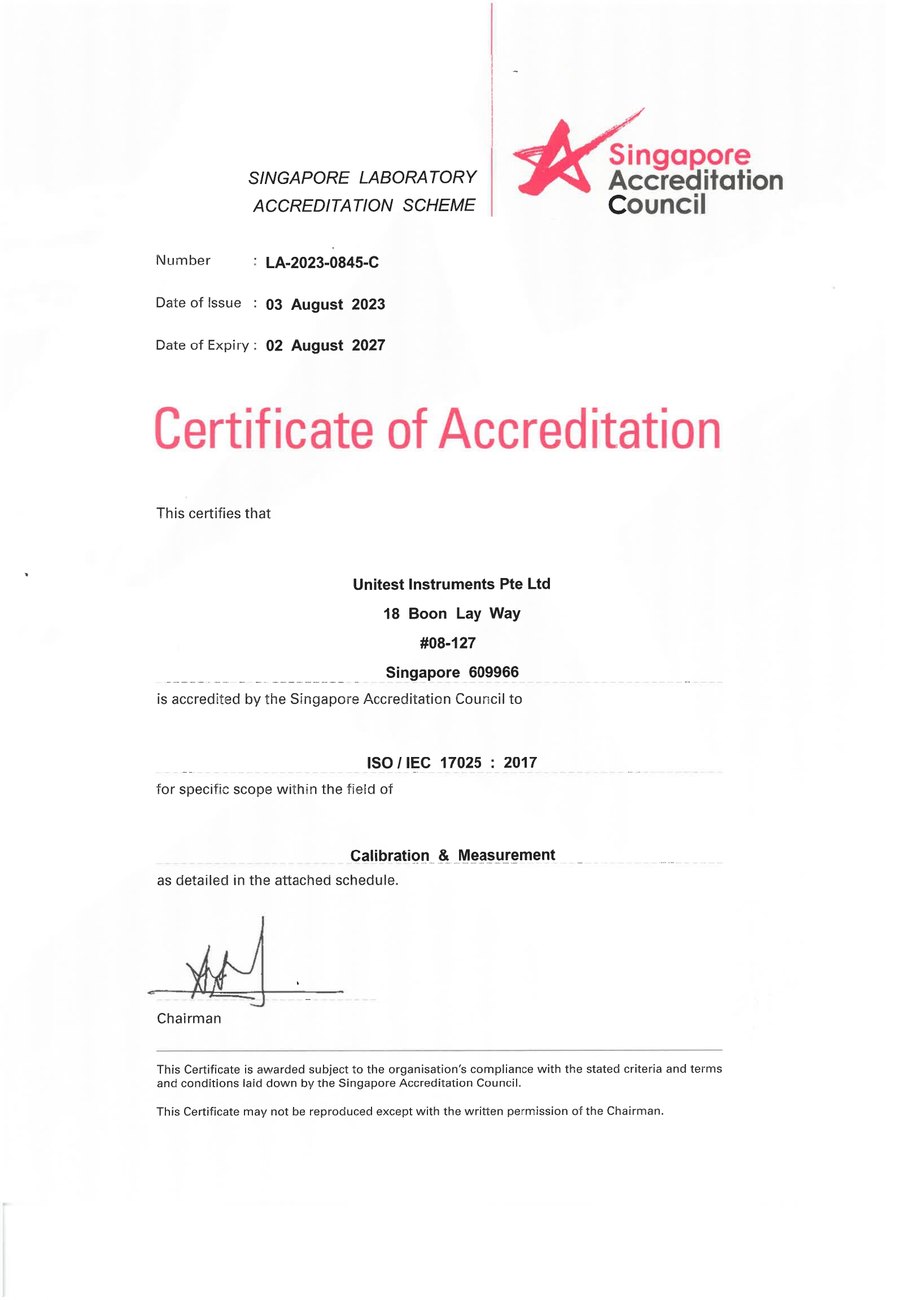
SAC-SINGLAS accredited calibration laboratory (Acc. No. LA-2023-0845-C) serving Singapore's industrial, pharmaceutical, and manufacturing sectors. All content reflects our ISO/IEC 17025 accredited scope and is reviewed by our technical calibration team.
Need PAT tester calibration in Singapore?
Unitest Instruments is SAC-SINGLAS accredited (Acc. No. LA-2023-0845-C) to ISO/IEC 17025. We calibrate PAT testers, insulation resistance testers, and earth bond testers with full NMC-traceable certificates, same-week turnaround available.