
Key Takeaways
- Candela (cd) is an SI base unit measuring luminous intensity, direction-specific brightness from a source. It is defined relative to a source emitting monochromatic radiation at 540 × 10¹² Hz with a radiant intensity of 1/683 W/sr.
- Lumen (lm) is the SI unit of luminous flux. The total light power emitted by a source weighted by V(λ), the CIE photopic luminosity function. One lumen equals one candela·steradian (cd·sr).
- Lux (lx) measures illuminance. Lux = lumens per square metre. Lux is distance-dependent; doubling the distance from a point source reduces illuminance to one quarter (inverse-square law).
- Singapore's SS 531: Part 1 (aligned with ISO 8995-1) mandates minimum maintained illuminance levels in lux for workplaces; general office work requires 500 lx at desk level.
- Lux meters must be calibrated against a traceable reference to state valid measurements for compliance. Calibration to ISO/IEC 17025 by an SAC-SINGLAS accredited lab is the recognised standard in Singapore.
The Three Photometric Units: Definitions and Physical Basis
Photometry is the science of measuring light as perceived by the human visual system, as opposed to radiometry, which measures raw electromagnetic energy regardless of human sensitivity. All photometric quantities are derived by weighting radiometric quantities with V(λ), the CIE 1931 photopic luminosity function, which quantifies the relative sensitivity of the average human eye at each wavelength of visible light from approximately 360 nm to 780 nm. V(λ) peaks at 555 nm (yellow-green) with a value of 1.0, dropping steeply toward blue and red wavelengths.
The candela (cd) is one of the seven SI base units. Its current definition, adopted in 1979 and reaffirmed in the 2019 SI revision, states: the candela is the luminous intensity, in a given direction, of a source that emits monochromatic radiation of frequency 540 × 10¹² Hz (≈ 555 nm, the peak of V(λ)) and has a radiant intensity in that direction of exactly 1/683 watts per steradian. This ties the candela to an absolute physical quantity (the watt), via the defined luminous efficacy of 683 lm/W at 555 nm.
The lumen (lm) is the SI derived unit of luminous flux. It quantifies the total amount of visible light emitted by a source per unit time, integrated over the full sphere and weighted by V(λ). Mathematically: 1 lm = 1 cd·sr (candela multiplied by steradian). A source emitting 1 cd uniformly in all directions produces 4π ≈ 12.57 lumens. LED product specifications always state lumens because it expresses the useful light output regardless of the fixture's beam angle or optics.
The lux (lx) is the SI derived unit of illuminance. The luminous flux incident per unit area of a surface. The definition is: 1 lx = 1 lm/m². Lux is the quantity measured by a lux meter (also called an illuminance meter or photometer) placed on a surface. It is inherently distance-dependent: as a fixed-lumen source moves further from a surface, the flux spreads over more area and lux falls. This relationship follows the inverse-square law: E = I / d², where E is illuminance in lux, I is luminous intensity in candela, and d is distance in metres.
Underlying Physics: The Inverse-Square Law and Solid Angle Geometry
Understanding the geometry of light propagation is essential for correctly applying these units. A point source radiates light in all directions. If the source has a luminous intensity of I candela in a particular direction, then the illuminance E at a perpendicular surface at distance d is given by E = I / d². At 1 m, a 100 cd source produces 100 lux. At 2 m, it produces 25 lux. At 4 m, just 6.25 lux. This is why specifying "lumens" alone tells you nothing about how bright a surface will be. The geometry matters as much as the source output.
Real luminaires are not perfect point sources, and their candela values vary with direction. A photometric report from an integrating sphere or goniophotometer expresses this as a luminous intensity distribution curve (LIDC) or a set of candela values in a standardised format (IES LM-63 or EULUMDAT). Lighting design software (DIALux, AGi32, Relux) uses the LIDC to calculate lux levels on room surfaces by summing contributions from all solid angles, including reflections modelled by radiosity or ray-tracing algorithms.
The cosine law of illuminance adds another dimension: if the light strikes a surface at an angle θ from the normal, the effective illuminance is E_incident × cos(θ). This is why lux meters include a cosine-corrected diffuser. A translucent hemispherical dome over the photosensor that mimics the cosine response. A poorly cosine-corrected meter will read high for oblique light incidence, which is a significant source of measurement error in real-world surveys.
Solid Angle and the Steradian
The steradian (sr) is the SI unit of solid angle. The three-dimensional equivalent of a radian. A full sphere subtends 4π steradians (≈ 12.566 sr). The relationship between candela and lumens passes through the steradian: luminous flux in lumens equals luminous intensity in candela multiplied by the solid angle in steradians over which it is emitted. For a narrow-beam LED spotlight of 1000 cd with a 10° half-angle beam, the solid angle is approximately 0.024 sr, giving a total flux of roughly 24 lm. Even though it appears brilliantly bright in its beam direction.
Measurement Methods: How Each Quantity Is Measured
Each photometric quantity requires a distinct measurement approach. Selecting the wrong instrument or technique for a given application is one of the most common errors in field photometry.
Measuring Candela: Goniophotometry
Luminous intensity (candela) is measured by a goniophotometer. An instrument that rotates either the light source or a photometric detector through defined angular positions, recording the luminous intensity distribution in all directions. Two types exist: Type A (rotating luminaire, fixed detector) and Type B (rotating mirror, fixed luminaire). Goniophotometry is performed in near-dark, thermally controlled rooms on optical benches long enough to approximate a point-source condition (typically 10× the largest dimension of the luminaire). The governing standard is CIE 121 (The Photometry and Goniophotometry of Luminaires) and IES LM-75 for LED luminaires.
Measuring Lumens: Integrating Sphere
Total luminous flux (lumens) is most efficiently measured using an integrating sphere (also called an Ulbricht sphere). The interior is coated with a near-Lambertian white diffusing paint (historically barium sulphate, increasingly PTFE-based coatings), and a photometer at a port samples the uniform scattered light level, which is proportional to the total flux entering the sphere. A correction factor accounts for the absorption of the port and auxiliary lamp. The governing standards include CIE 84 (The Measurement of Luminous Flux) and IES LM-79 specifically for LED products. For very small or very large sources, absolute or relative sphere methods are used.
Measuring Lux: Illuminance Meters
Illuminance (lux) is measured with a lux meter. A calibrated photosensor (typically a silicon photodiode with a colour-corrected filter) equipped with a cosine-corrected diffuser, connected to a readout unit. Key performance parameters of a lux meter include: f₁' (spectral mismatch error relative to V(λ)), f₂ (cosine response error), f₃ (fatigue), f₄ (non-linearity), f₅ (UV response), and f₆ (IR response). These are defined in CIE 069 and ISO/CIE 19476. Class L (reference), Class A, Class B, and Class C lux meters are defined by their allowable error limits in each parameter.
| Quantity | Unit | Symbol | What It Measures | Instrument | Key Standard |
|---|---|---|---|---|---|
| Luminous Intensity | Candela | cd | Power per solid angle in a given direction | Goniophotometer | CIE 121, IES LM-75 |
| Luminous Flux | Lumen | lm | Total visible light output (all directions) | Integrating sphere | CIE 084, IES LM-79 |
| Illuminance | Lux | lx | Luminous flux per unit area on a surface | Lux meter / illuminance meter | ISO/CIE 19476, CIE 069 |
| Luminance | Candela per m² | cd/m² | Intensity per unit projected area (perceived brightness) | Luminance meter / camera photometer | CIE 069, BS EN 14255 |
Note the fourth photometric quantity in the table (luminance (cd/m²)), which describes the perceived brightness of a surface or source as seen from a viewing direction. Display manufacturers specify luminance (often called "nits" in consumer contexts) for screens, and it is critical in glare analysis. It is measured with a spot luminance meter or an imaging photometer. While not the primary focus of this article, luminance is the quantity most directly linked to visual comfort and discomfort glare.
Need your lux meters or photometric instruments calibrated in Singapore?
Unitest Instruments (Acc. No. LA-2023-0845-C) calibrates illuminance meters, lux meters, and photometric reference standards traceable to NMC Singapore. Certificates accepted by ISO 9001 and SS 531 compliance auditors.
Calibration Implications: Why Traceability Matters for Photometric Instruments
A lux meter reading means nothing for compliance purposes unless it can be traced to a national or international measurement standard through an unbroken chain of comparisons, each with stated measurement uncertainty. In Singapore, this chain runs from the National Metrology Centre (NMC) at A*STAR, which maintains Singapore's photometric primary standards and is a signatory to the CIPM MRA (Comité International des Poids et Mesures Mutual Recognition Arrangement). Through SAC-SINGLAS accredited calibration laboratories such as Unitest Instruments, and finally to the end-user instrument.
During calibration of a lux meter, the laboratory sets up a photometric bench with a standard lamp operating at a defined colour temperature (typically CIE Standard Illuminant A, 2856 K, produced by a calibrated tungsten-filament lamp at a specified current). The reference illuminance at the measurement point is calculated from the lamp's calibrated candela value and the measured distance using E = I / d². The meter under calibration is placed at that point and its reading compared with the reference. Corrections are applied for the spectral mismatch between the meter's sensor and V(λ), quantified as f₁'. The laboratory then issues a calibration certificate stating the correction factor (or as-found/as-left readings) and the expanded measurement uncertainty at k = 2 (approximately 95% confidence level).
As explained in our article on how to read a calibration certificate, the measurement uncertainty value on the certificate is not a pass/fail figure. It is a statement of how well the calibrated value is known. Users must ensure the measurement uncertainty is fit for purpose: if a workplace lux requirement is 500 lx and the meter has an uncertainty of ±15%, measurements between 575 and 425 lx could be indeterminate. A tighter-uncertainty instrument or a Class A meter (f₁' ≤ 3%) is recommended for borderline compliance situations.
For LED lighting (which has a very different spectral power distribution from the 2856 K calibration source), spectral mismatch becomes a critical concern. An LED with a strong blue spike (around 450 nm) will cause a Class C lux meter (f₁' ≤ 9%) to read up to 10–15% in error compared to a spectroradiometer-based measurement. The emerging standard for LED photometry, CIE S 025 / IEC TR 63158, recommends using Class A or Class L meters and applying source spectral mismatch corrections where possible. Singapore's NEA Energy Label testing for luminaires requires lumen measurements in accredited laboratories, partly for this reason.
Singapore Regulatory Context: Where These Units Appear in Law and Standards
Singapore references photometric units extensively across building, workplace, and energy regulations. Understanding which authority uses which unit (and why), is essential for compliance teams, M&E engineers, and QA managers.
SS 531: Code of Practice for Lighting of Work Places
Singapore Standard SS 531: Part 1 (Indoor) and Part 2 (Outdoor) set maintained illuminance (Em) requirements in lux for every work-plane category. "Maintained" means the average lux value over the design life of the installation, accounting for lamp lumen depreciation and luminaire dirt accumulation. Typical maintained illuminance values from SS 531: Part 1 include: entrance halls and reception (200 lx), general office (500 lx), drawing offices (750 lx), inspection of fine detail (1000 lx), and colour-critical inspection (up to 2000 lx with Ra ≥ 90 for the light source). The standard also specifies uniformity ratio (Uo) (minimum illuminance divided by average illuminance), to prevent dark patches.
Green Mark and BCA Requirements
Singapore's Building and Construction Authority (BCA) Green Mark scheme and the Code on Envelope Thermal Performance (RETV) reference lux levels and lighting power density (W/m²) as twin metrics. A building must achieve minimum maintained lux levels (from SS 531) while not exceeding maximum lighting power density thresholds, pushing designers toward high-efficacy (high lm/W) LED sources. Verification during commissioning requires lux measurements with calibrated instruments.
NEA Mandatory Energy Labelling Scheme (MELS)
The National Environment Agency (NEA) requires lumen output and wattage data from accredited test laboratories as part of the Mandatory Energy Labelling Scheme for lamps and luminaires sold in Singapore. Luminous efficacy (lm/W) drives the number of ticks on the label. Test reports must originate from laboratories accredited to IES LM-79 (for LED products) or equivalent, and lumen measurements must be traceable to national standards.
Workplace Safety and Health (WSH) Act
The WSH Act and its subsidiary regulations (including the Factories [Workplace Safety and Health] Regulations) empower the Ministry of Manpower (MOM) to enforce adequate workplace lighting. While the act itself does not specify lux values, MOM's guidelines reference SS 531, and workplace safety inspectors may require demonstrated lux compliance via calibrated measurements and records.
Common Mistakes: What Engineers and Facilities Teams Get Wrong
Despite their apparent simplicity, lux and lumens are routinely misapplied in practice. Here are the most consequential errors encountered in Singapore industrial and commercial settings.
Specifying Lumens Instead of Lux for a Space
The single most common mistake is selecting a replacement LED lamp based on its lumen rating without considering the luminaire's geometry, beam angle, room dimensions, or reflectances. A 1000 lm downlight in a 3 m-high office ceiling may produce 450 lx on the desk directly below but only 180 lx at the perimeter. Potentially below the SS 531 requirement of 500 lx for office work. Lighting design requires lux calculations (or measurements), not lumen comparisons alone.
Using Uncalibrated or Poorly Matched Lux Meters for LED Lighting
Many facilities teams use ageing Class C lux meters originally calibrated for fluorescent or incandescent lighting. LED sources have a fundamentally different spectral power distribution, and a meter with poor f₁' (spectral mismatch) can read 10–20% in error for cool-white LEDs with a pronounced blue peak. For regulatory compliance surveys, a Class A meter (f₁' ≤ 3%) calibrated against a traceable reference is strongly recommended. As our article on accredited vs non-accredited calibration explains, using a non-accredited calibration certificate provides no defensible traceability chain for audits.
Ignoring the Cosine Response of the Meter
Holding a lux meter at an angle to a surface (or placing it on an angled desk), introduces cosine error. The diffuser dome must face the dominant light source perpendicularly, or the measurement must be made horizontally at the working plane height for horizontal illuminance measurements. Measuring with the meter tilted 30° introduces a cosine error of approximately 13%. Enough to fail a borderline workplace compliance measurement.
Confusing Lux with Luminance
Lux measures light arriving at a surface (illuminance); luminance (cd/m²) measures the light leaving a surface as seen by an observer. A white wall and a black wall under identical illuminance will have very different luminances. Glare, display visibility, and visual comfort are functions of luminance, not lux. Safety signage legibility requirements, for example, specify minimum luminance contrast ratios rather than illuminance levels.
Not Accounting for Maintained vs Initial Illuminance
SS 531 specifies maintained illuminance. The average lux at end of the maintenance cycle, after lamp depreciation and dirt accumulation. A new installation measured at 600 lx may drop to 450 lx (below the 500 lx requirement) after 12 months without cleaning and lamp replacement. A maintenance factor (MF) should be applied during design: MF = LLMF × LSF × LMF × RSMF, where LLMF is the lamp lumen maintenance factor, LSF is the lamp survival factor, LMF is the luminaire maintenance factor, and RSMF is the room surface maintenance factor. Failing to incorporate MF means the installation is non-compliant before the end of its design life.
Frequently Asked Questions
Candela (cd) is the SI base unit of luminous intensity (the power of light emitted per unit solid angle in a specific direction. Lumen (lm) is the SI unit of luminous flux), the total quantity of visible light emitted by a source in all directions, weighted by the human eye's sensitivity curve V(λ). Lux (lx) is the SI unit of illuminance. The luminous flux received per square metre of surface (1 lx = 1 lm/m²). Think of it this way: a lamp has a candela rating (how bright it is in one direction), a lumen rating (how much total light it produces), and the surfaces it illuminates are measured in lux.
Lux measures illuminance. The density of luminous flux falling on a surface. As distance from the light source increases, the same flux spreads over a larger area, so the lux value drops. This follows the inverse-square law: doubling the distance from a point source reduces illuminance to one quarter. Lumens describe total output from the source (distance-independent) and candela describes intensity in a given direction (also distance-independent). This is why office lighting standards specify lux levels at the work plane rather than lamp lumens.
In Singapore, workplace lighting requirements are governed by SS 531: Part 1 (Code of Practice for Lighting of Work Places. Indoor), which aligns with ISO 8995-1 and CIE S 008. Key maintained illuminance values include: general office work 500 lx, detailed drafting or inspection 750–1000 lx, corridors and stairways 100 lx, and precision assembly or fine inspection up to 2000 lx. The Workplace Safety and Health Act (WSH Act) and its subsidiary legislation also empower the Ministry of Manpower to enforce adequate lighting. Periodic lux meter calibration is essential to demonstrate compliance.
Lux meters are calibrated against a reference illuminance standard traceable to a national metrology institute. In Singapore, traceability runs through the National Metrology Centre (NMC) at A*STAR. Calibration typically uses a stabilised incandescent lamp of known colour temperature (usually CIE Standard Illuminant A, 2856 K) at a defined distance on a photometric bench. The meter's spectral responsivity, cosine (angular) response, and linearity are verified. The governing documentary standards are CIE 069, CIE 114, and ISO/CIE 19476. An accredited laboratory operating under ISO/IEC 17025 issues a calibration certificate with stated measurement uncertainty.
Luminous efficacy (measured in lm/W) expresses how efficiently a light source converts electrical power into visible light (lumens). A standard incandescent bulb produces roughly 10–15 lm/W. A high-quality LED can achieve 150–200 lm/W. Luminous efficacy is calculated by dividing the total luminous flux (lumens) by the consumed power (watts). It is a key metric for energy-labelling schemes such as Singapore's Mandatory Energy Labelling Scheme (MELS) administered by the National Environment Agency (NEA), which requires lumen output data from accredited test reports.
No. Smartphone camera sensors are not calibrated photometric instruments. Their spectral response, cosine response, and linearity are optimised for photography, not photometric measurement. Errors of 30–200% are typical. For regulatory compliance (workplace safety surveys, lighting acceptance testing, or product certification), a dedicated lux meter calibrated to ISO/IEC 17025 by an SAC-SINGLAS accredited laboratory is required. The calibration certificate must state traceability and expanded measurement uncertainty (typically expressed at k=2, 95% confidence).
V(λ) (the CIE 1931 photopic luminosity function), describes the relative sensitivity of the average human eye to different wavelengths of light under daylight-adapted (photopic) conditions. It peaks at 555 nm (yellow-green). All photometric quantities (lux, lumens, candela) are defined as radiometric quantities weighted by V(λ). This means a blue LED and a red LED of identical radiant power will produce different lumen and lux values because the eye is less sensitive to those wavelengths. Lux meters must have a spectral responsivity that closely matches V(λ); the degree of match is expressed as the f₁' index. A lower f₁' means better spectral accuracy.
Typical recalibration intervals for lux meters are 12 months for instruments used in compliance-critical measurements (workplace safety surveys, product testing, cleanroom verification). High-stability reference-grade instruments may extend to 24 months if historical calibration data demonstrates consistent performance. ISO/IEC 17025 and ISO 9001 quality systems require that measurement equipment used in scope be within its calibration interval. Singapore's WSH regulations and building code M&E acceptance testing implicitly require valid calibration certificates. See our guide on calibration intervals for a full decision framework.
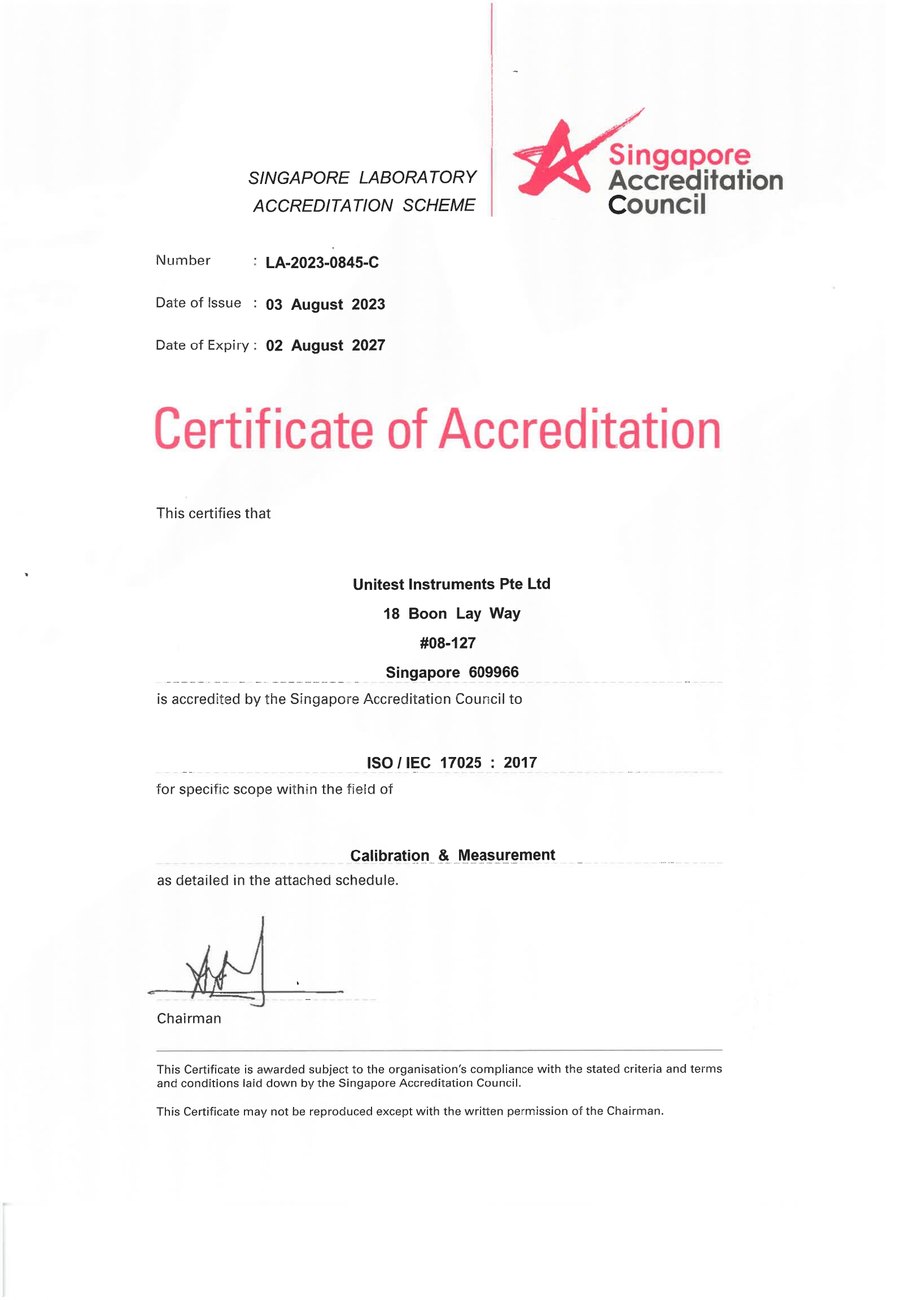
SAC-SINGLAS accredited calibration laboratory (Acc. No. LA-2023-0845-C) serving Singapore's industrial, pharmaceutical, and manufacturing sectors. All content reflects our ISO/IEC 17025 accredited scope and is reviewed by our technical calibration team.
Need photometric instrument calibration in Singapore?
Unitest Instruments is SAC-SINGLAS accredited (Acc. No. LA-2023-0845-C) to ISO/IEC 17025. Same-week turnaround, certificates accepted by ISO 9001 auditors, SS 531 compliance surveys, and NEA MELS test support.