
Key takeaways
- The Schedule of Accreditation is published at sac.gov.sg. Calibration outside this scope is not accredited even if the lab holds accreditation for other work.
- Best Measurement Capability (BMC) is the minimum achievable uncertainty under ideal conditions. Actual certificate uncertainty will always be equal to or greater than BMC.
- A lab may be accredited for "AC voltage" but not "AC current above 20A". Verify the specific measurand and range, not just the discipline heading.
- The scope is renewed on a ~4-year cycle with annual surveillance. Check the schedule is current at the time of calibration, not at the time of supplier qualification.
- When a lab calibrates outside its accredited scope, it must NOT display the SAC-SINGLAS logo on that certificate.
What the Schedule of Accreditation is, and where to find it
The Schedule of Accreditation is the definitive, publicly maintained document that specifies exactly what an ISO/IEC 17025 accredited laboratory is authorised to do under its accreditation. It is not a marketing brochure. It is a legal-grade technical document issued and maintained by the accreditation body (in Singapore's case, the Singapore Accreditation Council (SAC)), that has been technically verified before publication.
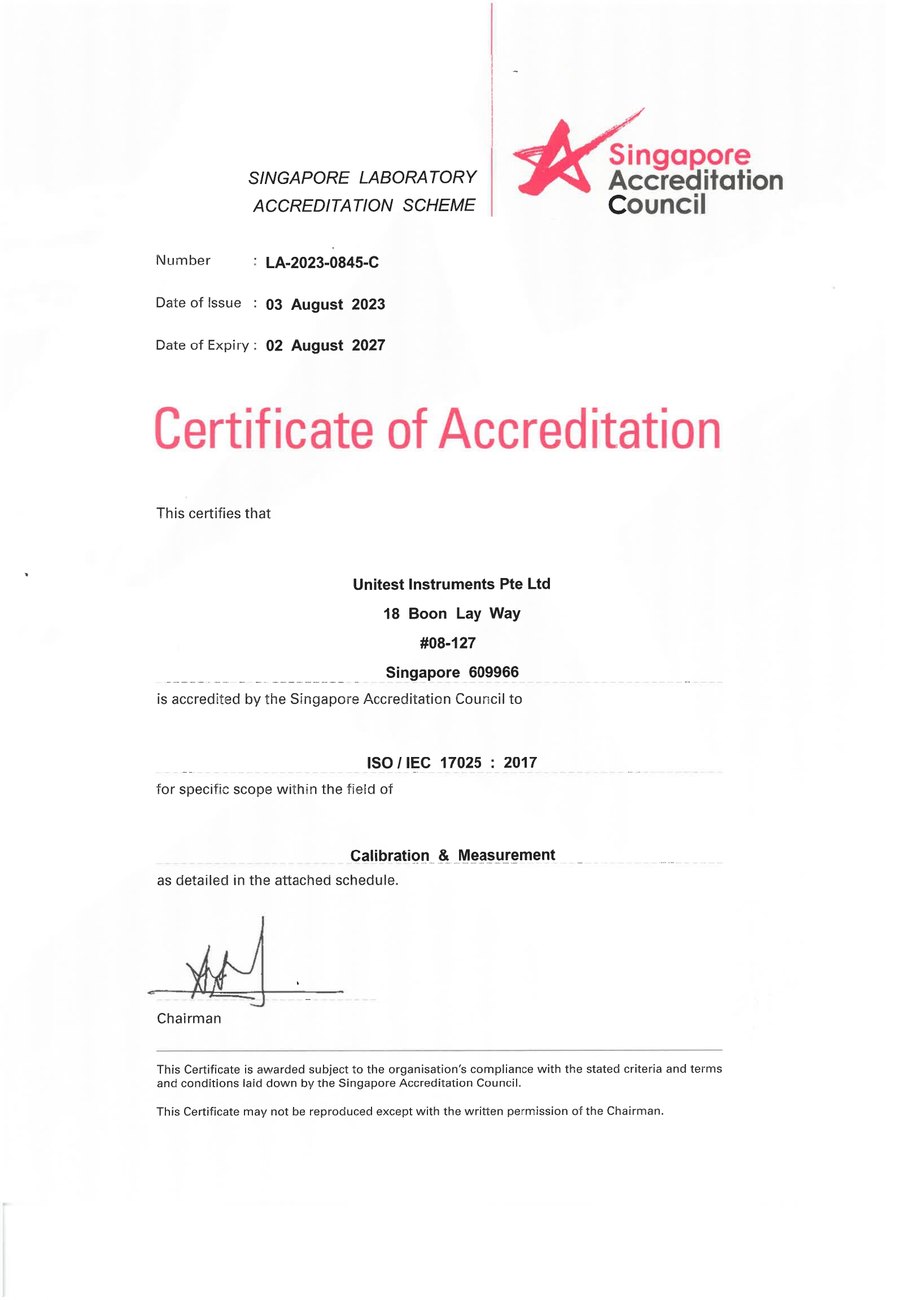
In Singapore, every SAC-SINGLAS accredited calibration laboratory has its schedule published on sac.gov.sg. To find it, navigate to the "Accredited Organisations" section, select "Laboratories," and search either by the laboratory name or its accreditation number. Singapore calibration laboratory accreditation numbers follow the format LA-YYYY-XXXX-C: "LA" denotes laboratory accreditation, the four-digit year indicates when the accreditation was first granted, the four-digit sequential number identifies the specific laboratory, and the trailing "C" denotes calibration (as opposed to "T" for testing). Unitest Instruments' accreditation number is LA-2023-0845-C.
The result of your search is a PDF schedule document. This is the authoritative source. Any version of the scope on a lab's own website, a supplier portal, or a qualification file is a copy, and copies go stale. For any compliance purpose, the live document from sac.gov.sg is the only version that matters. SAC updates the published schedule in real time when a scope change is approved; there is no lag between approval and publication.
Three levels of reading a scope, and why each level matters
Most procurement officers and quality engineers who check a lab's accreditation confirm only the first level. All three levels are required for reliable scope verification.
Level 1: Discipline
The discipline is the broadest grouping. Electrical, Temperature, Pressure, Dimensional, Torque, Humidity, and so on. Confirming the discipline is the starting point, not the finish line. A lab accredited under "Electrical" is not thereby accredited for "Temperature," even if it calibrates thermometers using electrical methods. The disciplines are mutually exclusive in the scope document, and an audit finding for using a certificate from the wrong discipline is one of the most common and most avoidable scope errors.
Level 2: Measurand
Within each discipline, the schedule lists specific measurands. The individual physical quantities being calibrated. "Electrical" breaks down into DC Voltage, AC Voltage, DC Current, AC Current, Resistance, Capacitance, Frequency, and others. Being accredited for DC Voltage does not cover AC Voltage, and being accredited for Resistance does not cover Capacitance, even though all are electrical quantities. This is the level where the most significant practical scope gaps occur. A lab may have a substantial electrical accreditation that covers ten measurands but not the one you need.
Consider a realistic scenario: a customer needs to calibrate a pressure transmitter at 350 bar and selects a lab whose accreditation covers pressure. The lab's scope lists Gauge Pressure with a range of 0 to 200 bar. The calibration at 350 bar is performed, and a certificate is issued with the SAC-SINGLAS logo. The customer uses the certificate to satisfy an ISO 9001 audit. The auditor pulls the scope document from sac.gov.sg, notes the 200 bar limit, and raises a major non-conformance. The certificate was never accredited. The lab violated accreditation conditions by using the SAC-SINGLAS mark. The customer must arrange a repeat calibration. All of this was avoidable by reading two rows of the schedule before submitting the instruments.
Level 3: Range
Even when the discipline and measurand are correct, the range must be explicitly checked. A schedule entry for "DC Voltage, 0 to 1000V" does not cover a 2000V measurement. A schedule entry for "RTD PT100, -200°C to +660°C" does not cover a PT100 used at +700°C. Range boundaries in accreditation schedules are hard limits, not guidelines. The technical competence assessment, the reference equipment, and the uncertainty budget were all verified specifically within the stated range. Outside it, the accreditation body has made no determination of the lab's competence.
Best Measurement Capability. What it is and why it matters
Best Measurement Capability (BMC) (sometimes called Calibration and Measurement Capability (CMC)), is the lowest expanded measurement uncertainty a laboratory can achieve for a specific measurand and range under its optimal, reference conditions. It is published in the schedule as a formula or value: for example, "U = 0.05°C, k=2" for a temperature measurand, meaning an expanded uncertainty of 0.05°C at approximately 95% confidence when k=2.
BMC is determined by the lab submitting a full uncertainty budget to SAC's technical assessors, who review it for completeness, correct methodology, and appropriate sources. The lab cannot simply claim a low BMC. The assessment process requires it to be substantiated through documented uncertainty components, cross-checked against reference equipment performance data, and validated against proficiency testing results where required.
BMC matters in two ways. First, it defines the performance floor: a customer who requires an uncertainty of less than 0.15% for a DC voltage calibration and finds the lab's BMC is 0.20% knows immediately that the lab cannot satisfy the requirement even under ideal conditions. No amount of repeat measurements or special handling can produce a result below the BMC. This is an engineering constraint, not a lab-specific limitation that can be negotiated away. Second, actual calibration certificates will always state an uncertainty equal to or larger than the BMC. The BMC is the best case; the certificate uncertainty is the real case, which includes additional contributions from the specific instrument under test, the ambient conditions on the day, and any measurement process factors beyond the lab's reference equipment chain.
When evaluating a lab for a measurement-critical application, compare your process tolerance or specification limit against the lab's BMC first, then request typical certificate uncertainty values for instruments similar to yours. Both numbers inform the decision.
How scope is assessed and maintained
A SAC-SINGLAS accreditation scope is not a one-time award. It is an ongoing status that requires active maintenance through a defined assessment cycle.
Initial accreditation. The lab applies to SAC, submits technical documentation for the requested scope, and undergoes an on-site technical assessment. Assessors examine reference equipment calibration records, witness calibrations for each requested measurand, review uncertainty budgets, check personnel competence records, and inspect environmental monitoring data. The scope granted at the end of this process is what appears in the first published schedule.
Annual surveillance. Each year, SAC conducts a surveillance assessment. Shorter than the initial assessment but substantive. Assessors check whether the lab continues to meet the technical requirements for its existing scope. New instruments must be calibrated; personnel changes must be documented; proficiency testing results are reviewed. Scope may be suspended or withdrawn during surveillance if non-conformances are found that the lab does not resolve within the required timeframe.
Four-year reassessment. Approximately every four years, the lab undergoes a full reassessment equivalent in depth to the initial accreditation. The entire scope is reviewed, not just changes since the last cycle. This is the mechanism by which the published schedule is comprehensively revalidated.
Scope changes. The scope can change at any time, in either direction. Additions occur when a lab develops capability for a new measurand or range, completes the required technical work, and receives SAC's assessment approval. Reductions occur when a lab retires equipment, loses a qualified person, or when SAC finds during surveillance that a portion of the scope no longer meets requirements. This makes the currency of the schedule important: a scope that was valid when you performed supplier qualification may have changed by the time the next calibration is due. Always download the current schedule from sac.gov.sg at the time of each calibration, and retain it in your calibration record alongside the certificate.
The implication for quality management systems is significant: a certificate from a lab that subsequently had its scope reduced or suspended does not retroactively become invalid if the calibration was performed while the accreditation was current, but the lab's status at the time of calibration must be verifiable. This is why retaining the schedule document as it existed at calibration time is better practice than relying on a URL that now shows a changed or lapsed scope.
Reading a real SAC-SINGLAS scope document. A worked example
A realistic constructed example illustrates what a schedule looks like in practice and what each column communicates. The following table represents five discipline sections from a hypothetical schedule, reflecting the kind of structure a lab like Unitest would publish.
| Discipline | Measurand | Range | Instrument type | Method | BMC / CMC | Remarks |
|---|---|---|---|---|---|---|
| Electrical | DC Voltage | 0 to 1000 V | Digital multimeter | SAC SOP E-001 | U = 0.008% + 2 µV, k=2 | In-lab only |
| Electrical | AC Voltage (45–1000 Hz) | 0 to 750 V | Digital multimeter, AC calibrator | SAC SOP E-002 | U = 0.02% + 5 µV, k=2 | Frequency range stated |
| Electrical | DC Resistance | 0.1 Ω to 100 MΩ | Digital multimeter, decade box | SAC SOP E-003 | U = 0.005% + 0.005 Ω, k=2 | , |
| Temperature | Thermocouple (K, T, J) | -200°C to +1100°C | Thermocouple, temperature calibrator | SAC SOP T-001 | U = 0.3°C, k=2 | At reference 23°C ±2°C ambient |
| Temperature | RTD PT100 | -200°C to +660°C | Resistance thermometer | SAC SOP T-002 | U = 0.05°C, k=2 | 3-wire and 4-wire configurations |
| Pressure | Gauge Pressure | 0 to 700 bar | Pressure gauge, transmitter | SAC SOP P-001 | U = 0.05% FS, k=2 | In-lab only; oil-free media only |
| Dimensional | Length (dial gauge) | 0 to 30 mm | Dial indicator, digital gauge | SAC SOP D-001 | U = 1 µm, k=2 | Temperature-controlled room |
| Torque | Torque (rotary) | 0.3 N·m to 1000 N·m | Torque wrench, torque screwdriver | SAC SOP TQ-001 | U = 0.5%, k=2 | Clockwise and anti-clockwise |
Notice what is absent from this constructed example: there is no entry for AC current, humidity, pH, vibration, mass, or sound level. A customer reading only the discipline heading "Electrical" might assume it covers all electrical measurements. It does not. A customer needing humidity calibration would need a different lab entirely, or would need to accept a non-accredited certificate for that parameter. The absence of an entry is as informative as the presence of one.
Also notice the "Remarks" column. "In-lab only" means calibration at the customer's site is not covered by the accreditation for that parameter. "At reference 23°C ±2°C ambient" means the stated BMC is only achievable in the specific environmental conditions. Results obtained outside those conditions carry higher uncertainty. These remarks are not footnotes; they are binding conditions of the accredited scope.
Scope gaps. What to do when your instrument is not covered
Finding that your instrument's parameter or range falls outside a lab's accredited scope is common. Here is the decision pathway.
Ask the lab first. A scope extension may be in progress. A lab may have recently acquired the reference equipment, completed the uncertainty budget work, and submitted an extension application to SAC. The assessment may be scheduled but not yet complete. In this case, the lab can tell you when the extension is expected and what the outcome will be. "Planning to add" is not "accredited", but it may be a few weeks away rather than a permanent gap.
Use a different lab. Search sac.gov.sg for other accredited labs covering your required measurand and range. There are multiple SAC-SINGLAS accredited calibration laboratories in Singapore. For uncommon parameters, the national metrology institute (NMC) or university-linked laboratories may hold the necessary scope.
Accept a non-accredited certificate, but document it properly. If no accredited lab in the region covers your requirement, a non-accredited certificate from a technically competent provider may be the only practical option. This is acceptable if you document the decision: record that no accredited scope was available, identify the provider's technical basis for the calibration, note the uncertainty claimed and how it was derived, and record the risk assessment for using non-accredited results in your quality-critical process. This documentation is what an auditor will ask for if the non-accredited certificate is ever questioned.
One requirement is absolute: a lab must not display the SAC-SINGLAS mark on a certificate for any measurement outside its accredited scope. If you receive a certificate bearing the SAC-SINGLAS logo for a parameter that does not appear in the lab's published schedule, the lab is in violation of its accreditation conditions. Raise it with the lab immediately and, if unresolved, with SAC directly.
Five common audit findings related to scope mismatches
Scope-related non-conformances are among the most frequent calibration findings in ISO 9001 and GMP audits in Singapore. The following five patterns account for the majority of them.
(a) SAC-SINGLAS logo on a certificate for an out-of-scope measurement. The certificate covers DC voltage only. The instrument calibrated was an AC clamp meter, and the lab performed the calibration and issued the certificate with the SAC-SINGLAS mark. The scope does not include AC current. The logo was misapplied. The certificate appears compliant on its face but is not. An auditor who checks the schedule will find this immediately.
(b) Method used was not the method listed in the scope. The schedule specifies SAC SOP T-001 as the validated method for thermocouple calibration. On the day, the lab used an alternative procedure that was not included in the scope assessment. The certificate references the SAC-accredited scope number but the method used was not the one assessed. The result is not covered by the accreditation even though the measurand and range are within scope.
(c) On-site calibration when scope only covers in-lab conditions. The schedule has a "Remarks" column entry: "In-lab only." The customer requested on-site calibration of pressure transmitters for convenience. The lab performed the calibration at the customer's facility, issued a certificate with the SAC-SINGLAS mark, and the certificate passed multiple internal audits before an external auditor read the scope remarks. All on-site certificates for that parameter were not covered by the accreditation.
(d) Certificate from a period when the scope was wider. The lab's scope previously covered a range of 0–1000 bar for pressure. Following a surveillance non-conformance, the scope was reduced to 0–600 bar. The customer's instruments were calibrated at 800 bar before the reduction. Those certificates remain valid for what they were at the time. New instruments submitted after the scope reduction were calibrated at 800 bar on certificates bearing the SAC-SINGLAS mark, but the scope was no longer valid for that range. The certificates are non-compliant.
(e) Electrical-only accredited lab providing a certificate for pressure calibration. A supplier qualification process identified a SAC-SINGLAS accredited lab and approved it for all calibration services. The lab was accredited for electrical parameters only. The supplier subsequently sent pressure gauges to the same lab, received certificates with the lab's header and accreditation number, and filed them as accredited. No one checked whether pressure was within the lab's scope. It was not. Multiple years of pressure calibration certificates were non-compliant.
Download Unitest's Schedule of Accreditation. Verify scope before you submit
Unitest's scope is publicly verifiable at sac.gov.sg. Electrical, temperature, pressure, dimensional, and torque calibration covered. Check the schedule to confirm your measurand and range.
Using the scope document in supplier qualification
For organisations with a formal supplier qualification program under ISO 9001, ISO 13485, or GMP, the calibration lab's scope document is a required record, not an optional reference. The following fields should be explicitly verified and retained in the supplier qualification file.
- Accreditation body and status. Confirm the accreditation is current at sac.gov.sg, not lapsed, suspended, or withdrawn.
- Measurand(s). List every specific measurand for which you intend to use the lab. Verify each is present in the schedule, at the discipline and measurand level, not just the discipline heading.
- Range(s). For each measurand, confirm your required measurement range falls entirely within the scheduled range.
- BMC vs your requirement. For measurement-critical applications, compare the published BMC against your process uncertainty requirement. If BMC exceeds your requirement, document that alternative provision is needed.
- Method. Note the method reference. If the lab changes its validated procedure and the new method is not in the scope, subsequent calibrations under the new method may not be accredited until a scope revision is approved.
- Remarks / conditions. Check for in-lab-only restrictions, environmental conditions, or configuration restrictions that affect whether the calibration you need can be performed within scope.
A critical QMS requirement that is often implemented inconsistently: retain the scope document as it existed at the time of each calibration, not just the current version. When a certificate is produced years later for a compliance review, the relevant question is whether the measurement was within scope at the time of calibration. Not whether the scope currently covers it. This means the supplier qualification file should include a dated copy of the downloaded schedule alongside each year's calibration records.
Extending a scope. What it actually involves
When a lab announces that it is "working on" adding a new parameter or range to its scope, it is reasonable to ask what that means in practice and how long it takes.
A genuine scope extension requires the lab to complete several substantive steps. Method development. The lab must establish or adopt a documented calibration procedure for the new measurand, including all measurement steps, reference equipment requirements, and environmental conditions. Reference equipment. The lab must procure, install, and have calibrated appropriate reference standards for the new parameter, with traceability to an NMI or another accredited lab at a performance level consistent with the BMC being claimed. Uncertainty budget. A full uncertainty budget must be developed and documented for each new measurand and range combination, identifying all uncertainty sources, quantifying each, and combining them correctly to arrive at the claimed BMC. Competence demonstration, at least one technician must demonstrate and document their specific competence for the new parameter. SAC technical assessment. The lab submits the extension application to SAC, which schedules a technical assessment. SAC assessors review the documentation and typically witness actual calibrations performed using the new method. Deficiencies must be corrected before the extension is approved.
The typical timeline from initial preparation to published scope extension is three to six months, though this varies with the complexity of the parameter, the lab's preparedness, and SAC's scheduling. During this period, the lab may perform calibrations for the new parameter, but they are not accredited calibrations. The SAC-SINGLAS mark must not appear on those certificates until the extension is formally approved and published.
If a lab tells you a scope extension is "pending," ask for the SAC application reference number and the expected assessment date. A lab that cannot provide a specific SAC application number has not yet formally applied, and the timeline is indeterminate.
Unitest's scope. What is covered and how to verify it
Unitest Instruments Pte. Ltd. holds SAC-SINGLAS accreditation under accreditation number LA-2023-0845-C. The accreditation is verifiable in real time at sac.gov.sg by searching for the accreditation number or the company name.
The accredited scope covers the following disciplines: Electrical (including DC voltage, AC voltage, DC resistance, and related measurands), Temperature (thermocouples, RTDs, and temperature indicators), Pressure (gauge and differential pressure instruments), Dimensional (dial gauges and related instruments within the scheduled range), and Torque (torque wrenches, torque screwdrivers, and torque sensors within the scheduled range).
The authoritative statement of Unitest's scope (including the specific ranges, methods, BMC values, and any conditions), is the published schedule at sac.gov.sg, not this article. Before submitting instruments for calibration, customers are encouraged to download the current schedule and confirm that their specific measurand and range are listed. If there is any uncertainty about coverage, contact Unitest directly. Confirming scope before submitting instruments is faster and less costly than discovering out-of-scope results after calibration is complete.
Unitest's scope document is also available as a direct PDF download from the accreditation page of this website. The download reflects the current approved schedule; the sac.gov.sg version remains the primary source for audit and compliance purposes.
Frequently asked questions
Go to sac.gov.sg and navigate to "Accredited Organisations," then select "Laboratories." Search by lab name or accreditation number (e.g. LA-2023-0845-C for Unitest). The result shows the current scope document as a downloadable PDF, the validity of the accreditation, and a full listing of accredited disciplines, measurands, ranges, and BMC values. The document is publicly accessible (no login or request required), and is updated in real time when SAC approves scope changes.
Best Measurement Capability (BMC) (also called Calibration and Measurement Capability (CMC)), is the lowest expanded measurement uncertainty a lab can achieve for a given measurand and range under optimal reference conditions. It is the floor of what is technically possible, not a typical result. Actual certificates will show uncertainty equal to or greater than the BMC. If your process requires an uncertainty lower than the published BMC, that lab cannot satisfy your requirement regardless of how the calibration is conducted. The BMC is a hard engineering limit, not a negotiable figure.
Yes. A lab may perform the calibration, but the result is not covered by the accreditation. The certificate for out-of-scope work must not carry the SAC-SINGLAS logo, and it should be clearly labelled as non-accredited. If a lab issues a certificate with the SAC-SINGLAS mark for a measurement outside its published scope, it is in breach of its accreditation conditions. Raise it with the lab; if unresolved, it can be reported directly to SAC. Accepting a falsely marked out-of-scope certificate exposes your QMS to significant audit risk.
The formal reassessment cycle is approximately every four years, with annual SAC surveillance visits in between. However, the scope can change at any time. Additions when a lab extends its capability and receives SAC approval, reductions when capability is retired or a non-conformance requires scope withdrawal. Always download the current schedule from sac.gov.sg at the time of each calibration. A scope that was valid during your last supplier qualification may have narrowed by the time instruments are sent. Retaining the dated schedule alongside calibration records protects you in a retrospective audit.
Calibration points within 0–300 bar may be covered by the accreditation; any point above 300 bar is outside the accredited scope. The certificate should identify which results are accredited. If the full 0–500 bar range is required for compliance, you need a lab whose scope covers the full range, or the out-of-scope portion must be explicitly identified and documented as non-accredited. Never treat a certificate as fully accredited when part of the measurement range falls outside the scheduled limit. Auditors who check the scope will find the discrepancy.
First, confirm the scope gap using the current schedule at sac.gov.sg. The lab may have received a scope extension since you last checked. If the gap is confirmed and the certificate carries the SAC-SINGLAS logo on an out-of-scope measurement, contact the lab immediately and request a corrected certificate without the accreditation mark. For your QMS, document the non-conformance, assess the risk to any process that depended on the certificate, and determine whether recalibration with an in-scope lab is required to satisfy your compliance obligations.
Unitest's current published scope at sac.gov.sg covers electrical, temperature, pressure, dimensional, and torque calibration. To confirm the current status of humidity as an accredited measurand, download the latest schedule from sac.gov.sg or contact Unitest directly before sending humidity instruments. Scope documents on the SAC website are updated in real time, making them the authoritative source. Do not rely on a cached copy of a scope. Always verify against the live SAC record at the time of calibration.
Unitest Instruments Pte. Ltd. is a SAC-SINGLAS accredited calibration laboratory (ISO/IEC 17025, no. LA-2023-0845-C) based in Singapore. We calibrate electrical, temperature, pressure, dimensional, and torque instruments for manufacturers, service providers, and regulated industries across Singapore and the region. Our Schedule of Accreditation is publicly verifiable at sac.gov.sg.
Verify Unitest's scope before you send your instruments
Our SAC-SINGLAS Schedule of Accreditation (LA-2023-0845-C) is downloadable and verifiable at sac.gov.sg.
Verifiable at sac.gov.sg · Acc. No. LA-2023-0845-C · ISO/IEC 17025:2017