
Key takeaways
- All three bodies enforce the same standard (ISO/IEC 17025:2017), so the technical requirements for traceability, uncertainty, and competence are identical regardless of which body issued the accreditation.
- All three are ILAC MRA signatories. Certificates from SAC-SINGLAS accredited labs are recognised in the US and EU; UKAS and A2LA certificates are recognised in Singapore, under the same MRA framework.
- SAC-SINGLAS is Singapore's national body. Its accreditation is verifiable at sac.gov.sg and directly accepted by Singapore regulators (HSA, NEA, CAAS, BizSAFE) without additional cross-referencing steps.
- SAC is also a signatory to the APLAC MRA (Asia-Pacific Laboratory Accreditation Cooperation), giving SAC-SINGLAS certificates additional recognition across Asia-Pacific beyond the global ILAC MRA. Recognition that UKAS and A2LA certificates do not automatically carry in this region.
- When a lab in Singapore claims international accreditation, verify the body. A SAC-SINGLAS accreditation number should appear and be searchable at sac.gov.sg; a generic "ISO 17025 accredited" claim without a verifiable body and number is not the same thing.
Why accreditation body identity matters
Accreditation is only as useful as your ability to verify it. The value of an accreditation body's mark is not the logo itself. It is the publicly maintained, independently verified record behind the logo that anyone can check in real time. A calibration certificate with an accreditation body's mark and a specific accreditation number is verifiable: you can visit the body's public directory, enter the number, and confirm in seconds whether the accreditation is live, what scope it covers, and which lab holds it.
Without a verifiable body and number, a certificate claiming "accredited to ISO/IEC 17025" tells you very little. The lab may have been assessed at some point, may claim internal alignment to the standard, or may be using the language loosely. The accreditation body's name and number is the mechanism that transforms a claim into independently verifiable evidence, and that distinction matters when an ISO 9001 auditor, an HSA inspector, or an overseas customer's procurement team asks to see calibration records.
Logos can also be misused. A lab that once held accreditation but has since allowed it to lapse, or a lab that holds accreditation in one parameter scope but implies broader coverage, can appear to carry more authority than it actually does. The only reliable verification is the public directory of the named accreditation body. For Singapore-based instruments and Singapore regulatory submissions, that directory is at sac.gov.sg.
The common foundation: ISO/IEC 17025 and what it requires
ISO/IEC 17025:2017 is the international standard for the competence of testing and calibration laboratories. It is published jointly by the International Organisation for Standardisation (ISO) and the International Electrotechnical Commission (IEC), and it applies universally. The same version of the standard is implemented identically by SAC-SINGLAS, UKAS, A2LA, and every other ILAC MRA signatory body worldwide.
The standard covers five areas that directly determine whether a calibration certificate is technically trustworthy.
Metrological traceability. Every reference standard used in calibration must be traceable (through an unbroken, documented chain of calibrations each with a stated uncertainty), to a national metrology institute (NMI). In Singapore, the NMI is the National Metrology Centre (NMC), a division of A*STAR. In the UK, it is the National Physical Laboratory (NPL). In the US, it is the National Institute of Standards and Technology (NIST). The standard requires not just claimed traceability, but a complete, verified chain where each link carries a stated measurement uncertainty.
Measurement uncertainty. Every calibration result must be accompanied by a stated measurement uncertainty. A quantified estimate of the doubt in the result, calculated from all identified uncertainty sources: the reference instrument's own uncertainty, the device under test's characteristics, environmental effects, repeatability, and resolution. The standard specifies that uncertainty must be calculated, documented, and reported on the certificate for every accredited result.
Method competence. The lab must demonstrate that each calibration method in its scope is technically validated, documented in a written procedure, and that the personnel performing calibrations are competent for the specific methods. This is assessed through procedure review, witnessed calibrations, and proficiency testing participation.
Equipment and environment. Reference instruments must be appropriate for the parameter and range, maintained to the required performance, and themselves calibrated on a documented schedule. Environmental conditions (temperature, humidity, vibration), must be monitored and recorded during calibrations where they affect results.
Personnel competence. Every technician performing accredited calibrations must have documented, assessed competence for the relevant parameters. The standard distinguishes between general technical training and demonstrated competence for specific calibration methods.
All of this is what the accreditation body assesses during its on-site technical review. The assessment is not a document review or a quality management audit. Assessors witness calibrations in progress, inspect equipment and environmental records, and technically review uncertainty budgets. What the lab self-declares in its quality manual is the starting point; the assessor's independent verification is what the accreditation represents.
The ILAC MRA: why a Singapore certificate is accepted in Germany
ILAC (the International Laboratory Accreditation Cooperation), is the global network of accreditation bodies for testing and calibration laboratories. Its Mutual Recognition Arrangement (MRA) is a peer-evaluation framework in which accreditation bodies assess each other's technical competence and formally agree to recognise the output of each other's accredited laboratories.
The MRA works because each signatory body has been peer-evaluated by other ILAC members against the requirements of ISO/IEC 17011. The standard for the competence of accreditation bodies themselves. A body that has passed that peer evaluation and signed the MRA is considered technically equivalent to all other signatories. Their accredited labs' certificates are therefore considered equivalent, and importing economies accept them without requiring re-calibration, additional documentation, or repeat verification.
The practical benefit for Singapore is significant. A SAC-SINGLAS accredited calibration certificate is accepted by customers and regulators in the US, all EU member states, Australia, Japan, China, South Korea, Canada, and over 100 other economies, without any additional steps. A manufacturer in Singapore exporting to Germany does not need to send instruments to a German or European lab for recalibration. The certificate issued by a SAC-SINGLAS accredited Singapore lab is accepted under the MRA framework. The same applies in reverse: UKAS and A2LA certificates are accepted in Singapore under the same arrangement.
This mutual recognition is what makes the choice of accreditation body primarily a geographic question rather than a technical one. The standard is the same; the recognition is mutual; the practical question is which body's verification path is most efficient for your location and your regulatory context.
SAC-SINGLAS: Singapore's national accreditation body
SAC-SINGLAS is Singapore's national laboratory accreditation scheme, administered by the Singapore Accreditation Council (SAC). A statutory body under Enterprise Singapore (formerly the Ministry of Enterprise and Innovation). SAC was established as Singapore's national accreditation infrastructure to provide internationally recognised accreditation services and support Singapore's quality and conformance framework.
SINGLAS stands for Singapore Laboratory Accreditation Scheme. Under this scheme, SAC accredits calibration laboratories, testing laboratories, inspection bodies, and certification bodies across a wide range of technical disciplines. For calibration, accreditation is issued under ISO/IEC 17025 and covers parameters including electrical, temperature, pressure, humidity, dimensional, mass, and acoustic measurements.
Accreditation numbers follow the format LA-YYYY-XXXX-C, where C indicates calibration. Every current SAC-SINGLAS accredited lab and its full scope of accreditation is publicly searchable at sac.gov.sg in real time. The public record shows the lab's name and address, accreditation number, the parameters and ranges covered, and the current validity status, including any suspensions or limitations. This real-time public verification is the mechanism that makes an accreditation number meaningful as evidence in an audit or regulatory submission.
SAC is also a signatory to the APLAC MRA (Asia-Pacific Laboratory Accreditation Cooperation), which provides regional recognition across Asia-Pacific in addition to the global ILAC MRA coverage. Singapore government agencies. Including the Health Sciences Authority (HSA), National Environment Agency (NEA), Civil Aviation Authority of Singapore (CAAS), and Workplace Safety and Health Council (BizSAFE). Typically reference SAC-SINGLAS directly in their technical requirements and regulatory guidance. For instruments calibrated in Singapore and used in Singapore regulatory contexts, SAC-SINGLAS accreditation is the directly referenced standard.
UKAS: the UK's national accreditation body
UKAS (the United Kingdom Accreditation Service), was established in 1995 as the sole national accreditation body recognised by the UK government under the Accreditation Regulations 2009 (SI 2009/765). It operates under a Memorandum of Understanding with the UK government and is the UK's designated body under EU Regulation 765/2008 (as it applied prior to Brexit) and its UK successor arrangements.
UKAS is one of the largest national accreditation bodies in the world, with approximately 3,500 accredited laboratories, inspection bodies, and certification bodies across all types. As a full ILAC MRA signatory, UKAS-accredited certificates are recognised globally. UKAS is also a signatory to the EA MLA (European Accreditation Multilateral Agreement), providing direct recognition within European regulatory frameworks.
UKAS accreditation is directly relevant for Singapore companies in specific circumstances: organisations that supply the UK market and whose UK customers require UKAS-specific accreditation; defence contractors working to UK Ministry of Defence requirements; pharmaceutical companies whose UK parent company requires UKAS as a company-wide standard; or financial institutions with UK reporting requirements that reference UKAS. In these cases, a UKAS certificate from a UK-accredited lab satisfies the requirement directly, and a SAC-SINGLAS certificate satisfies it via the ILAC MRA.
UKAS does not carry APLAC recognition. For Singapore companies trading primarily within Asia-Pacific, a UKAS certificate carries the ILAC MRA global layer but not the additional APLAC regional layer that a SAC-SINGLAS certificate provides. For instruments calibrated in the UK by a UKAS lab and used in Singapore, the certificate is accepted under the ILAC MRA, but a question about the geographic traceability chain (whether the calibration conditions and reference chain reflect Singapore operating conditions) may arise in technically demanding applications.
A2LA: the US laboratory accreditation body
A2LA (the American Association for Laboratory Accreditation), was founded in 1978 and operates as a private non-profit accreditation body in the United States. It is one of the two major US accreditation bodies for calibration and testing laboratories, alongside NVLAP (the National Voluntary Laboratory Accreditation Program operated by NIST). A2LA is a full ILAC MRA signatory.
A2LA is widely used in the US defence supply chain. Accreditation is referenced in DCSA (Defense Counterintelligence and Security Agency) and CAGE-related requirements and is commonly expected by US prime contractors. It is also used extensively in pharmaceutical and medical device supply chains where FDA oversight applies, and in automotive and aerospace supply chains governed by IATF 16949 and AS9100 quality management requirements.
For Singapore companies that supply the US market, an A2LA certificate from a US-accredited lab satisfies US-side requirements directly, and a SAC-SINGLAS certificate satisfies them via the ILAC MRA framework. Like UKAS, A2LA does not carry APLAC recognition. For a Singapore-based lab seeking accreditation to serve Singapore customers, A2LA accreditation would be unusual. SAC-SINGLAS covers the same technical requirement domestically, carries both ILAC and APLAC recognition, and is the body directly verifiable by Singapore customers and regulators. A2LA accreditation at a Singapore lab would typically arise only if the lab has a specific US-customer requirement that mandates A2LA by name, rather than accepting ILAC MRA equivalents.
Side-by-side comparison
The table below summarises the key features across the three bodies. The rows that matter most for Singapore-based instrument users and manufacturers follow immediately after.
| Feature | SAC-SINGLAS | UKAS | A2LA |
|---|---|---|---|
| Country | Singapore | United Kingdom | United States |
| Full name | SAC-SINGLAS (Singapore Accreditation Council) | United Kingdom Accreditation Service | American Association for Laboratory Accreditation |
| Standard assessed | ISO/IEC 17025:2017 | ISO/IEC 17025:2017 | ISO/IEC 17025:2017 |
| ILAC MRA signatory? | Yes. Full signatory | Yes. Full signatory | Yes. Full signatory |
| APLAC MRA signatory? | Yes | No | No |
| Recognised in Singapore? | Yes. National body; primary verification | Yes. Via ILAC MRA | Yes. Via ILAC MRA |
| Verifiable at | sac.gov.sg | ukas.com | a2la.org |
| Relevant for SG regulatory submissions? | Directly | Via ILAC MRA (accepted) | Via ILAC MRA (accepted) |
| Relevant for UK regulatory submissions? | Via ILAC MRA | Directly | Via ILAC MRA |
| Relevant for US FDA / DoD? | Via ILAC MRA | Via ILAC MRA | Directly |
| Approx. accredited labs | ~400 (SG scale) | ~3,500 | ~5,000+ |
| Assessment frequency | Initial + annual surveillance + 4-yr reassessment | Similar cycle | Similar cycle |
The ILAC MRA row is the most important for practical international trade. All three bodies are full signatories. A SAC-SINGLAS certificate is accepted in the US and UK; UKAS and A2LA certificates are accepted in Singapore. The accreditation body column matters for two reasons: geographic authority (which body's public directory can you verify in?) and the APLAC layer (which bodies carry Asia-Pacific regional recognition in addition to global ILAC coverage?).
The approximate lab count differences reflect the scale of each country's economy, not differences in technical rigour. Singapore's ~400 accredited labs is a proportionate number for a small, trade-intensive economy. UKAS and A2LA operate at larger national scale, which means more accredited labs but does not imply more stringent assessment, the standard is identical.
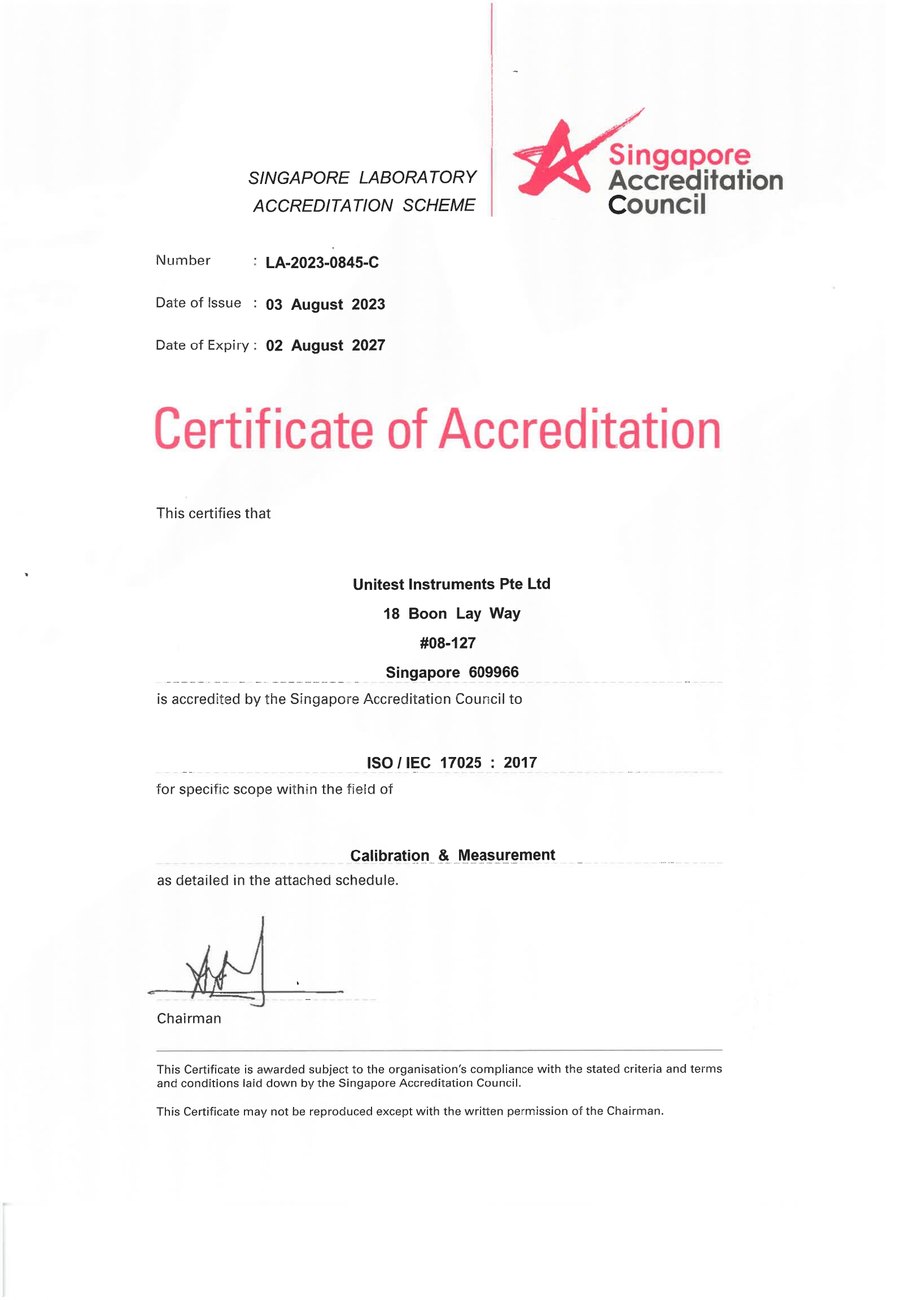
Unitest holds Singapore's national accreditation, verifiable at sac.gov.sg
Our certificates carry SAC-SINGLAS accreditation and are recognised across all ILAC MRA and APLAC member economies. Including the EU, US, UK, China, Japan, and Australia.
The APLAC advantage for Singapore's Asia-Pacific trade
APLAC (the Asia-Pacific Laboratory Accreditation Cooperation), is the regional laboratory accreditation cooperation body for the Asia-Pacific. Its MRA operates in parallel to the global ILAC MRA but is specifically structured around the Asia-Pacific region's regulatory and trade relationships. SAC is a full APLAC MRA signatory; UKAS and A2LA are not, as APLAC membership is restricted to bodies from Asia-Pacific economies.
The practical significance of APLAC recognition is greatest in trade that involves Asia-Pacific regulatory frameworks rather than simply ILAC-accepted international frameworks. The following national accreditation bodies are APLAC MRA signatories: China's CNAS (China National Accreditation Service for Conformity Assessment), Japan's IAJapan (including JNLA for calibration), South Korea's KOLAS (Korea Laboratory Accreditation Scheme), Australia's NATA (National Association of Testing Authorities), New Zealand's IANZ, Taiwan's TAF, and the accreditation bodies of Malaysia, Thailand, Vietnam, Philippines, and most ASEAN economies.
For a Singapore manufacturer exporting to China, a SAC-SINGLAS accredited calibration certificate is recognised by CNAS under the APLAC MRA. Without requiring the Chinese customer or regulator to rely on the broader ILAC MRA cross-recognition. In practical terms, a SAC-SINGLAS certificate may pass through a China-side acceptance check more smoothly than a UKAS or A2LA certificate, because APLAC recognition is a more direct and regionally specific framework than the global ILAC MRA for intra-Asia-Pacific trade.
Similarly, for Singapore companies supplying into Japan, South Korea, or Australia, the APLAC layer means their SAC-SINGLAS accredited calibration evidence is accepted under a regional framework that those countries' accreditation bodies have specifically signed up to. This is a commercial and regulatory advantage that UKAS and A2LA certificates do not automatically carry for Asia-Pacific trade. It is specific to accreditation bodies from APLAC member economies.
Practical scenarios: which body matters when
The choice of accreditation body is ultimately determined by who is receiving the certificate and what framework they are operating under. Four scenarios illustrate the most common situations for Singapore-based organisations.
Scenario A: Singapore ISO 9001 audit. Your ISO 9001 auditor requires evidence of calibration with stated measurement uncertainties and traceable reference standards. A SAC-SINGLAS accredited certificate satisfies this directly. The accreditation number is verifiable at sac.gov.sg, the traceability chain runs through Singapore's NMC, and the uncertainty is stated on every accredited result. A UKAS or A2LA certificate is also technically acceptable under the ISO 9001 standard (which does not name any specific body), but an auditor unfamiliar with UKAS or A2LA may ask for additional explanation of the MRA framework, adding a verification step that a SAC-SINGLAS certificate avoids.
Scenario B: UK pharmaceutical customer requiring MHRA-level evidence. A UK pharmaceutical manufacturer asks for calibration evidence acceptable to their MHRA-regulated GMP requirements. Both UKAS (directly) and SAC-SINGLAS (via ILAC MRA) are acceptable. If the instruments are calibrated in Singapore, the SAC-SINGLAS accredited certificate from a Singapore lab is the practical path. It covers the Singapore calibration event with an ILAC-recognised accreditation. A UKAS certificate for the same instruments would require sending them to a UK lab, which introduces shipping cost, time, and a different traceability chain.
Scenario C: US FDA medical device supplier. A Singapore medical device manufacturer supplying the US market must demonstrate instrument calibration to FDA 21 CFR Part 820 quality system requirements. A2LA (directly) and SAC-SINGLAS (via ILAC MRA) are both accepted. A US FDA auditor will recognise a SAC-SINGLAS certificate under the ILAC MRA framework. If the US customer's quality requirements specifically mandate A2LA by name rather than any ILAC MRA-equivalent, that would be a contractual requirement rather than a regulatory one, and should be resolved by confirming whether the customer accepts ILAC MRA equivalents, most do.
Scenario D: Singapore NEA environmental measurement submission. An environmental consultancy submits measurement data to the National Environment Agency (NEA) in support of a licensing or compliance application. NEA's technical requirements reference SAC-SINGLAS accredited calibration directly. A UKAS or A2LA certificate may be accepted by NEA on a case-by-case basis under the ILAC MRA, but the primary and most straightforward path is a SAC-SINGLAS certificate. The one NEA's own technical guidelines point to by default.
Verifying an accreditation claim in Singapore
Verifying a calibration lab's accreditation is a two-minute process that any procurement officer, quality manager, or auditor can complete without contacting the lab. Here is the step-by-step process for a Singapore verification.
- Go to sac.gov.sg and navigate to the Accredited Laboratories directory (under Accreditation > Accredited Organisations).
- Search by the lab's name or by their stated accreditation number (format: LA-YYYY-XXXX-C for calibration labs).
- Check the current status. The database shows Active, Suspended, Withdrawn, or Lapsed. Only Active means the accreditation is currently valid for use.
- Review the scope of accreditation. The listed parameters, methods, and ranges. Accreditation is scope-specific. A lab accredited for electrical measurements is not automatically accredited for pressure or temperature, even if they offer those services.
- Confirm the lab address matches the location where calibration is actually performed. Accreditation is tied to a specific laboratory address, not a company name alone.
- Where the parameter involves a specific range (e.g. calibration of a pressure gauge at 0–10 bar), verify that the lab's accredited scope includes that range, not just the parameter heading.
Common misrepresentation patterns to watch for include: a calibration certificate that displays an accreditation body logo but does not state an accreditation number (the logo may be a general quality mark, not an active calibration accreditation); an accreditation number that returns no result or a Lapsed/Withdrawn result in the sac.gov.sg database; a scope of accreditation that covers different parameters than those listed on the certificate (e.g. electrical accreditation applied to a temperature calibration); and the phrase "calibrated to ISO/IEC 17025" without naming the accreditation body, which is a statement about the method used, not evidence of independent accreditation assessment.
If you cannot verify a lab's claimed accreditation through the public directory, the appropriate response is to request the lab's current accreditation certificate directly from SAC and ask them to identify the specific accreditation number and scope under which the calibration was performed. A legitimate accredited lab will have this documentation readily available. If the lab cannot produce a verifiable accreditation number from a named body's public directory, the certificate should be treated as non-accredited for compliance purposes.
Frequently asked questions
Yes. UKAS is a full signatory to the ILAC Mutual Recognition Arrangement (MRA), and Singapore's SAC is also an ILAC MRA signatory. Under this framework, UKAS-accredited certificates are mutually recognised in Singapore. However, if the calibration was performed in the UK, a Singapore regulator or auditor may raise questions about the physical traceability chain for instruments actually used in Singapore. For Singapore-based instruments, SAC-SINGLAS accreditation covers both the technical requirement and the local verification pathway in a single step. The certificate is verifiable at sac.gov.sg and the traceability runs through Singapore's own NMC.
The ILAC MRA (International Laboratory Accreditation Cooperation Mutual Recognition Arrangement) is a peer-evaluation framework in which national accreditation bodies assess each other's competence and formally agree to recognise each other's accredited labs' certificates. As of 2024, ILAC has over 100 member economies including all EU member states, the US, UK, Australia, Japan, China, Canada, South Korea, India, and most major trading partners. A certificate from an ILAC MRA signatory body's accredited lab is recognised in all other member economies without requiring re-calibration or additional documentation. Directly reducing compliance cost for international trade.
Go to sac.gov.sg and navigate to the Accredited Laboratories directory. Search by the lab's name or their stated accreditation number. The public database shows whether the accreditation is currently active, the scope of accreditation (parameters and ranges covered), validity dates, and the lab's registered address. Unitest Instruments holds SAC-SINGLAS accreditation no. LA-2023-0845-C. Always verify that the specific parameter and range you need falls within the lab's listed scope. Accreditation is scope-specific and results outside the scope are not covered by the accreditation reference on the certificate.
SAC-SINGLAS accreditation is the process by which a Singapore calibration laboratory is independently assessed and certified to ISO/IEC 17025. ISO/IEC 17025 is the standard that defines the technical requirements; SAC-SINGLAS is the accreditation body that conducts the assessment and issues the accreditation. All three bodies (SAC-SINGLAS, UKAS, and A2LA), assess to the same ISO/IEC 17025:2017 standard. When a lab says it is SAC-SINGLAS accredited, that is the correct full statement: ISO/IEC 17025 is the standard applied, and SAC-SINGLAS is the body that assessed it. Either phrase alone is incomplete. You need both the standard and the named accreditation body with a verifiable number.
In most cases, yes. A2LA is a full ILAC MRA signatory, and Singapore's SAC is also an ILAC MRA signatory. Under this framework, A2LA-accredited certificates are mutually recognised in Singapore. However, whether a specific Singapore agency accepts an A2LA certificate in a particular regulatory submission depends on the agency and the specific technical requirement. For instruments calibrated in Singapore and used in Singapore regulatory contexts (HSA, NEA, CAAS, BizSAFE), a SAC-SINGLAS accredited certificate is the most straightforward path. It is verifiable domestically at sac.gov.sg and directly referenced in Singapore technical guidelines, with no reliance on the MRA cross-recognition step.
APLAC (Asia-Pacific Laboratory Accreditation Cooperation) is the regional peer arrangement for the Asia-Pacific. While the ILAC MRA provides global recognition, APLAC's MRA provides an additional, regionally specific layer of recognition that is particularly relevant for trade into China (CNAS), Japan (IAJapan/JNLA), South Korea (KOLAS), Australia (NATA), and other APLAC member economies. Some regional buyers, government procurement requirements, and local regulatory systems reference APLAC recognition directly in addition to (or instead of), the broader ILAC MRA. SAC is an APLAC signatory; UKAS and A2LA are not, as APLAC is specific to the Asia-Pacific region. For Singapore exporters trading primarily within Asia-Pacific, SAC-SINGLAS accreditation carries the APLAC layer automatically alongside the global ILAC MRA coverage.
All ISO/IEC 17025 accredited labs (regardless of whether the accreditation body is SAC-SINGLAS, UKAS, or A2LA), are assessed to the same standard and are technically required to meet the same requirements for traceability, measurement uncertainty, method competence, equipment, and personnel. In that sense, the technical requirements are equivalent. The practical differences are: geographic authority (SAC-SINGLAS certificates are directly verifiable by Singapore authorities); scope (each lab's accreditation covers only the parameters and ranges that were assessed. Verify before sending instruments); and the geographic traceability chain (calibration performed in the UK by a UKAS lab follows a UK traceability chain through NPL, which may prompt additional explanation when used in Singapore contexts). Verify any lab's accreditation directly with the issuing body's public database before accepting its certificate.
Unitest Instruments Pte. Ltd. is a SAC-SINGLAS accredited calibration laboratory (ISO/IEC 17025, no. LA-2023-0845-C) based in Singapore. We calibrate electrical, temperature, pressure, humidity, and related instruments for manufacturers, service providers, and regulated industries across Singapore and the region. Our accreditation is verifiable at sac.gov.sg.
Calibrate in Singapore with nationally accredited, globally recognised certificates
Unitest's SAC-SINGLAS accreditation (LA-2023-0845-C) is Singapore's national body, verifiable at sac.gov.sg and recognised across all ILAC MRA and APLAC member economies.
Verifiable at sac.gov.sg · ILAC MRA + APLAC recognised · Acc. No. LA-2023-0845-C