
Key takeaways
- Fluke ScopeMeter: field and industrial maintenance. Rugged, battery-powered, isolated channels, CAT III/IV ratings, lower bandwidth.
- Tektronix: bench and laboratory use. Higher bandwidth (200 MHz to 1 GHz+), deeper waveform memory, advanced trigger and analysis, not designed for live electrical measurement.
- Safety is the critical distinction: Fluke's isolated channels allow safe measurement on motor drives and live switchgear; Tektronix bench scopes share a common ground and must not be used in these applications.
- Both brands calibrate at Unitest. Brand does not affect calibration requirement or cost.
- The correct calibration interval for both is 12 months when used for measurement and compliance decisions.
The fundamental design difference: field vs bench
Every feature difference between Fluke ScopeMeter and Tektronix oscilloscopes flows from a single design decision made at the product level: who is the user and where do they work?
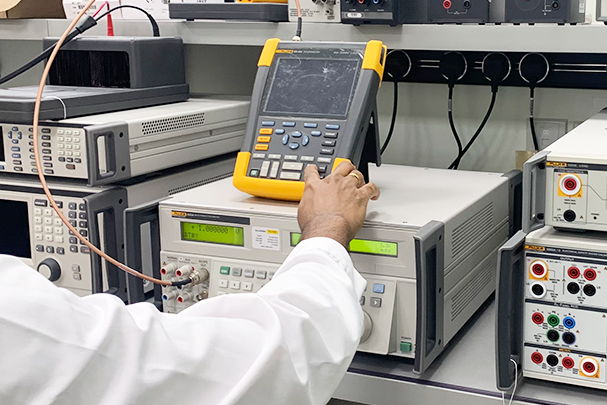
Fluke designed the ScopeMeter for the field engineer or maintenance technician who needs to make measurements in live industrial electrical equipment. The defining technical choice is fully isolated inputs. Each channel is isolated from the others and from the chassis. This means you can measure the voltage across a three-phase motor drive output without creating a ground fault through the instrument and the mains earth. It is a fundamental safety feature for industrial electrical work, and it comes at a cost: isolated channels require more complex internal circuitry, which limits bandwidth and adds weight and cost.
Tektronix designed the TDS, MDO, and MSO families for the bench engineer. Electronics designers and test engineers working on PCBs, embedded systems, RF circuits, and production test. These instruments share a common ground across channels and to the chassis, which means they cannot be safely used on live electrical equipment above low voltages without a differential probe. In exchange for this limitation, Tektronix achieves higher bandwidth, longer waveform memory, more sophisticated trigger and analysis features, and generally higher vertical accuracy for the bandwidths in question.
| Attribute | Fluke ScopeMeter (e.g. 190 series) | Tektronix (e.g. TDS2000/MDO3000) |
|---|---|---|
| Primary application | Field maintenance, live electrical equipment | Bench / laboratory, PCB debug and design |
| Channel isolation | Fully isolated channels (each channel independently isolated) | Common ground. Channels share reference, not isolated |
| Safety rating | CAT III 1000 V / CAT IV 600 V | CAT I / CAT II only (bench use) |
| Bandwidth | 60 MHz to 500 MHz (ScopeMeter range) | 70 MHz to 1 GHz+ (bench models) |
| Power | Battery-powered with AC adapter option | Mains-powered (bench use) |
| Portability | Handheld, IP51 rated, drop-resistant | Benchtop, not designed for field carry |
| Waveform memory | Moderate (suited to transient capture in maintenance) | Deep (suited to complex protocol decode, glitch capture) |
| Calibration interval | 12 months | 12 months |
Where each brand is used in Singapore
Fluke ScopeMeter in Singapore
Fluke ScopeMeters are the preferred instrument for electrical maintenance engineers in Singapore's industrial facilities. Jurong Island process plants, manufacturing facilities, MRO operations, and building services engineering. They are used to measure voltage waveforms on motor drive outputs (where the floating ground is critical), diagnose harmonics on three-phase distribution systems, and troubleshoot industrial control signals (4–20mA loops, 0–10V signals, pulse trains) in the field. The IP51 protection and drop resistance makes them viable in panel rooms and on the factory floor where a bench oscilloscope would be at risk.
Tektronix in Singapore
Tektronix oscilloscopes dominate in Singapore's electronics and semiconductor sectors. Most of Singapore's electronics design houses, wafer fabrication facilities, and product development labs use Tektronix or Keysight as the primary bench oscilloscope. University engineering departments (NUS, NTU, SUTD) standardise on Tektronix for undergraduate labs. Production test stations for PCB assemblies commonly use Tektronix TDS or MDO series. The combination of bandwidth, mixed-signal options (logic analyser channels on MSO models), and advanced trigger capabilities makes Tektronix the benchmark for bench test.
We calibrate Fluke and Tektronix oscilloscopes. Brand-agnostic, fully traceable
Unitest calibrates oscilloscopes from both brands with SAC-SINGLAS accreditation. Every certificate shows vertical accuracy, timebase accuracy, and stated uncertainty for your ISO 9001 or AS9100 records.
Oscilloscope calibration: what is checked and why it matters
Oscilloscope calibration is brand-agnostic. The same parameters are verified regardless of whether the instrument is a Fluke or Tektronix. Calibration verifies:
- Vertical accuracy: the percentage error in the amplitude measurement at each V/division setting. A 1% vertical accuracy error at 1 V/div means a 10 mV error on a 1 V measurement, which may matter significantly in production test.
- Timebase accuracy: the percentage error in the time axis. Directly determines the accuracy of frequency and period measurements derived from the oscilloscope. Timebase drift is typically due to crystal oscillator aging in the reference oscillator.
- Bandwidth: the -3 dB frequency. A scope nominally rated 200 MHz may be measuring at 180 MHz after drift. Enough to cause rise-time measurement errors on fast digital signals.
- DC offset accuracy: the accuracy of the DC offset control, which affects whether the waveform is correctly positioned vertically for amplitude measurements.
The calibration certificate records as-found and as-left readings at each test point, with the deviation from nominal and the expanded uncertainty. This certificate is the evidence that ISO 9001 clause 7.1.5, AS9100, and CAAS Part 145 auditors require to accept the oscilloscope's measurement results as valid.
Understanding CAT ratings: why isolation is not optional
The CAT (measurement category) rating printed on a Fluke ScopeMeter is not a marketing figure, it is an IEC 61010 safety classification that determines where the instrument can be safely connected without exposing the operator to transient overvoltage risk. CAT III covers distribution-level circuits: fixed installation wiring, distribution boards, and three-phase motor circuits typical of an industrial panel room. CAT IV covers the origin of the installation: main switchboards and the utility connection point, where transient energy from a fault or lightning strike can be at its highest. A standard Tektronix bench scope holds no CAT rating for live power circuits at all, because its design assumes a benign, low-energy signal source on a lab bench, not a fault-capable industrial supply. Connecting a common-ground bench oscilloscope directly across a live three-phase motor drive output is not merely inaccurate, it risks creating a short circuit through the instrument's chassis ground and the building's electrical earth, a genuine safety hazard to both the equipment and the operator. This is the single most important reason the Fluke-versus-Tektronix decision is a safety question first and a measurement-quality question second.
Probes and accessories: an overlooked accuracy factor
An oscilloscope's calibration certificate verifies the instrument itself, but the probe connecting it to your circuit is a separate source of measurement error that calibration alone does not eliminate. A standard 10:1 passive probe must be compensated (adjusting a small trimmer to match the probe's capacitance to the specific channel input) every time it is moved between channels or instruments; an uncompensated probe introduces waveform overshoot or rounding that can look like a genuine signal characteristic to an inexperienced operator. Fluke's ScopeMeter test leads are typically matched and rated to the same CAT III/IV category as the instrument itself, and mixing in a lower-rated generic probe defeats the safety rating of the whole measurement chain, even though the meter itself remains correctly rated. For Tektronix bench work, differential probes are required whenever a measurement point is not referenced to the instrument's common ground, and selecting an appropriately rated differential probe is what actually enables safe higher-voltage measurement on a bench scope, not a feature of the oscilloscope itself. When budgeting for calibration and compliance, the probe set deserves the same attention as the instrument, since a correctly calibrated scope paired with a degraded or mismatched probe will still produce an unreliable measurement.
Hybrid use cases: when one instrument category is not enough
Some Singapore engineering teams genuinely need both categories and maintain separate fleets rather than trying to make one instrument serve both roles. A plant engineering team responsible for both control-system commissioning (bench-style protocol debug on a PLC's communication bus) and live panel troubleshooting (checking motor drive output waveforms) typically finds that no single oscilloscope model serves both roles well: the isolation and ruggedness that make a ScopeMeter safe in the field come at the cost of the bandwidth and analysis depth a protocol debug session needs, and vice versa. Rather than compromising on one higher-cost hybrid instrument, most well-run maintenance and engineering functions maintain a Fluke ScopeMeter for field safety work and a separate Tektronix (or equivalent) bench unit for design and debug work, calibrating both annually as independent assets in the calibration register.
Bandwidth, rise time, and why the "5x rule" matters
An oscilloscope's bandwidth specification determines how accurately it can capture fast-changing signals, and understanding the relationship between bandwidth and rise time helps explain why a Tektronix bench scope's higher bandwidth genuinely matters for certain work rather than being a spec-sheet vanity number. A widely used rule of thumb states that an oscilloscope's bandwidth should be at least five times the highest frequency component of the signal being measured, to capture the signal's edges and harmonic content without significant attenuation or rounding. For a digital signal with a rise time of 1 nanosecond, the practical bandwidth requirement to accurately capture that edge without excessive rounding is in the hundreds of megahertz, well beyond what a typical Fluke ScopeMeter is designed to provide, and squarely within Tektronix bench scope territory. This is precisely why fast digital signal work, USB, high-speed serial buses, modern digital logic, genuinely requires the higher bandwidth Tektronix offers; it is not a marginal quality difference but a hard technical requirement below which the captured waveform simply does not represent the real signal accurately, regardless of how carefully the measurement is otherwise performed.
Sample rate, memory depth, and what they actually buy you
Beyond bandwidth, an oscilloscope's sample rate (how many voltage samples per second the instrument takes) and memory depth (how many samples it can store per acquisition) jointly determine how long a capture window can be held at a given time resolution. A Tektronix bench scope's deeper memory allows capturing a long time window, useful for catching an intermittent glitch or decoding an extended digital protocol exchange, while still maintaining a high sample rate for detail at the point of interest within that window. A Fluke ScopeMeter's comparatively shallower memory reflects its design priority: fast setup and clear waveform capture for a maintenance technician diagnosing a known fault type in the field, rather than deep post-capture analysis of a long, complex signal. Neither approach is wrong, they are optimised for different tasks: field diagnosis benefits from speed and simplicity over raw capture depth, while bench debug work on complex or intermittent signals benefits directly from deep memory's ability to hold a longer window of high-resolution data for detailed post-capture analysis.
Trigger sophistication: a genuine capability gap, not just a nice-to-have
Trigger functions determine when an oscilloscope actually captures and displays a waveform, and this is an area where Tektronix bench scopes offer materially more sophistication than a ScopeMeter, reflecting their different design purpose. Beyond basic edge triggering (capturing when a signal crosses a set voltage threshold), Tektronix bench models typically offer pulse-width triggering (catching a glitch of a specific duration), pattern triggering across multiple channels, and, on MSO (Mixed Signal Oscilloscope) variants, protocol-aware triggering that can capture on a specific digital communication event, such as a particular I2C address or a UART error frame. This advanced triggering is precisely what makes a bench scope effective for catching an intermittent digital fault that might occur once in thousands of cycles, since without the ability to define exactly what event to trigger on, finding that one occurrence in a continuous stream of otherwise-normal signal activity would be close to impractical. Fluke ScopeMeters generally offer simpler triggering suited to their field diagnostic role, where the fault being investigated is typically already known and the instrument's job is confirming its presence and characteristics, not searching for a rare, undefined anomaly.
Setting a defensible calibration interval for either instrument
Twelve months is the conventional starting interval for both Fluke and Tektronix oscilloscopes used in a quality-affecting or compliance-relevant measurement role, and it remains the sensible default for most Singapore engineering and maintenance functions. What justifies moving off that default is the same as for any other instrument: documented as-found drift history. A bench oscilloscope used occasionally in a controlled lab environment, showing consistently tight as-found results across several calibration cycles, is a reasonable candidate for a documented extension to 18 or 24 months. A field ScopeMeter subjected to regular drops, temperature extremes, and dusty panel-room environments is a poorer candidate for extension regardless of its as-found history, simply because its physical duty cycle introduces more opportunities for damage between calibrations than the certificate alone can capture. AS9100 and CAAS Part 145 environments in particular expect this reasoning to be documented in the calibration plan, not left as an informal judgment call by whoever manages the instrument.
Vertical resolution and why 8-bit is not always enough
Most oscilloscopes, across both brands and most price tiers, digitise the incoming signal at 8-bit vertical resolution, giving 256 discrete voltage levels across the full screen height at any given vertical scale setting. For most general troubleshooting and waveform characterisation work this is entirely adequate, but for applications needing to resolve a small signal riding on a much larger one, measuring ripple on a DC supply rail, for instance, 8-bit resolution can genuinely limit measurement quality regardless of how capable the rest of the instrument is. Some higher-end Tektronix bench models offer higher-resolution modes (12-bit or greater, either through dedicated hardware or high-resolution acquisition modes that trade bandwidth for resolution), a capability with no real equivalent in the Fluke ScopeMeter range given its different design priorities. For engineers working on power supply ripple analysis, low-noise analog circuit characterisation, or similar precision measurement tasks, checking whether a given bench scope model offers enhanced vertical resolution modes is worth doing at the specification stage, since the standard 8-bit resolution common across most instruments can be the limiting factor in measurement quality well before bandwidth or sample rate becomes relevant.
A practical selection question for procurement
Before specifying either brand, ask one question: will this instrument's test leads ever be connected directly to a circuit that is not referenced to the instrument's own local earth, for example a live three-phase supply, a motor drive output, or any distribution-level circuit? If yes, a common-ground bench oscilloscope is the wrong instrument regardless of its bandwidth or brand reputation, and an isolated-channel, appropriately CAT-rated instrument like a Fluke ScopeMeter is required. If no, and the work is entirely bench-based signal characterisation referenced to a shared ground (PCB debug, embedded systems development, RF and digital design), a Tektronix or equivalent bench scope will generally outperform a ScopeMeter on bandwidth, memory depth, and analysis tools for a comparable budget. Getting this one question right before purchase avoids both a safety incident and an expensive instrument mismatch.
Probes are not interchangeable across the two categories either
It bears repeating with a specific example, since it is a mistake we have seen happen in the field: a standard 10:1 passive probe designed for a Tektronix bench scope, rated for low-voltage, common-ground bench measurements, carries no meaningful safety rating for live industrial electrical work, and using one to probe a motor drive output because "the scope was busy" is a genuine safety hazard, not a minor technique shortcut. Conversely, a Fluke ScopeMeter's CAT-rated test leads, while perfectly safe for industrial field use, are generally not optimised for the very low-capacitance, high-bandwidth signal integrity a Tektronix bench scope's fast digital signal work depends on, so borrowing ScopeMeter leads for bench PCB debug work will typically degrade measurement quality even though no safety issue arises. Treating the probe or test lead set as an integral, brand-and-application-matched part of the instrument, not an interchangeable accessory, is a small discipline that protects both safety and measurement quality across either category of oscilloscope.
Frequently asked questions
Fluke ScopeMeters are designed for field and industrial maintenance use. Handheld, rugged (IP51), battery-powered, with fully isolated channels for safe measurement in live electrical equipment (CAT III 1000V / CAT IV 600V). Tektronix oscilloscopes are designed for bench and laboratory use. Higher bandwidth, deeper waveform memory, more analysis features, optimised for electronics design and characterisation, with common-ground channel architecture that makes them unsafe for live electrical measurements above low voltages. The right choice depends on the measurement environment, not the brand reputation.
Both are widely used but in different sectors. Tektronix is dominant in Singapore's electronics design houses, semiconductor facilities, research labs, and university engineering departments. Fluke ScopeMeters are preferred by electrical maintenance engineers, facilities teams, MRO technicians, and field service engineers working on live industrial electrical equipment. In production test, Keysight oscilloscopes are also common alongside Tektronix. The brand split tracks the field vs bench application divide precisely.
The calibration requirement depends on how the oscilloscope is used, not the brand. If it is used for measurement decisions that go into quality records, test reports, or compliance evidence (ISO 9001, AS9100, CAAS Part 145), then traceable calibration with stated uncertainty is required. SAC-SINGLAS accredited calibration provides this evidence for both Fluke and Tektronix oscilloscopes. Oscilloscopes used only for qualitative observation with no compliance implication may be controlled differently, but the decision to exempt them should be documented.
Oscilloscope calibration verifies: vertical accuracy (amplitude measurement error as % of full scale at each V/div setting), timebase accuracy (time axis error, which determines frequency and period measurement accuracy), bandwidth (-3 dB frequency), trigger level accuracy, and DC offset accuracy. The certificate records as-found and as-left readings at each test point with deviation from nominal and expanded measurement uncertainty. The data format required by ISO 9001 clause 7.1.5 and AS9100.
12 months is the standard calibration interval, recommended by both Fluke and Tektronix and accepted by ISO 9001, AS9100, and CAAS Part 145 auditors. For production test environments with heavy use, consider 6 months. Review the interval using as-found calibration data. If the instrument consistently returns well within specification, extending to 18 months may be justified with documented evidence.
Oscilloscope calibration typically requires in-lab calibration because the reference instruments needed (calibrated signal generators, precision voltage sources, and bandwidth verification equipment), are not easily portable. For organisations with a large number of oscilloscopes at a single site, on-site calibration may be arranged. Contact us to discuss your specific situation and instrument count.
For bench avionics test at Seletar and Changi MRO facilities, Tektronix is the more common choice. The bandwidth (200 MHz to 1 GHz+) covers avionics digital bus and RF requirements. Fluke ScopeMeters are better for aircraft electrical system maintenance (28V DC, 115V/400Hz AC) where isolated inputs are critical. Under CAAS Part 145, both require calibration certificates with documented NMC traceability. SAC-SINGLAS accredited calibration from Unitest satisfies this requirement for both brands.

Unitest Instruments Pte. Ltd. is a SAC-SINGLAS accredited calibration laboratory (ISO/IEC 17025, no. LA-2023-0845-C) based in Singapore. We calibrate electrical, temperature, pressure, humidity, and related instruments for manufacturers, service providers, and regulated industries across Singapore and the region.
Calibrate your Fluke or Tektronix oscilloscope at Singapore's accredited lab
Unitest holds SAC-SINGLAS accreditation no. LA-2023-0845-C. We calibrate oscilloscopes from both brands with stated uncertainties and full NMC traceability. Accepted by ISO 9001, AS9100, and CAAS Part 145 auditors.
Verifiable at sac.gov.sg · Acc. No. LA-2023-0845-C