
Key Takeaways
- Any instrument that produces a number on a batch record, CoA, or stability report must be formally calibrated. GMP does not allow estimation or assumption.
- SAC-SINGLAS accredited calibration (ISO/IEC 17025) provides the documented metrological traceability chain that HSA inspectors and ISO 9001 auditors require.
- Calibration intervals are not fixed by regulation. They must be established by your QA team based on criticality, drift history, and manufacturer data, then reviewed annually.
- An out-of-tolerance result is a GMP event: it requires a formal deviation, a retrospective impact assessment on all batches tested since the last good calibration, and corrective action.
- Stability chambers, autoclaves, and cold storage units need continuous or periodic temperature mapping in addition to point calibration of their sensors.
- Calibration certificates must include the accreditation number, traceable reference standards used, as-found/as-left readings, expanded uncertainty, and a next-due date to be GMP-compliant.
Why Calibration Is Non-Negotiable in Pharmaceutical Manufacturing
In most industries, an instrument that drifts slightly out of specification is a quality nuisance. In pharmaceutical manufacturing, it can be the difference between a safe, efficacious product and one that causes patient harm. A balance that reads 2 mg high on a 100 mg tablet core means every tablet in the batch is under-dosed. A pH meter that reads 0.15 units low could cause an incorrect buffer preparation to pass QC when it should fail. These are not hypothetical scenarios. They are the exact failure modes that GMP calibration requirements were written to prevent.
Singapore's Health Sciences Authority (HSA) regulates pharmaceutical manufacturing under PIC/S GMP guidelines, which are harmonised with the EU GMP and WHO GMP frameworks. All three frameworks share the same core requirement: manufacturers must establish, maintain, and document a calibration and qualification programme covering all instruments used in production and quality control. Instruments with no current calibration certificate are, by definition, unqualified for GMP use, and any data they generated may be considered unreliable by an inspector.
The calibration requirement extends beyond the QC lab. Production equipment sensors, environmental monitoring systems, utilities measuring instruments (purified water conductivity, clean steam pressure), and packaging line torque wrenches all fall within GMP scope if their readings are used to make a product release or in-process control decision.
Which Instruments Require Calibration in a Pharmaceutical QC Lab
The scope of calibration in a pharmaceutical QC lab is broad. A useful rule of thumb: if the instrument produces a number that appears on a specification, a certificate of analysis, a batch record, or a stability report, it is in scope. The table below covers the most common instrument categories, the parameters measured, and the typical GMP criticality level.
| Instrument | Parameters Calibrated | GMP Criticality | Typical Interval |
|---|---|---|---|
| Analytical balance | Mass (linearity, repeatability, off-centre load) | Critical | 6–12 months + daily check |
| pH meter & electrode | pH (2–3 point calibration with certified buffers) | Critical | 6–12 months; electrode replaced per drift |
| HPLC system | UV detector wavelength, pump flow rate, column oven temperature, injector volume | Critical | 6–12 months per module |
| UV-Vis spectrophotometer | Wavelength accuracy, photometric accuracy, stray light | Critical | 6–12 months |
| Karl Fischer titrator | Volume delivered, reagent titer | Critical | 6–12 months + per-run verification |
| Dissolution tester | Rotation speed (RPM), vessel temperature, vessel dimensions | Critical | 6 months |
| Stability chamber | Temperature uniformity, relative humidity uniformity (mapping + sensor calibration) | Critical | Mapping annually; sensors 6–12 months |
| Autoclave / steam steriliser | Temperature (multiple points), pressure, time | Critical | 6 months + each load qualification |
| Incubator | Temperature uniformity (mapping) | High | 6–12 months |
| Refrigerator / cold room | Temperature (multiple points, min/max logging) | High | 12 months + continuous monitoring |
| Pipettes (Class A) | Volume dispensed (gravimetric verification) | High | 6–12 months |
| Thermometers / probes | Temperature accuracy at calibration points | Medium–High | 12 months |
| Pressure gauges | Pressure (multiple points) | Medium–High | 12 months |
| Conductivity meter | Electrical conductivity (for purified water testing) | High (if used for WFI/PW release) | 6–12 months |
Note that glassware (volumetric flasks, burettes, Class A pipettes) is typically verified by the manufacturer at point of manufacture and does not require periodic external calibration in the same way, though a documented incoming inspection and periodic gravimetric verification programme is considered best practice under GMP.
Understanding Calibration Intervals in a GMP Context
One of the most common questions from QA teams is: "How often does the regulation say we must calibrate?" The honest answer is that neither PIC/S GMP nor HSA prescribes specific intervals for most instruments. The regulation instead places the responsibility on the manufacturer to establish scientifically justified intervals and review them regularly.
In practice, calibration intervals are set based on four inputs. First, manufacturer recommendations from the instrument's qualification documentation. Second, historical drift data. If an instrument has never gone out of tolerance in five consecutive annual calibrations, there is a documented basis to extend the interval to 18 months. Conversely, if an instrument drifts out of tolerance, the interval must be shortened. Third, the criticality of the measurement. A balance used to weigh active pharmaceutical ingredients for potency calculations warrants a more frequent interval than a thermometer used to monitor a non-critical ambient room. Fourth, regulatory expectations: some pharmacopoeial tests (e.g. dissolution per USP <711>) contain embedded calibration and verification requirements that effectively set a minimum frequency.
For more on the principles governing how intervals should be set and reviewed, see our article on how often calibration should be performed and what drives the interval decision.
Need pharmaceutical-grade calibration certificates accepted by HSA auditors?
Unitest Instruments is SAC-SINGLAS accredited (Acc. No. LA-2023-0845-C). We calibrate analytical balances, pH meters, HPLC modules, dissolution testers, temperature sensors, and more, with certificates that include full uncertainty budgets and traceable reference standards.
SAC-SINGLAS Accreditation and What It Means for GMP Compliance
SAC-SINGLAS (Singapore Accreditation Council. Singapore Laboratory Accreditation Scheme) is Singapore's national laboratory accreditation body, operating under the international mutual recognition arrangement (ILAC MRA). When a calibration laboratory holds SAC-SINGLAS accreditation, it means an independent third party has verified that the laboratory operates in compliance with ISO/IEC 17025. The international standard for testing and calibration laboratory competence.
For pharmaceutical QA teams, SAC-SINGLAS accreditation from the calibration provider accomplishes several things simultaneously. It demonstrates metrological traceability to Singapore's National Metrology Centre (NMC), which is a signatory to the BIPM Mutual Recognition Arrangement. Meaning Singapore's calibration results are internationally comparable. It provides documented evidence that the calibration laboratory uses qualified personnel, validated measurement methods, and fit-for-purpose reference standards. And it removes from the pharmaceutical company the burden of independently auditing and qualifying their calibration provider, which is a significant administrative saving.
In practical audit terms: when an HSA inspector or an ISO 9001 auditor asks to see evidence of metrological traceability for your analytical balance, presenting a calibration certificate from a SAC-SINGLAS accredited laboratory bearing accreditation number LA-2023-0845-C closes that question immediately. Presenting a certificate from an unaccredited provider opens a lengthy discussion about how you verified the provider's traceability chain. A discussion most QA managers prefer to avoid.
To understand more about how accreditation is evaluated and what the certificate covers in detail, see our guide on the difference between accredited and non-accredited calibration.
What a GMP-Compliant Calibration Certificate Must Contain
Not all calibration certificates are equal. A calibration certificate that satisfies GMP requirements must contain specific elements, and a certificate missing any of them is effectively incomplete for audit purposes. Here is what to look for and what to require from your calibration provider.
- Laboratory identification and accreditation number. The full name of the calibration laboratory and its SAC-SINGLAS accreditation number (e.g. LA-2023-0845-C), confirming the certificate falls within the accredited scope.
- Instrument identification. The equipment description, make, model, and unique serial number or asset tag. The certificate must be unambiguously linked to a specific instrument, not a generic type.
- Calibration date and next due date, both are required. The next due date is used to manage your calibration schedule and must align with your approved interval.
- Environmental conditions. Temperature and relative humidity at the time of calibration, which affect measurement uncertainty and are required for traceability.
- Reference standards used. Description and certificate number of the reference standards used, enabling you to verify their own traceability chain.
- As-found and as-left readings. What the instrument read before any adjustment and after adjustment. The as-found data is critical for retrospective batch impact assessment if the instrument was found out of tolerance.
- Measurement uncertainty. The expanded uncertainty at a stated coverage factor (typically k=2, approximately 95% confidence level). This is an ISO/IEC 17025 mandatory element.
- Authorised signatory. The name and signature of the person technically responsible for the calibration results.
For a full breakdown of how to read and interpret a calibration certificate, including the uncertainty statement and what the as-found data tells you about equipment health, see our detailed guide on what a calibration certificate means and how to use it.
Building a Calibration Programme: What Pharmaceutical QA Teams Need to Do
A calibration programme is more than a list of instruments and their due dates. In a GMP environment it is a documented system with procedures, records, competency requirements, and a change control process. Here is a practical outline of what a complete pharmaceutical calibration programme looks like.
Step 1: Create and Maintain an Equipment Master List
Every instrument in scope must be assigned a unique asset ID and entered into a calibration register (sometimes called the Equipment Master List or Instrument Calibration Database). The register must capture: instrument description, manufacturer, model, serial number, location, criticality classification, calibration method, approved interval, last calibration date, next due date, and the calibration provider. This register is a living document. Instruments are added when purchased, updated when calibrated, and retired when decommissioned.
Step 2: Write Calibration Procedures
For each instrument category, a written procedure must specify the calibration method, acceptance criteria (tolerances), the action to take if out-of-tolerance, and who is authorised to send instruments for calibration. These procedures should reference the relevant pharmacopoeial chapters (USP, BP, EP) where applicable, for example, USP <1058> Analytical Instrument Qualification is a widely referenced framework for pharmaceutical labs.
Step 3: Schedule and Track Calibration Events
Most QA teams use a combination of a master spreadsheet and their quality management system (QMS) to generate automated reminders 30 to 60 days before an instrument's calibration is due. Best practice is to stagger calibration events across the calendar year rather than scheduling all instruments in the same month, which avoids bottlenecks at your calibration provider and ensures that a surge of instruments out for calibration does not create a lab capacity crisis.
Step 4: Manage Out-of-Tolerance Findings as GMP Deviations
When a calibration provider reports that an instrument was found out of tolerance (the as-found reading exceeded the acceptance criterion), the QA team must open a GMP deviation. The deviation investigation must answer: when did the instrument last pass calibration? What measurements were made with this instrument between the last good calibration and the discovery of the out-of-tolerance condition? Could those measurements have been affected by the drift? The outcome of this retrospective assessment determines whether batches tested in the affected period need to be held, retested, or subjected to additional review before release.
Step 5: Review Intervals Annually
Once per year, the calibration programme should be formally reviewed. Instruments with a clean calibration history (consistently within tolerance, minimal drift) may be candidates for interval extension. Instruments with a history of drift or out-of-tolerance findings must have their intervals shortened. Any interval change requires a documented rationale and change control approval before implementation.
Temperature Mapping: The Calibration Requirement Beyond Point Sensors
One area frequently overlooked in pharmaceutical calibration programmes is temperature mapping of storage and incubation equipment. Calibrating the temperature sensor of a stability chamber tells you that the sensor is accurate, but it does not tell you whether the temperature is uniform throughout the chamber. A chamber with a calibrated sensor reading 25.0°C may have hot and cold zones varying by ±3°C, which could invalidate stability data for products stored in those zones.
PIC/S GMP and ICH Q1A(R2) guidelines require that storage conditions for stability studies be validated, which in practice means performing a temperature mapping study using a grid of calibrated data loggers placed throughout the chamber volume. The mapping study must be performed at commissioning, after any major repair or modification, and repeated periodically (typically annually) to confirm continued uniformity. All data loggers used in mapping studies must themselves be calibrated by an accredited laboratory before the mapping exercise.
The same logic applies to cold rooms, refrigerators used for reference standards or biological samples, and autoclaves. Where temperature uniformity and heat penetration studies are required as part of sterilisation process validation.
Frequently Asked Questions
Any instrument used to make a measurement that affects product quality or regulatory compliance must be calibrated. In a typical pharmaceutical QC lab this includes analytical balances, pH meters, Karl Fischer titrators, HPLC systems (pressure, flow, UV detector wavelength), UV-Vis spectrophotometers, dissolution testers, autoclave temperature and pressure sensors, incubators and stability chambers, thermometers, barometers, and torque meters used in packaging. Under GMP, the rule of thumb is: if it produces a number that appears on a certificate of analysis or a batch record, it needs a calibration record.
Singapore's HSA PIC/S GMP guidelines do not prescribe a single universal interval; instead, they require manufacturers to establish intervals based on instrument criticality, historical drift data, and manufacturer recommendations. In practice, high-criticality instruments such as analytical balances and HPLC detectors are typically calibrated every 6 to 12 months, while environmental monitoring sensors in stability chambers are often checked every 3 to 6 months. Less critical reference instruments may be calibrated annually. Your calibration programme must document the rationale for each interval and adjust it when out-of-tolerance findings occur.
HSA GMP guidelines strongly encourage, and in practice effectively require, the use of accredited calibration providers for critical measurement equipment. SAC-SINGLAS accreditation (ISO/IEC 17025) provides the documented chain of traceability to Singapore's National Metrology Centre (NMC) that auditors look for. Using a non-accredited provider places the burden of traceability verification entirely on the pharmaceutical company. For ISO 9001 and GMP audits, a certificate from a SAC-SINGLAS accredited lab is the most straightforward evidence of metrological traceability.
Calibration establishes the relationship between an instrument's readings and a known traceable reference, and documents any correction factors. Qualification (IQ/OQ/PQ) demonstrates that equipment is installed correctly, operates within its specification, and performs consistently in its intended use, it builds on calibration data. Validation is applied to processes and analytical methods, confirming they consistently produce results meeting predetermined criteria. In GMP terms: calibrate first, qualify the equipment using calibrated reference standards, then validate the method on that qualified equipment.
A GMP-compliant calibration certificate must include: the name and accreditation number of the calibration laboratory (e.g. SAC-SINGLAS LA-2023-0845-C), the instrument description and unique ID/serial number, the date of calibration and next due date, the traceable reference standards used (with their own calibration certificate numbers), the measurement conditions (temperature, humidity), the as-found and as-left readings at each test point, the expanded measurement uncertainty, and the signature of the authorised signatory. Certificates missing any of these elements are routinely flagged at GMP inspections.
An out-of-tolerance finding must trigger a formal deviation or non-conformance investigation under your quality system. The first step is to assess the retrospective impact: every batch produced or tested since the last successful calibration must be evaluated to determine whether the measurement error could have affected product quality or a release decision. Depending on the risk assessment outcome, batches may be quarantined, retested, or rejected. The instrument must be adjusted, repaired, or replaced, then re-calibrated before returning to service. The calibration interval should also be shortened until stability is demonstrated.
Best practice is to maintain a master calibration schedule (Equipment Master List or Calibration Register) listing every controlled instrument, its unique ID, calibration interval, last calibration date, next due date, and the accredited provider responsible. This register should be reviewed at least quarterly and integrated with your change control and preventive maintenance systems. Automated reminders 30 to 60 days before due dates prevent lapses. QA teams should also conduct an annual review of calibration intervals, tightening them for instruments with historical drift and relaxing them (with documented justification), for instruments with a consistently stable record.
In-house calibration is permitted under GMP provided the company can demonstrate metrological traceability through its own reference standards, which must themselves be calibrated by an accredited external laboratory. In practice, most pharmaceutical companies in Singapore outsource calibration of their critical instruments to a SAC-SINGLAS accredited laboratory because maintaining the required reference standards, documented procedures, and technical competence in-house is costly. In-house verification checks (e.g. daily balance check-weighing with certified weights) are common as interim controls between full calibrations, but these checks cannot replace a formal accredited calibration.
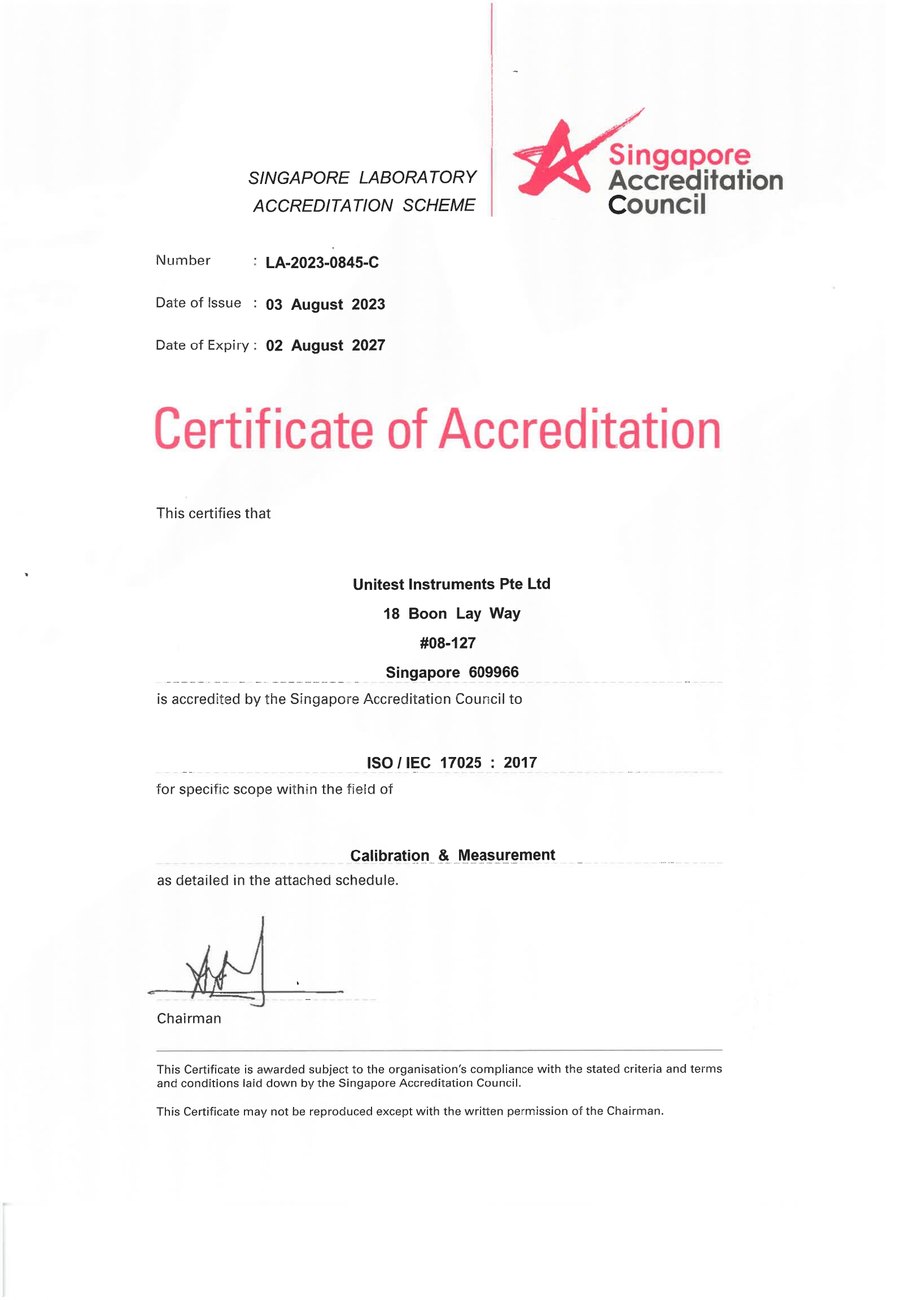
SAC-SINGLAS accredited calibration laboratory (Acc. No. LA-2023-0845-C) serving Singapore's industrial, pharmaceutical, and manufacturing sectors. All content reflects our ISO/IEC 17025 accredited scope and is reviewed by our technical calibration team.
Need pharmaceutical-grade calibration in Singapore?
Unitest Instruments is SAC-SINGLAS accredited (Acc. No. LA-2023-0845-C) to ISO/IEC 17025. Same-week turnaround, certificates accepted by HSA GMP inspectors and ISO 9001 auditors.