
Key Takeaways
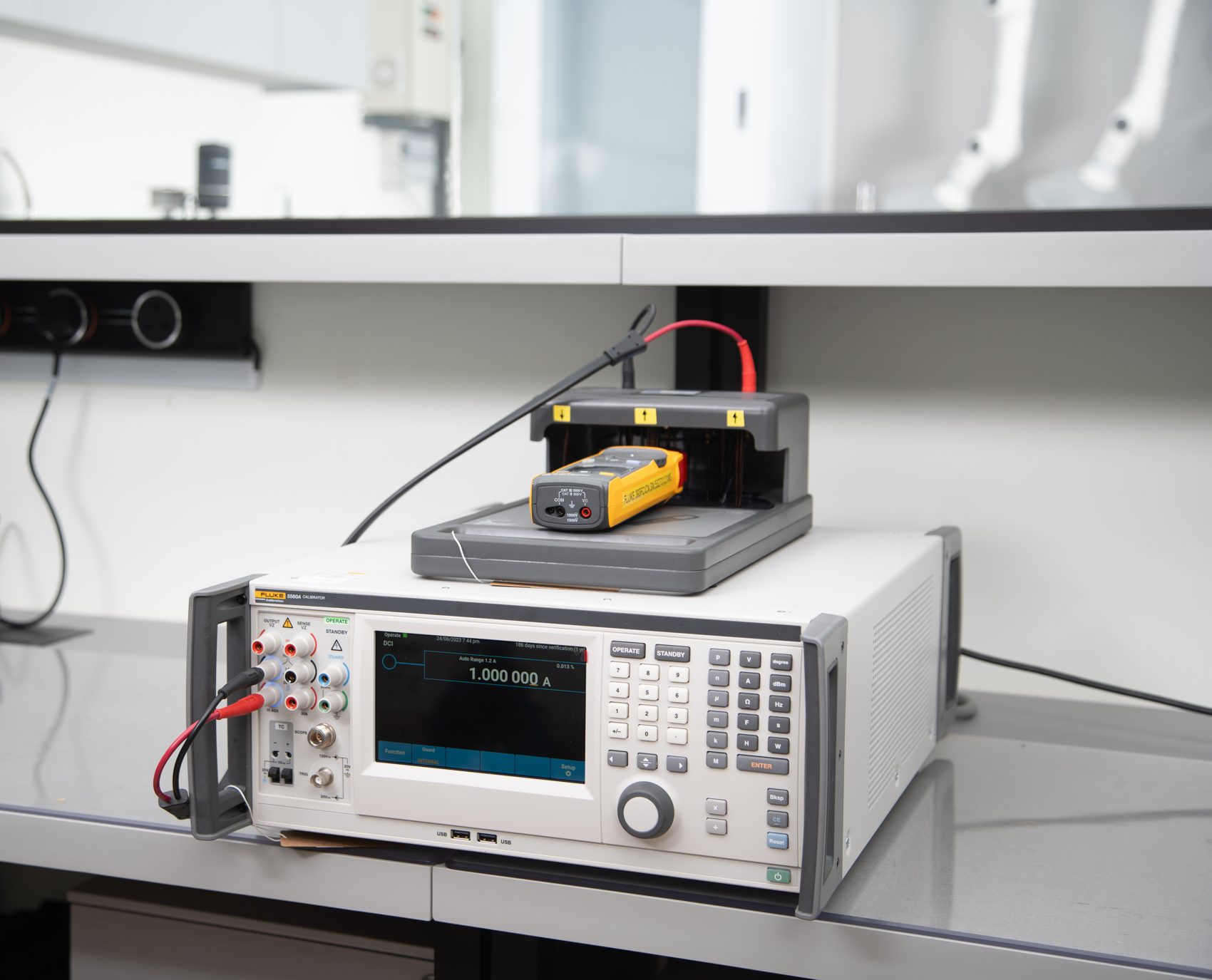
- Any instrument used to monitor or verify a HACCP Critical Control Point must carry a current, traceable calibration certificate.
- Key instruments include food probe thermometers, infrared thermometers, temperature data loggers, weighing scales, pH meters, water activity meters, and cold-room humidity sensors.
- Standard calibration intervals for CCP instruments in Singapore F&B are 6 to 12 months, with more frequent verification for high-use or high-risk points.
- A SAC-SINGLAS accredited certificate (ISO/IEC 17025) provides metrological traceability accepted by SFA, HACCP auditors, and ISO 9001 bodies.
- Measurement uncertainty declared on the certificate allows your QA team to apply correct safety margins at each CCP limit.
Why Calibration Is Non-Negotiable Under HACCP
HACCP (Hazard Analysis and Critical Control Points), is a preventive food safety management system mandated for food establishments in Singapore by the Singapore Food Agency (SFA). At its core, HACCP requires that every Critical Control Point (CCP) in the production process has a defined critical limit, a monitoring method, and a verification procedure. The monitoring method almost always involves a measuring instrument: a thermometer reading core cook temperature, a scale confirming salt concentration, or a pH meter verifying the acidity of a marinated product.
If that instrument is not calibrated, the monitoring data it generates is metrologically meaningless. An uncalibrated thermometer may read 75°C when the actual core temperature is only 71°C. A four-degree shortfall that can leave pathogens like Salmonella or Listeria monocytogenes viable in the product. HACCP Principle 6 (verification) explicitly requires that monitoring equipment is calibrated at specified intervals, and auditors will ask to see calibration certificates for every CCP instrument during a scheduled or unannounced inspection.
For Singapore operators, the stakes are real. A failed SFA audit can trigger a licence suspension, mandatory recalls, and significant reputational damage in a market where food safety headlines travel fast. Maintaining a complete, up-to-date calibration register is the single cheapest insurance policy a food business can hold.
Which Instruments Are Used in F&B and Central Kitchen Operations
The instrument portfolio of a central kitchen spans every phase of production, from goods receipt through cooking, portioning, chilling, and cold storage. Each phase introduces different measurement parameters and different calibration requirements. Understanding this full picture is the starting point for building a calibration schedule that satisfies both HACCP documentation requirements and practical operations.
Temperature Measurement
Temperature is the most critical parameter in food safety. Probe thermometers are used to verify that cooked items have reached minimum safe internal temperatures (75°C for poultry in Singapore). Infrared (non-contact) thermometers allow rapid surface checks during goods receipt. Temperature data loggers monitor cold chain continuity in chillers, blast freezers, and during transport. Thermocouple probes inserted into sous-vide baths or retorts verify processing temperatures against scheduled processes.
Each of these instrument types has different calibration requirements. Probe thermometers need multi-point calibration across their working range. Infrared thermometers require calibration against a black-body reference. Data loggers need verification of both sensor accuracy and logging resolution. All must carry a certificate traceable to Singapore's national measurement standards.
Mass and Weight
Weighing scales are used for recipe batching, portioning, allergen-control (where ingredient masses must be precisely controlled), and yield monitoring. A scale that drifts by 5% on a 10 kg batch of a major allergen ingredient is not just a quality problem. It can be a legal liability under Singapore's Sale of Food Act. Calibration of weighing instruments confirms linearity, repeatability, and accuracy across the full operating range.
pH and Acidity
For marinated products, fermented items, acidified foods, and beverages, pH is a CCP parameter. A pH below 4.6 is the threshold below which Clostridium botulinum cannot produce toxin. A critical limit in many food safety plans. pH meters are sensitive instruments that drift with electrode age, temperature changes, and contamination. They must be calibrated using buffer solutions and verified against known standards; the electrode itself has a defined service life that must be tracked.
Humidity and Pressure
Walk-in cold rooms, proofing chambers, and curing rooms all depend on humidity control. Water activity (aw) meters are used in product development and production sign-off for shelf-stable or reduced-moisture items. Pressure gauges on retorts (used in commercial sterilisation) and carbonation rigs must be calibrated because they directly control the safety or consistency of the process. Even differential pressure gauges in clean-room or positive-pressure areas of high-care facilities fall within scope.
| Parameter | Instrument Type | Typical CCP / Application | Recommended Calibration Interval |
|---|---|---|---|
| Temperature | Food probe thermometer, thermocouple | Core cook temperature, pasteurisation | 6 months (high-use: 3 months) |
| Temperature | Infrared thermometer | Goods receipt surface checks | 6–12 months |
| Temperature | Data logger / chart recorder | Cold room, blast chiller monitoring | 12 months (plus sensor check every 6 months) |
| Mass / Weight | Bench scale, floor scale | Recipe batching, portioning, allergen control | 12 months (or after repair / relocation) |
| pH / Acidity | Benchtop pH meter, portable pH meter | Acidified products, marinades, beverages | 6–12 months; electrode replacement as needed |
| Water Activity | Water activity meter (aw) | Shelf-stable product validation | 12 months or per manufacturer guidance |
| Pressure | Pressure gauge, manometer | Retort, carbonation, positive-pressure rooms | 12 months |
| Humidity / RH | Hygrometer, RH transmitter | Cold room RH, curing rooms, proofing chambers | 12 months |
Calibration Intervals: What SFA and Auditors Actually Expect
There is no single legally mandated calibration interval for all instruments. HACCP is a risk-based system, and intervals are set in proportion to the criticality of the measurement and the instrument's use profile. However, industry practice in Singapore, shaped by SFA guidance and third-party HACCP certification bodies, has converged on working norms that auditors expect to see.
For probe thermometers used directly at CCPs, a 6-month interval is the practical standard. Instruments that are dropped, exposed to extreme temperature cycling, or used in high-throughput production lines are often placed on a 3-month schedule. Infrared thermometers used for quick goods-receipt screening are commonly calibrated annually, since they are a verification tool rather than a primary CCP monitor. Data loggers installed in fixed cold rooms are calibrated annually at minimum, but many operations run a 6-month sensor verification to catch drift between full calibrations.
Weighing scales calibrated annually satisfy most food manufacturing audits, but scales used in allergen-critical batching or pharmaceutical-grade nutraceutical production may require quarterly verification. pH meters, which drift continuously as the electrode ages, are typically calibrated every 6 months, with a daily or pre-use buffer verification logged in production records. This pre-use check is a verification step, not a calibration. It does not replace the formal accredited certificate.
For a deeper look at how to set and justify calibration intervals based on instrument risk and history, see our guide to how often calibration should be done.
Need HACCP-compliant calibration certificates for your F&B operation?
Unitest Instruments calibrates food thermometers, scales, pH meters, and cold-room sensors with full traceability to Singapore's NMC. Same-week turnaround available.
The Role of SAC-SINGLAS Accreditation in F&B Compliance
Not all calibration certificates carry the same evidential weight. A certificate produced by an in-house team or a non-accredited workshop may record a reading comparison, but it cannot demonstrate independent competence, reference standard traceability, or conformity with internationally recognised quality requirements. When an SFA auditor or a third-party HACCP certification body reviews your calibration register, they look for certificates that are traceable to national measurement standards and issued by a laboratory whose technical competence has been independently verified.
SAC-SINGLAS (Singapore Accreditation Council. Singapore Laboratory Accreditation Scheme) accreditation under ISO/IEC 17025 provides precisely this assurance. It means the laboratory has been assessed by SAC technical experts, demonstrated competence in the specific measurement parameters within its scope, and maintains an unbroken traceability chain from its reference standards to Singapore's National Metrology Centre (NMC). Unitest Instruments holds SAC-SINGLAS accreditation No. LA-2023-0845-C for temperature, mass, pressure, and related parameters. The core disciplines for F&B calibration.
The practical significance for your QA team is this: when a certificate bearing the SAC-SINGLAS mark is in your calibration file, the burden of demonstrating measurement validity shifts from you to the accredited body. An auditor cannot reasonably challenge the technical validity of a traceable, accredited certificate the way they might challenge an in-house comparison. This matters most in the moments when food safety is under scrutiny. An adverse event investigation, a customer audit, or an SFA inspection triggered by a complaint.
For a full explanation of what an ISO/IEC 17025 calibration certificate contains and how to read it, see our article on accredited versus non-accredited calibration.
What Your QA Team Needs to Do: A Practical Action Plan
Building a calibration programme for a central kitchen or F&B facility does not require specialist metrological knowledge. It requires methodical documentation and a reliable laboratory partner. The following steps translate HACCP calibration requirements into operational practice.
Step 1. Build a Complete Instrument Register
Start by listing every instrument used in the facility, including its make, model, serial number, location, and the measurement parameter it monitors. Flag each instrument against your HACCP plan: is it used at a CCP, a control point, or for general production monitoring? CCP instruments are your highest priority. Do not overlook instruments that feel routine. A broken or drifted receiving thermometer has caused serious food safety failures in kitchens that assumed it was "good enough."
Step 2. Assign Calibration Intervals and Trigger Events
Based on the parameter, criticality, and use profile, assign a calibration interval to each instrument. Record the due date and set a reminder at least four weeks out so you can schedule the calibration without production disruption. In addition to scheduled intervals, define trigger events that require an out-of-schedule calibration: instrument is dropped or physically damaged; instrument reads outside expected range during a pre-use verification check; instrument returns from repair; instrument is relocated or reassigned to a different process. These trigger-event criteria should be documented in your HACCP-supporting procedures.
Step 3. Manage Certificates and Track Expiry
Maintain a calibration register (a simple spreadsheet is sufficient for most operations), that records the instrument ID, last calibration date, certificate number, calibration laboratory, and next due date. Store the physical or digital certificate in a location accessible to your QA manager and auditors. An expired certificate is treated the same as no certificate during an audit: the instrument is considered out of calibration and any data it has generated since expiry is suspect.
Step 4. Use Calibration Data Operationally
A calibration certificate is not just a compliance document, it is actionable data. If the certificate shows your probe thermometer consistently reads 1.2°C high across its range, your QA team can document a correction factor and apply it to CCP monitoring records. If measurement uncertainty is ±0.8°C, your safety margin at a 75°C CCP must account for this. You may require the instrument to read 75.8°C or higher before releasing the product. This is the practical application of measurement uncertainty in food safety; see our detailed explainer on measurement uncertainty for a step-by-step walkthrough.
Step 5. Run a Daily or Pre-Shift Verification
Between formal calibrations, run an in-house verification check at the start of each production shift. For thermometers, this is typically an ice-point check (crushed ice slurry at 0°C ± 0.5°C) recorded in a logbook. For scales, place a check weight of known value on the scale and record the reading. If a verification check falls outside your acceptance criteria, remove the instrument from service, initiate a formal calibration, and review any production data generated since the last satisfactory check. This daily vigilance is what transforms calibration from a paper exercise into a genuine food safety control.
Common Mistakes F&B Operations Make with Calibration
Despite the clear requirements, certain calibration failures appear repeatedly in Singapore F&B audit findings. Being aware of them allows your QA team to close gaps before an auditor finds them.
Calibrating the wrong range. A thermometer used to check refrigeration temperatures (2–8°C) that is calibrated only at 0°C and 100°C has a gap in its verified range. Ensure calibration points span the actual working range of the instrument, not just convenient reference points.
Treating calibration and verification as the same thing. An ice-bath check is a verification. It confirms the instrument is within an acceptable tolerance at one point. It does not replace a multi-point accredited calibration. Both are required: formal calibration sets the baseline and produces the certificate; daily verification confirms the instrument has not drifted since.
No process for out-of-tolerance findings. When a calibration reveals the instrument was out of tolerance (meaning it was not reading correctly during the period since its last calibration), many operations have no documented procedure for investigating what food was produced during that period and whether it is safe. Your HACCP plan must include a corrective action procedure for this scenario, including the criteria for product recall or additional testing.
Buying new instruments without calibrating before use. A new instrument from a manufacturer is not automatically calibrated to your required accuracy. Factory calibration certificates may not cover your temperature range, may use different reference standards, or may already be months old. Always commission a formal accredited calibration before placing a new instrument into CCP service.
Frequently Asked Questions
Under a HACCP plan, any instrument used to monitor or verify a Critical Control Point (CCP) must be calibrated. This typically includes food-grade thermometers (probe, infrared, and data loggers), weighing scales and balances, pH meters, water activity meters, pressure gauges on retorts or blast chillers, and humidity sensors in cold rooms and proofing chambers. If an instrument's reading influences a food safety decision, it must carry a valid calibration certificate.
Singapore Food Agency (SFA) guidelines and HACCP auditors generally expect food thermometers used at CCPs to be calibrated at least every 6 to 12 months, or more frequently if the instrument is dropped, gives suspect readings, or is used in harsh environments. High-throughput central kitchens producing cook-chill or sous-vide items commonly calibrate probe thermometers every 3 to 6 months due to the volume and food-safety criticality of the measurements.
Yes. A calibration certificate issued by a SAC-SINGLAS accredited laboratory under ISO/IEC 17025 provides the highest level of metrological evidence available in Singapore. The certificate demonstrates traceability to Singapore's national measurement standards (NMC), includes documented measurement uncertainty, and is directly accepted by SFA auditors, BizSAFE auditors, and third-party HACCP certification bodies. Using an accredited certificate removes ambiguity during inspections and strengthens your food safety documentation.
Measurement uncertainty is a quantified statement of the range within which the true value is expected to lie. For food safety it is critical because HACCP CCPs carry defined temperature or pH limits, for example, a minimum cook temperature of 75°C. If your thermometer has an uncertainty of ±0.5°C but you do not know this, you may believe food is safe when it is not. An ISO/IEC 17025 calibration certificate documents this uncertainty so that your QA team can apply the correct safety margins and avoid both under-processing (safety risk) and over-processing (quality loss).
An ice bath check (0°C reference) is a useful daily or pre-shift verification step but it is not a substitute for formal calibration. An in-house ice bath check confirms the instrument is approximately correct at one point and is not traceable to national standards. For HACCP audit purposes, you will still need a traceable multi-point calibration certificate from an accredited laboratory, typically covering the full working range of the instrument (e.g. -20°C to 150°C for a cook-chill probe).
Unitest Instruments offers same-week turnaround for most food and central kitchen instruments. Many thermometers, pH meters, and scales can be calibrated within 1 to 3 working days. For operations that cannot afford instrument downtime, we recommend maintaining a small pool of calibrated spares in rotation, or booking on-site calibration where feasible. Contact us to discuss scheduling around your production shifts.
A temperature calibration certificate from Unitest will state the calibration points (e.g. 0°C, 75°C, 100°C), the reading of your instrument at each point, the reference standard value, the error (deviation), and the expanded measurement uncertainty at a stated confidence level (typically 95%). It will also identify the calibration standard used, its own traceability, and the next recommended calibration date. This multi-point data allows your QA team to apply a correction factor across the instrument's operating range.
Weighing instruments in central kitchens are typically calibrated against OIML (International Organisation of Legal Metrology) class E2 or F1 reference weights, traceable to Singapore's national mass standards. Calibration covers the full weighing range of the scale with points spread across its capacity. For production scales used in recipe batching, a calibration certificate confirms linearity and reproducibility. Both critical for consistent product yield and allergen-control accuracy where ingredient masses are tightly specified.
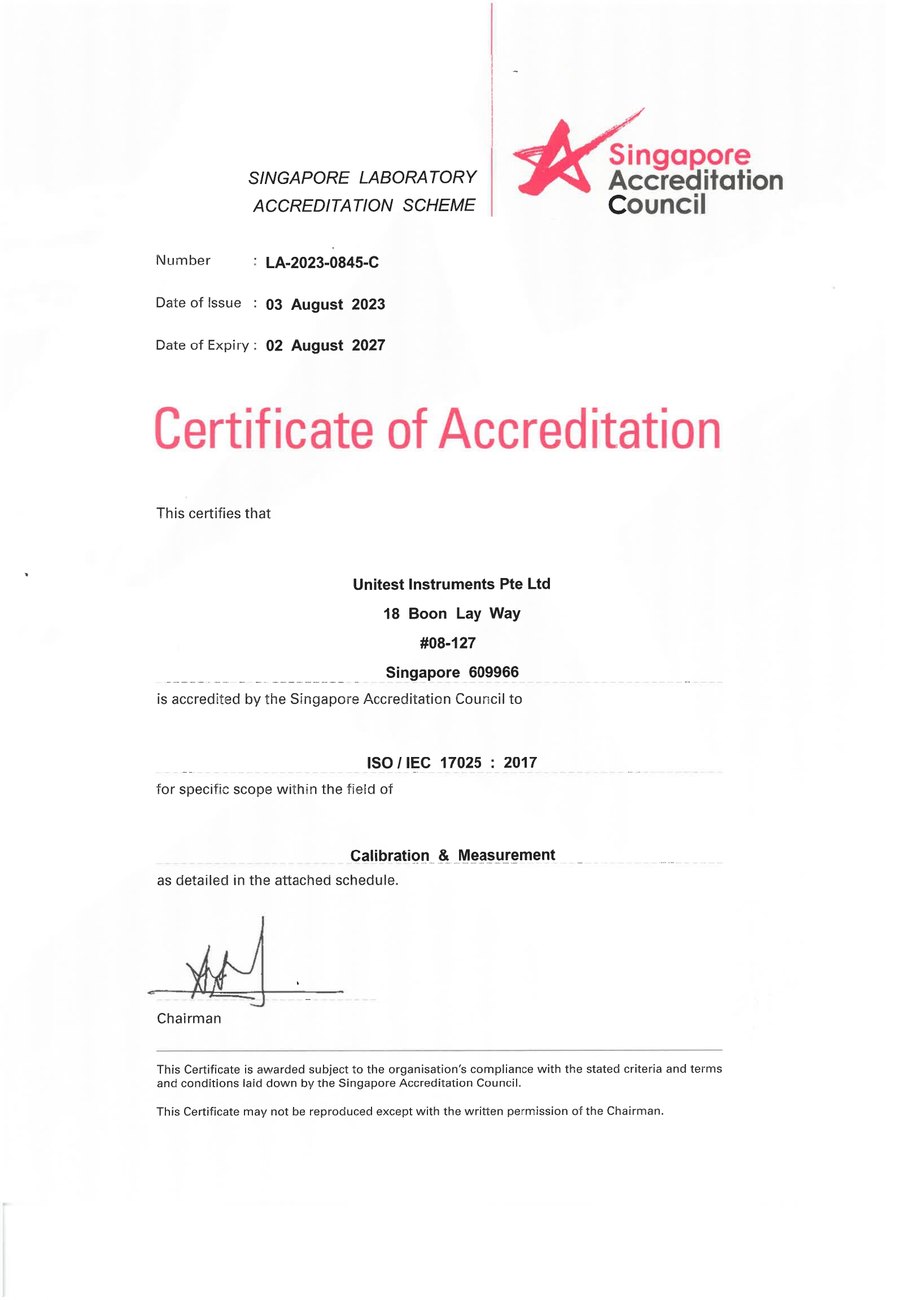
SAC-SINGLAS accredited calibration laboratory (Acc. No. LA-2023-0845-C) serving Singapore's industrial, pharmaceutical, and manufacturing sectors. All content reflects our ISO/IEC 17025 accredited scope and is reviewed by our technical calibration team.
Need HACCP and F&B calibration in Singapore?
Unitest Instruments is SAC-SINGLAS accredited (Acc. No. LA-2023-0845-C) to ISO/IEC 17025. Same-week turnaround, certificates accepted by SFA auditors and ISO 9001 bodies.