
Key Takeaways
- Facilities teams are responsible for instruments across ACMV, electrical, IAQ, and safety domains. All of which need documented calibration histories.
- SAC-SINGLAS accredited certificates (ISO/IEC 17025) are the gold standard for audit evidence in Singapore. Accepted by BCA, NEA, MOM, and ISO 9001 auditors.
- Most building management instruments should be calibrated annually; safety-critical or high-use instruments should be calibrated every six months.
- A calibration register (instrument asset list with due dates) is the foundation of a compliant facilities maintenance programme.
- Out-of-tolerance findings require a documented corrective action and a risk-of-use review, not just a re-calibration.
Why Calibration Is a Facilities Management Responsibility
In a commercial building or integrated development, the facilities management (FM) team is the operational backbone. Your team controls indoor climate, manages electrical safety, monitors air quality, and ensures that the building complies with Singapore's dense stack of regulatory requirements, from BCA's Code on Accessibility to NEA's indoor air quality advisories to MOM's Workplace Safety and Health Act.
What most FM teams underestimate is that every measurement that underpins a compliance decision is only as reliable as the instrument making it. If your temperature sensor is reading 1.5°C high, your chiller is running inefficiently and your Green Mark energy calculations are wrong. If your CO2 monitor is drifting 150 ppm upward, you are likely over-ventilating (or worse, under-ventilating), without knowing it. If your clamp meter has not been calibrated, your electrical safety readings are unverifiable.
Calibration is not a paperwork exercise. It is the mechanism by which your team can trust the numbers coming out of your instruments, and demonstrate that trust to any auditor who walks through your door. In Singapore's highly regulated building environment, that audit-readiness is not optional.
Key Instruments Used in Building Management, and What They Measure
Facilities teams work with a wider variety of measuring instruments than most industries. The table below covers the primary instrument categories, the parameters they measure, their typical calibration interval, and the compliance context in Singapore.
| Instrument Type | Parameter Measured | Typical Calibration Interval | Singapore Compliance Context |
|---|---|---|---|
| Temperature & Humidity Sensors / Data Loggers | Dry-bulb temperature (°C), relative humidity (%RH) | 12 months | BCA Green Mark, NEA IAQ guidelines, SS 553 (ACMV code) |
| CO2 / Carbon Dioxide Monitors | CO2 concentration (ppm) | 6–12 months | NEA IAQ guidelines (1,000 ppm limit for occupied spaces) |
| Pressure Gauges | Gauge pressure (bar, kPa) | 12 months | PUB water pressure, ACMV duct pressure, fire suppression system pressure |
| Thermometers (Contact & Infrared) | Surface / liquid temperature (°C) | 12 months | Chilled water temperature monitoring, hot water system safety |
| Lux Meters / Illuminance Meters | Illuminance (lux) | 12 months | SS 531 (Code of Practice for Lighting), BCA Green Mark lighting credits |
| Sound Level Meters | Sound pressure level (dB, dBA) | 12 months | MOM WSH noise regulations, NEA environmental noise control |
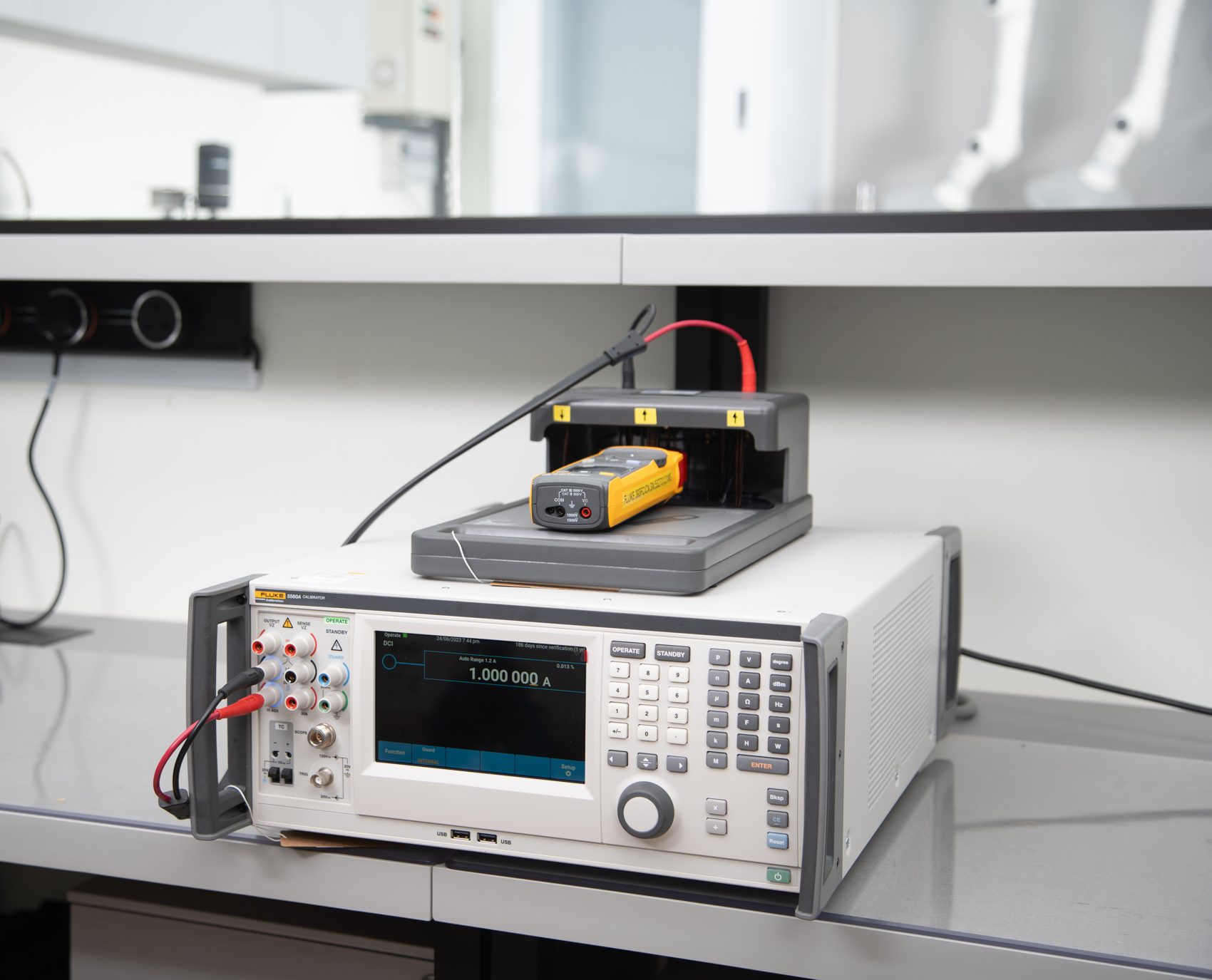
| Clamp Meters / Multimeters | Voltage (V), current (A), resistance (Ω) | 12 months | MOM WSH (Electrical), EMA licensed electrical worker requirements |
| Insulation Resistance Testers | Insulation resistance (MΩ) | 12 months | Periodic electrical testing of fixed installations (EMA requirements) |
| Differential Pressure Gauges / Manometers | Differential pressure (Pa, mmWG) | 12 months | AHU filter monitoring, cleanroom pressure differentials |
| Power Quality Analysers | Power factor, harmonics, energy (kWh) | 12 months | BCA Green Mark energy metering, SP Group energy audits |
This is not an exhaustive list. Specialist facilities (data centres, hospitals, laboratories, food courts) will have additional instrument types such as particle counters, pH meters, or flow meters. The principle applies uniformly: if you use it to make a decision, it needs a calibration record.
Singapore's Regulatory Landscape for Building Calibration
Singapore does not have a single omnibus regulation that mandates calibration for all building management instruments. Instead, calibration obligations arise from a patchwork of standards, codes of practice, and agency guidelines. Understanding where the obligations originate helps you prioritise your calibration schedule correctly.
BCA Green Mark
The Building and Construction Authority's Green Mark certification requires verifiable measurement data for energy performance, indoor environment quality, and water efficiency credits. Assessors expect that instruments used to generate these measurements are calibrated and traceable. A temperature or energy meter without a current calibration certificate will undermine your Green Mark submission.
NEA Indoor Air Quality
The National Environment Agency publishes indoor air quality guidelines for non-industrial premises. For CO2, PM2.5, TVOC, and temperature/humidity, the guidelines recommend that monitoring instruments be calibrated by a competent laboratory. Using a SAC-SINGLAS accredited laboratory ensures your IAQ monitoring data will be accepted as reliable by NEA inspectors. This is particularly important if your building experiences a complaint or enforcement action.
MOM Workplace Safety and Health
The Workplace Safety and Health Act requires employers to manage risks from noise, electrical hazards, and environmental conditions. Sound level meters used for noise risk assessments and electrical test equipment used for installation safety checks must be in calibrated condition to produce legally defensible readings.
SS 553 and ACMV Systems
Singapore Standard SS 553 covers the installation and maintenance of air-conditioning and mechanical ventilation systems. It references calibration of measurement instruments used during commissioning and performance testing. Facilities teams maintaining ACMV systems as part of their preventive maintenance programme should ensure temperature, humidity, pressure, and airflow instruments are calibrated in accordance with the standard's requirements.
Get your building management instruments calibrated, audit-ready certificates, same week.
Unitest Instruments (Acc. No. LA-2023-0845-C) calibrates the full range of facilities and building management instruments. Certificates are accepted by BCA, NEA, MOM, and ISO 9001 auditors.
What an Accredited Calibration Certificate Provides, and Why It Matters
Not all calibration certificates carry the same weight. A certificate from a SAC-SINGLAS accredited laboratory under ISO/IEC 17025 is fundamentally different from one issued by a non-accredited service provider. Understanding the difference is important for facilities teams who need to defend their compliance posture.
An ISO/IEC 17025 accredited certificate includes measurement uncertainty. A quantified statement of how confident you can be in the result. It also includes full traceability: a documented chain of references linking your instrument's calibration back through national and international measurement standards (in Singapore's case, back to the National Metrology Centre). Without these two elements, a calibration document is little more than an instrument comparison with no defensible basis.
For a deeper look at what a calibration certificate should contain, see our guide on how to read a calibration certificate. For context on why traceability matters for compliance, our article on measurement traceability in calibration explains the chain of reference from your instrument all the way to Singapore's national standards.
For facilities teams, the practical consequence is straightforward: SAC-SINGLAS certificates are accepted by auditors and regulators; non-accredited certificates may be questioned. Using an accredited laboratory is the lower-risk choice, and in Singapore, Unitest Instruments (Acc. No. LA-2023-0845-C) holds SAC-SINGLAS accreditation covering the key parameters used in building management.
How to Build and Maintain a Calibration Register
A calibration register is the operational core of a compliant FM calibration programme. It is a living document (typically a spreadsheet or a module in your Computerised Maintenance Management System (CMMS)), that tracks every measuring instrument in the facility.
What the register should contain
For each instrument, record: a unique asset ID, instrument description (type, make, model), serial number, location in the building, last calibration date, calibration certificate number, the calibrating laboratory and its accreditation status, next calibration due date, and the assigned responsible person. The due date column is the most operationally important: it drives your forward booking with the calibration laboratory.
Setting calibration intervals
Intervals should be risk-based, not arbitrary. Start with the manufacturer's recommendation as a baseline, then adjust based on usage intensity, environmental exposure (humidity, vibration, temperature extremes), and the criticality of the measurement. A CO2 monitor in a densely occupied boardroom used daily in Singapore's humid climate may warrant a six-month interval; a backup pressure gauge checked only during maintenance may be fine at twelve months.
Once you have established intervals, review them annually. If an instrument consistently comes back within tolerance, you may be able to extend the interval. If it regularly shows drift, shorten it. This interval-optimisation process is documented in ISO 9001's approach to monitoring and measurement resources and is good practice regardless of certification status. Our article on how to determine calibration intervals provides a detailed framework for this decision.
Managing lapsed certificates
If an instrument's calibration has lapsed (meaning the due date has passed and no new calibration has been performed), you have a gap in your compliance record. Do not simply re-calibrate and move on. Document the gap, assess whether any safety or compliance decisions were made using the instrument during the lapsed period, and record the outcome of that assessment. Auditors will ask. Having a documented response demonstrates a mature quality system; having no response at all suggests a systemic weakness.
Practical Steps for Facilities Teams: Getting Started
If your building does not currently have a structured calibration programme, or if your existing programme has gaps, the following steps will get you to a defensible baseline quickly.
Step 1: Conduct an instrument audit
Walk the building systematically (plant room by plant room, floor by floor), and list every measuring instrument. Include fixed sensors, portable instruments, and any equipment used by contractors during routine maintenance. Many facilities teams are surprised to find instruments they had forgotten about: a sound level meter in the security office, a temperature gun in the F&B pantry, pH strips in the cooling tower chemical dosing area.
Step 2: Prioritise by risk
Classify each instrument by the risk of its measurement being wrong. Safety-critical instruments (electrical testers, gas detectors, pressure gauges on fire suppression systems) are highest priority. Compliance-critical instruments (CO2 monitors, energy meters, temperature sensors tied to Green Mark data) are next. Operational instruments (general HVAC monitoring) can follow.
Step 3: Identify gaps and book calibration
Cross-reference your instrument list against calibration certificates on file. Any instrument without a current, accredited calibration certificate is a gap. Compile the gap list and contact Unitest Instruments to arrange calibration. We can typically accommodate same-week turnaround for most building management instrument types.
Step 4: Integrate into your CMMS
Once all instruments are calibrated and certificates are filed, enter the due dates into your CMMS or maintenance calendar. Set reminder triggers 4–6 weeks before each due date so you have time to book calibration before the certificate lapses. Treat calibration renewals the same way you treat preventive maintenance for your chillers and AHUs: scheduled, tracked, and not allowed to slip.
Step 5: Train your team
Your technicians and engineers should understand why calibration matters, not just that it is required. When they know that an uncalibrated temperature sensor can cause the chiller to run inefficiently or that an uncalibrated clamp meter produces an unverifiable safety reading, calibration compliance becomes part of professional pride rather than a paperwork burden. Brief quarterly toolbox talks covering the calibration register and any upcoming renewals are an effective way to maintain awareness.
How Sensor Drift Quietly Inflates Your Building's Energy Bill
Most FM teams think of calibration purely as an audit requirement: a certificate to produce when someone asks. But for the sensors wired into your Building Management System (BMS), sometimes called a Building Automation System (BAS), calibration accuracy has a second, less visible consequence. It directly affects how much energy your building consumes every single day.
A BMS makes continuous, automated decisions from the sensor data it receives. Chiller staging (how many chillers run, and at what load), VAV (variable air volume) damper positioning, economiser cycle switching, and demand-controlled ventilation (adjusting fresh air intake based on CO2 readings) are all driven by real-time sensor inputs, not human judgement. If a chilled water supply temperature sensor reads even a small, sustained offset warmer or cooler than actual, the BMS control logic can keep an additional chiller running longer than needed, or extend a cooling cycle past the point of diminishing return. Multiply that error across every control loop, every hour, every day of the year, and a modest sensor drift compounds into a measurable increase in utility spend. One that is invisible on the energy bill because there is no obvious fault, no alarm, and no occupant complaint. The system is simply working harder than it needs to, quietly, in the background.
This distinction matters because most FM teams calibrate the wrong instruments. It is common practice to calibrate the portable reference meter used for spot checks (a handheld thermometer or lux meter), while the hundreds of fixed sensors embedded in the BMS itself, wired into DDC (direct digital control) controllers throughout the ceiling void, are left untouched for years at a time. Recalibrating an embedded BMS sensor is more involved than sending a portable instrument to a lab: it typically requires an in-situ comparison, where a calibrated portable reference instrument is placed alongside the fixed sensor under normal operating conditions and the two readings are compared side by side. If the fixed sensor's reading falls outside acceptable tolerance of the calibrated reference, it is flagged for adjustment, recalibration, or replacement through your BMS vendor or ELV contractor, rather than left running on an assumption of accuracy.
For buildings pursuing BCA Green Mark or the Super Low Energy (SLE) programme, this matters even more directly. Green Mark's energy performance criteria increasingly reward continuous, data-driven optimisation, meaning an assessor is not just looking at a single measurement snapshot but at the BMS trend data itself as evidence of ongoing performance. If the sensors feeding that trend data have never been verified against a traceable reference, the entire optimisation narrative rests on unverified numbers, however sophisticated the analytics dashboard sitting on top of them. A calibrated portable reference instrument used periodically to cross-check your BMS sensor network is a straightforward way to close this gap, and it gives both your energy management team and your Green Mark assessor genuine confidence that the numbers driving your building's automated decisions are correct, not just plausible.
Accredited vs Non-Accredited Calibration: The Bottom Line for FM Teams
The simplest way to frame the choice is this: accredited calibration from a SAC-SINGLAS laboratory costs a comparable amount to non-accredited calibration from an unrecognised provider, but the accredited certificate is accepted everywhere (by every auditor, every regulator, every ISO standard), without question. A non-accredited certificate may be accepted in some contexts but rejected in others, introducing uncertainty exactly when you need certainty.
For a detailed comparison of what separates accredited from non-accredited calibration services (including how to evaluate a laboratory's competence before sending your instruments), read our guide on accredited vs non-accredited calibration.
For building management teams whose instruments underpin regulatory submissions, safety decisions, and ISO 9001 quality systems, the choice to use a SAC-SINGLAS accredited laboratory is not a premium, it is the baseline. Unitest Instruments holds SAC-SINGLAS accreditation number LA-2023-0845-C and calibrates across the full range of parameters relevant to Singapore's facilities and building management sector.
Frequently Asked Questions
Facilities teams typically need to calibrate temperature and humidity sensors (for ACMV systems and server rooms), CO2 and indoor air quality monitors, pressure gauges on pumps and air handling units, thermometers used for chilled water and hot water systems, lux meters for lighting compliance, sound level meters for noise management, and electrical test equipment such as clamp meters and insulation testers. Any instrument used to make a compliance or safety decision should be on a regular calibration schedule.
Most building management instruments should be calibrated annually as a baseline. High-use instruments in critical environments (such as temperature sensors in server rooms or CO2 monitors in densely occupied spaces), may require calibration every six months. Singapore's NEA indoor air quality guidelines and BCA Green Mark requirements do not always specify a fixed interval, but auditors expect documented, traceable calibration history. Calibration intervals should be reviewed and recorded in your preventive maintenance schedule.
Yes. NEA's indoor air quality guidelines recommend that IAQ monitoring instruments be calibrated against a traceable reference to ensure readings are reliable and defensible. While NEA does not mandate a specific accreditation body, using a SAC-SINGLAS accredited laboratory (such as Unitest Instruments, Acc. No. LA-2023-0845-C) provides the strongest form of calibration evidence because the laboratory's competence has been independently verified against ISO/IEC 17025.
SAC-SINGLAS (Singapore Accreditation Council – Singapore Laboratory Accreditation Scheme) is Singapore's national laboratory accreditation programme. A SAC-SINGLAS accredited calibration certificate carries formal government-backed recognition that the laboratory meets ISO/IEC 17025 requirements for technical competence and measurement traceability. For a facilities team, this means your calibration certificates will be accepted without question by ISO 9001 auditors, BCA Green Mark assessors, NEA inspectors, and occupational health & safety auditors.
A calibration certificate is a document issued by a calibration laboratory recording the measured values of your instrument compared to a reference standard, along with the measurement uncertainty. For a facilities audit, the certificate should include: the instrument description and serial number, calibration date and due date, reference standard traceability details, measured results at multiple test points, declared measurement uncertainty, and the accreditation body's logo (e.g. SAC-SINGLAS) and the laboratory's accreditation number. A certificate without measurement uncertainty or traceability information is not compliant with ISO/IEC 17025.
Technically, you can use any laboratory, but for compliance and audit purposes it is strongly recommended to use a SAC-SINGLAS accredited laboratory. Certificates from non-accredited laboratories may be questioned or rejected by ISO 9001 auditors and government agency inspections. Accredited laboratories have their measurement traceability and technical competence independently verified, which is what gives the certificate its weight in an audit context.
If an instrument is found to be out of tolerance during calibration, the laboratory will note this on the certificate. You then have two options: have the instrument adjusted or repaired and re-calibrated, or retire it from use. You should also assess whether any decisions made using that instrument since its last calibration were affected. This is known as a 'risk of use' review. Documenting this review and any corrective actions protects you in an audit and demonstrates a mature calibration management process.
Start by creating an instrument register listing every measuring device used in your facility, its location, make, model, serial number, last calibration date, and next due date. Then group instruments by risk and usage frequency: safety-critical or high-use instruments should be calibrated every 6 months, while lower-risk instruments can follow an annual cycle. Integrate calibration due dates into your CMMS or preventive maintenance calendar. Engage a SAC-SINGLAS accredited laboratory such as Unitest Instruments ahead of due dates so certificates are renewed before expiry. Auditors look for continuous coverage with no gaps.
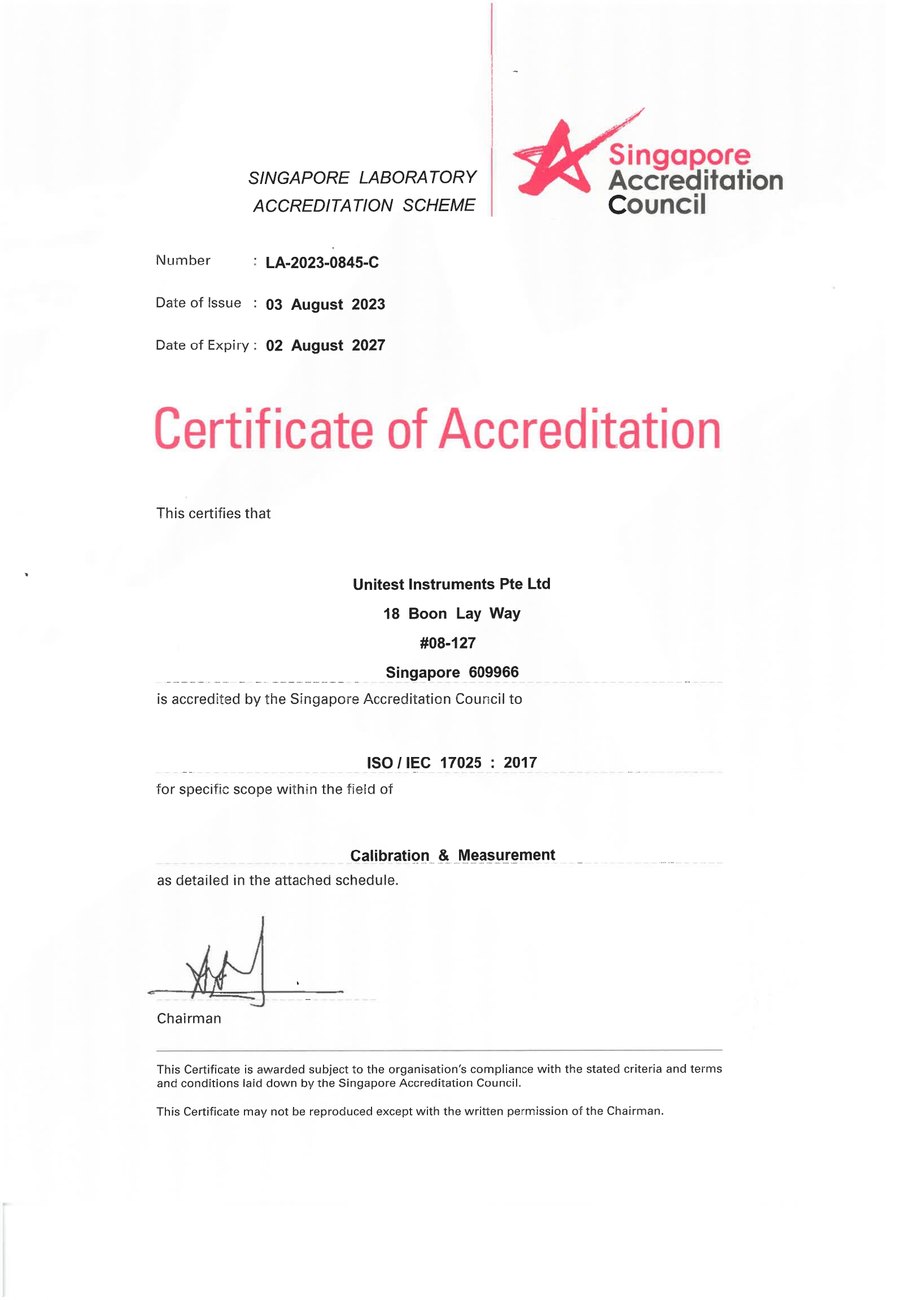
SAC-SINGLAS accredited calibration laboratory (Acc. No. LA-2023-0845-C) serving Singapore's industrial, pharmaceutical, and manufacturing sectors. All content reflects our ISO/IEC 17025 accredited scope and is reviewed by our technical calibration team.
Need building management instrument calibration in Singapore?
Unitest Instruments is SAC-SINGLAS accredited (Acc. No. LA-2023-0845-C) to ISO/IEC 17025. Same-week turnaround, certificates accepted by ISO 9001 auditors, BCA Green Mark assessors, and NEA inspectors.