
Key takeaways
- ISO 9001 permits in-house calibration (it does not require an external lab), but the traceability and uncertainty requirements still apply in full.
- The true cost of in-house calibration includes reference instrument capital, annual recalibration of those references, staff time, and environment control , often underestimated by 3–5×.
- Instruments required to carry a SAC-SINGLAS accredited certificate by customer contract or regulatory requirement must be calibrated externally by an accredited lab.
- A drifting in-house reference standard has cascading impact. Every instrument calibrated with it during the drift period may need reassessment.
- Most Singapore manufacturers use a hybrid model: outsource critical and compliance-driven instruments; use in-house checks for high-frequency, lower-risk items.
What in-house calibration actually requires
When a quality manager says "we do it in-house," it is worth being precise about what "it" means. In-house calibration that complies with ISO 9001:2015 clause 7.1.5 requires:
- Reference standards with documented traceability. Your in-house reference instruments must be calibrated by a SAC-SINGLAS accredited lab (or equivalent ILAC MRA member), with certificates showing stated uncertainties and traceability to Singapore's NMC.
- Documented calibration methods. Written procedures for each instrument type, specifying the method, the test points, the acceptance criteria, and the record format.
- Measurement uncertainty budgets, for each calibration type, a documented assessment of the uncertainty sources (reference uncertainty, instrument resolution, repeatability, environmental effects) and their combined expanded uncertainty.
- Controlled environment. Most calibration methods specify temperature (typically 23°C ±2°C) and humidity (45–75% RH) control. An uncontrolled factory floor does not meet this requirement for most electrical and temperature calibrations.
- Competent personnel. Documented training and authorisation for each technician performing calibrations, specific to the instrument types and methods they are authorised for.
None of this is impossible, but it is substantial. An organisation that sets up an in-house calibration capability and does it correctly is essentially running a small calibration lab. The question is whether that lab is cost-effective compared to outsourcing.
The true cost of in-house calibration
The most common mistake in the in-house vs outsource calculation is underestimating the true cost of in-house calibration. The visible cost is the technician's time. The hidden costs are larger:
| Cost element | Typical range (Singapore) | Notes |
|---|---|---|
| Reference instruments (capital) | S$40,000–S$150,000+ depending on scope | Amortised over 10 years; does not cover maintenance or repair |
| Annual accredited recalibration of references | S$3,000–S$15,000 per year | Your reference instruments need their own SAC-SINGLAS calibration annually |
| Technician time | S$25–S$60 per instrument per hour | Include setup, calibration, record-keeping, certificate issue |
| Environment control | S$5,000–S$20,000 per year | Dedicated air-conditioned room, humidity monitoring, records |
| Calibration management system | S$2,000–S$10,000 per year | Software, spreadsheet maintenance, audit preparation |
| Uncertainty budget development | S$5,000–S$20,000 (one-time setup) | Technical work to develop and validate uncertainty budgets per method |
For an operation calibrating 100 instruments per year with an average outsourcing cost of S$80 per instrument (S$8,000 per year), the in-house infrastructure cost is typically 3–5× the outsourcing cost at that volume. In-house calibration starts to become cost-competitive when the volume exceeds 300–500 instruments per year of the same parameter type, at that point, the fixed infrastructure cost is amortised across enough calibrations to bring the unit cost below the outsourcing rate.
Outsource your calibration to Singapore's accredited lab, and stop managing the infrastructure
Every Unitest certificate carries SAC-SINGLAS accreditation, stated uncertainties, and full NMC traceability. Fast turnaround, no capital investment required.
The decision framework: what to keep in-house, what to outsource
Apply four questions to each instrument or instrument type in your calibration register:
1. Does the compliance requirement demand SAC-SINGLAS accreditation?
Some customer contracts, industry standards, and regulatory frameworks explicitly require that calibration be performed by a SAC-SINGLAS accredited lab (or equivalent national accreditation body). If your customer's quality agreement, your AS9100 scope, your CAAS Part 145 approval, or your HSA GMP licence specifies accredited calibration, those instruments must go to an accredited lab, regardless of your in-house capability. Check contractual and regulatory requirements before deciding.
2. Do you have a reference standard capable of calibrating this instrument to the required uncertainty?
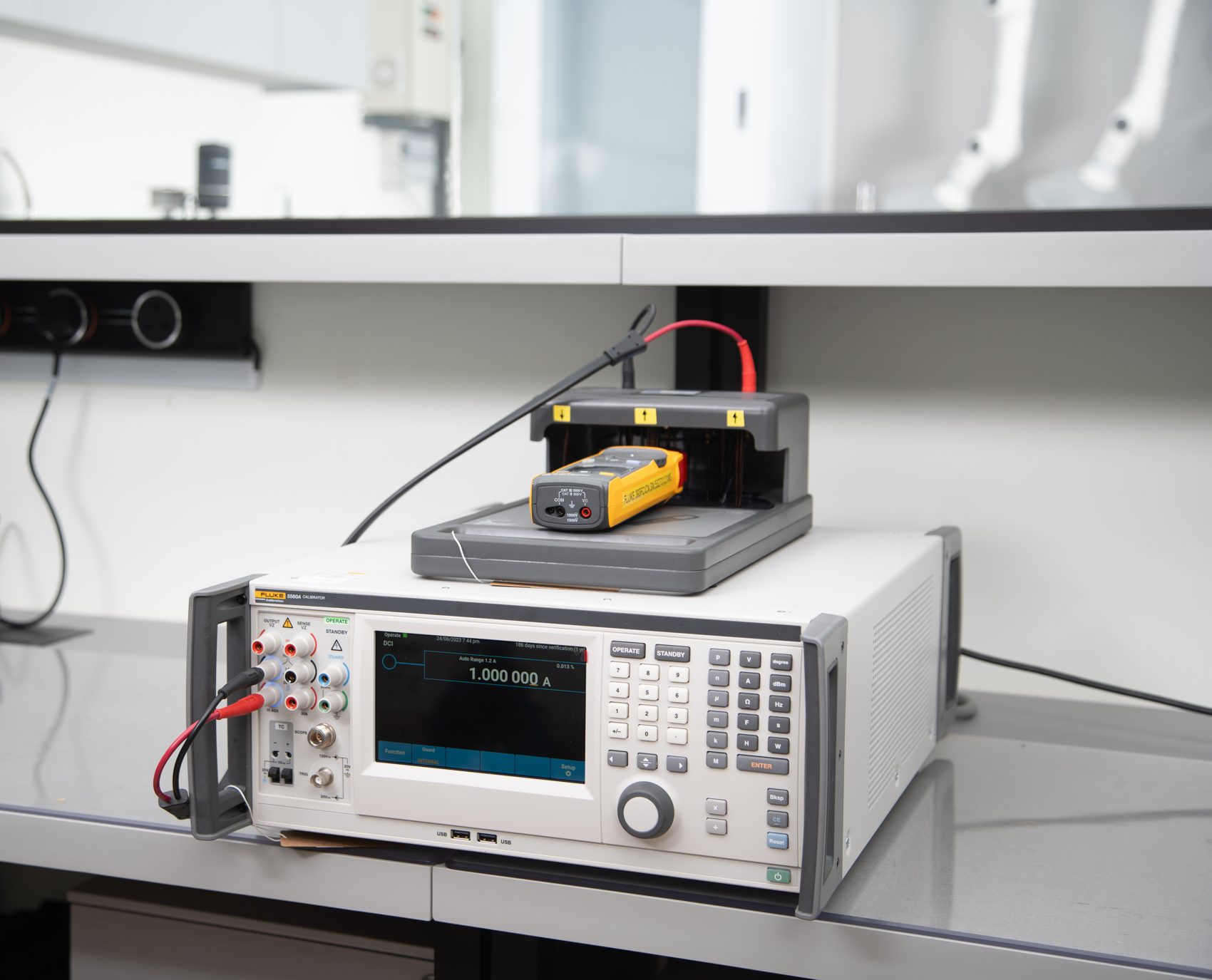
Your in-house reference standard must have an uncertainty at least 4× better than the tolerance of the instrument under calibration. The 4:1 test-to-tolerance ratio that is the practical standard in most calibration management frameworks. If you are calibrating a multimeter with a 0.05% DC voltage tolerance, your in-house reference must have an uncertainty of 0.0125% or better. In practice, this requires a high-accuracy multifunction calibrator that itself costs S$60,000–S$120,000 and needs annual accredited recalibration. If you cannot meet the 4:1 ratio, outsource.
3. What is the calibration frequency and instrument volume?
High-volume, high-frequency calibrations of the same parameter benefit most from in-house capability. If you have 500 identical pressure gauges all calibrated every 6 months, a single in-house reference and a trained technician can be cost-effective. If you have 50 different instrument types calibrated annually, the diversity of reference equipment needed and the lower volume per type make outsourcing more economical.
4. What are the consequences of a calibration error?
Instruments used in safety-critical, GMP-critical, or legal-for-trade applications carry higher consequences of calibration error. For these, the independent verification provided by SAC-SINGLAS accreditation is worth more than the cost saving of in-house calibration. In-house calibration is better suited to instruments used for process monitoring where the consequence of a small error is limited.
The hybrid model most Singapore manufacturers use
In practice, most Singapore quality operations use a hybrid: some instruments go to Unitest or another accredited lab; others are checked in-house between accredited calibrations. The typical hybrid structure looks like this:
- Tier 1. External accredited calibration: all instruments where SAC-SINGLAS accreditation is required; all instruments where the required uncertainty cannot be met in-house; instruments used in regulatory submissions or GMP-critical applications.
- Tier 2, in-house calibration using calibrated references: instruments where you hold a compliant in-house reference, the uncertainty budget is documented, and the compliance requirement does not mandate external accreditation. Records show the reference used, its traceability certificate number, and the measurement result with uncertainty.
- Tier 3. Interim verification checks: between calibration due dates, high-use instruments are checked against a calibrated reference. Not a full calibration, but a documented check that the instrument has not drifted significantly. If it passes the check, it remains in service. If it fails, it is sent for full calibration.
This structure gives you speed (in-house checks take minutes, not days), compliance (critical instruments always carry accredited certificates), and cost efficiency (you are not paying accredited calibration rates for low-risk instruments).
The competence requirement most in-house programmes underestimate
Owning a sufficiently accurate reference standard is necessary but not sufficient for a defensible in-house calibration programme; the person performing the calibration also needs genuine competence in calculating a measurement uncertainty budget for the specific method being used. This is a distinct skill from simply reading a reference instrument's display and writing down a number. A correct uncertainty budget accounts for the reference standard's own stated uncertainty, the resolution and repeatability of the instrument under test, environmental effects during the measurement, and, where relevant, the reference standard's drift since its own last calibration. Many in-house programmes we encounter during customer transitions have a technically adequate reference standard but no one on staff who can defensibly calculate and document this uncertainty budget, which means the resulting "calibration" record, however carefully performed, would not hold up under a genuinely technical audit. Building this competence in-house (through formal metrology training, which is available in Singapore through several institutes) or maintaining it via a documented relationship with an accredited lab that reviews your uncertainty methodology periodically is a real cost that belongs in any honest in-house-versus-outsource comparison.
A worked cost comparison
Consider a mid-sized Singapore manufacturer with roughly 80 electrical test instruments (multimeters, clamp meters, insulation testers) requiring annual calibration. Outsourcing this volume to an accredited lab at typical per-instrument electrical calibration rates represents a predictable, budgetable annual operating cost with no capital outlay. Bringing this in-house requires a precision multifunction calibrator (a genuine capital purchase, plus its own annual accredited recalibration cost), a trained technician's time allocated to calibration work rather than other duties, a controlled calibration area, and the uncertainty-budget competence discussed above. For a facility with only 80 instruments across several different parameter types, the fixed costs of building this in-house capability rarely pay back against the outsourced cost within a reasonable timeframe. The economics shift meaningfully only at much higher volumes of a narrow instrument type, for example several hundred identical pressure gauges calibrated on a short interval, where a single dedicated in-house reference and technician amortise their cost across enough calibrations to beat outsourced pricing.
The hidden cost of a poorly maintained in-house programme
The real risk with in-house calibration is rarely the initial setup, it is programme decay over time: a reference standard's own recalibration lapses quietly, a trained technician leaves and is replaced by someone without equivalent competence, or documented uncertainty budgets are copied forward year after year without being genuinely re-verified against current reference standard performance. Because in-house calibration does not involve an external accreditation body's periodic surveillance the way an accredited lab does, there is no independent check catching this decay before an auditor finds it. We have seen in-house programmes pass unnoticed for years before a customer audit or an ISO 9001 surveillance visit finally traces a quality issue back to a reference standard that had been overdue for recalibration for an extended period, at which point every instrument calibrated against it during that window becomes suspect, a considerably larger cleanup than the calibration cost the in-house programme was originally built to save.
Transitioning between models without creating a compliance gap
Moving from outsourced to in-house calibration, or the reverse, is a genuine transition project, not a single switch flipped on a chosen date, and rushing it is how gaps enter a previously clean calibration register. Moving toward in-house capability, the sequence that avoids a gap is: build and validate the in-house reference standard and uncertainty budget first, run it in parallel against the outsourced provider for at least one full cycle on a sample of instruments to confirm the in-house results agree within expected tolerance, and only then transition the full instrument population, retaining the outsourced provider as a fallback for any instrument category the in-house capability does not yet confidently cover. Moving toward outsourcing, the reverse applies: identify an accredited provider, confirm their scope genuinely covers every instrument type currently calibrated in-house, and stagger the transition by instrument category rather than sending the entire fleet at once, both to manage the provider's turnaround capacity and to catch any scope or specification mismatch on a small batch before it affects the whole population. In both directions, the calibration register itself should be updated in real time as each instrument transitions, so at no point does an instrument fall into an ambiguous state where neither the old nor new arrangement has clear, documented responsibility for it.
Staff retention risk: the single point of failure most in-house programmes don't plan for
A frequently underestimated risk in an in-house calibration programme is concentration of competence in one person. Many SME in-house programmes are built and sustained by a single trained technician who understands both the practical calibration procedure and the uncertainty-budget methodology behind it, and when that person leaves, whether through resignation, illness, or simply moving to a different role internally, the organisation can be left holding calibration equipment and procedures that nobody remaining genuinely understands well enough to operate defensibly. This is a materially different risk profile from outsourcing, where the accredited lab's own competence is institutional, spread across multiple trained staff and subject to the accreditation body's own ongoing assessment of the lab's overall competence, not any single individual's presence. Organisations running a genuine in-house programme should treat succession planning, having at least a documented procedure detailed enough that a second person could follow it, and ideally cross-training more than one staff member, as a core part of the programme's risk management, not an optional nicety, precisely because the alternative is a calibration capability that quietly evaporates the day one person's employment ends.
Periodic internal audit: the check that catches decay before an external audit does
Because in-house calibration lacks the external accreditation body's periodic surveillance visits, building an equivalent internal check is the practical way to catch programme decay before a customer or ISO 9001 auditor finds it first. A useful internal audit, run at least annually and ideally by someone not directly responsible for day-to-day in-house calibration work, specifically verifies: that the reference standard's own accredited recalibration is current, not overdue; that the documented uncertainty budget has been genuinely reviewed against the reference standard's current performance, not simply copied forward from a previous year; that the technician or technicians performing calibrations still hold demonstrable, ideally documented, competence; and that a sample of recent in-house calibration records shows the same rigour (stated uncertainty, correctly applied decision rules, proper as-found and as-left data) that would be expected from an accredited external certificate. This internal audit is, in effect, a self-imposed version of the surveillance an accreditation body would otherwise provide, and running it consistently is the single most effective safeguard against the slow, quiet decay that undermines most failed in-house calibration programmes.
Building the business case: what to put in the decision memo
When presenting an in-house-versus-outsource decision internally, a credible business case covers five elements: the full annual outsourced cost for the instrument population under consideration, as a baseline; the full in-house cost including capital, the reference standard's own recurring accredited recalibration, technician time allocated (not just nominal, actual hours diverted from other duties), and the cost of building or maintaining uncertainty-budget competence; the compliance constraints that mandate external accreditation regardless of cost (contractual, regulatory, or customer-driven); a realistic volume and growth projection, since a marginal in-house case today can become a strong one if instrument volume is genuinely expected to grow; and a named owner responsible for the ongoing integrity of the in-house programme, specifically who checks that the reference standard's own calibration has not lapsed. A decision memo missing that last element is the single most common gap we see when a previously sound in-house programme quietly degrades over a few years without anyone noticing.
Revisiting the decision periodically, not just once
Whichever model an organisation chooses, the underlying variables driving the decision, instrument volume, compliance requirements, staff availability, and outsourced pricing, do not stay fixed indefinitely, and a decision made correctly five years ago is not automatically still correct today. A facility that grew from 80 to 400 instruments of a narrow type over several years may have quietly crossed the volume threshold where in-house calibration would now be genuinely cost-effective, without anyone revisiting the original outsourcing decision to notice. Equally, a facility that built an in-house programme around a specific product line that has since been discontinued may be maintaining calibration capability and competence for an instrument population that no longer justifies the fixed cost. Building a periodic review, even a brief annual check against the same five-element business case framework above, into the calibration programme's own governance is what keeps the in-house-versus-outsource decision genuinely current rather than a one-time choice nobody revisits until a crisis (an audit finding, a key technician leaving, a sudden volume change) forces the question back onto the table.
Frequently asked questions
Yes. ISO 9001:2015 clause 7.1.5 permits in-house calibration provided the reference standards used are traceable to national or international standards, measurement uncertainty is understood and recorded, and the calibration method is documented. The reference standards themselves must be calibrated by a higher-level lab, typically SAC-SINGLAS accredited. An in-house lab that meets these requirements is fully compliant with ISO 9001, provided auditors are satisfied that the traceability chain and uncertainty budgets are sound.
It depends on what you calibrate. Electrical calibration (multimeters) requires a precision multifunction calibrator (S$40,000–S$120,000). Temperature calibration requires a reference PRT and dry-block or liquid bath (S$8,000–S$25,000). Pressure calibration requires a dead-weight tester or precision pressure reference (S$15,000–S$80,000). All reference instruments must be calibrated annually at a SAC-SINGLAS accredited lab. The infrastructure cost is the primary reason most organisations with fewer than 300 instruments per year find outsourcing more economical.
In-house calibration does not need to be SAC-SINGLAS accredited to comply with ISO 9001. However, some customer contracts, industry standards (AS9100, IATF 16949), and regulatory frameworks (HSA GMP, CAAS Part 145) require calibration by an accredited lab. Check your compliance framework before assuming in-house calibration will satisfy all your requirements. Where accredited calibration is required, those instruments must go to an external SAC-SINGLAS accredited lab regardless of your in-house capability.
Calculate the total annual cost of in-house calibration: (capital cost of reference instruments ÷ 10 years) + annual accredited recalibration of those references + staff time (hours × hourly rate) + environment control + calibration management. Compare this to your annual outsourcing spend for the same instruments. For most Singapore operations calibrating fewer than 200–300 instruments per year, outsourcing is cheaper by a factor of 2–5×. In-house becomes cost-competitive only at high volumes (300+ instruments per year) of the same parameter type.
A hybrid calibration programme uses external accredited calibration for compliance-critical instruments and in-house calibration or verification for lower-risk instruments. A typical structure: Tier 1 (external SAC-SINGLAS accredited) for instruments where accreditation is required or uncertainty requirements demand an accredited reference; Tier 2 (in-house with calibrated references) for instruments where your own reference meets the 4:1 ratio and compliance does not mandate external accreditation; Tier 3 (interim verification checks) between due dates for high-use instruments. Most Singapore manufacturers use some form of hybrid.
Yes, provided: technicians are competent for the specific calibration (with documented training and authorisation), the calibration method is written down, the reference standards used are traceable with known uncertainty, and the record states the measurement uncertainty. ISO 9001 does not require calibration by an external lab. Auditors will scrutinise in-house calibration records more closely than accredited certificates, particularly the traceability chain and the uncertainty budget, have these documented and ready.
If your reference standard is found out of tolerance when it goes for its own accredited recalibration, you must assess the validity of all calibrations performed using that reference since its last known-good calibration. This cascading impact is one of the underappreciated risks of in-house calibration: a single drifted reference may require reassessment of dozens of instruments, and the quality records for all the products measured by those instruments. Outsourcing to an accredited lab eliminates this risk because the lab's reference standards are maintained under an independently audited calibration system.

Unitest Instruments Pte. Ltd. is a SAC-SINGLAS accredited calibration laboratory (ISO/IEC 17025, no. LA-2023-0845-C) based in Singapore. We calibrate electrical, temperature, pressure, humidity, and related instruments for manufacturers, service providers, and regulated industries across Singapore and the region.
Let Singapore's accredited lab handle your calibration backlog
Unitest holds SAC-SINGLAS accreditation no. LA-2023-0845-C. No infrastructure investment, no reference management, no uncertainty budget. Just compliant certificates with stated uncertainties and full NMC traceability.
Verifiable at sac.gov.sg · Acc. No. LA-2023-0845-C